Politics & Government
New Hampshire Supreme Court Dismisses Addison's Death Penalty Appeal
The killer of Manchester Police Officer Michael Briggs, a decorated police officer, husband, and father of two, loses another appeal.

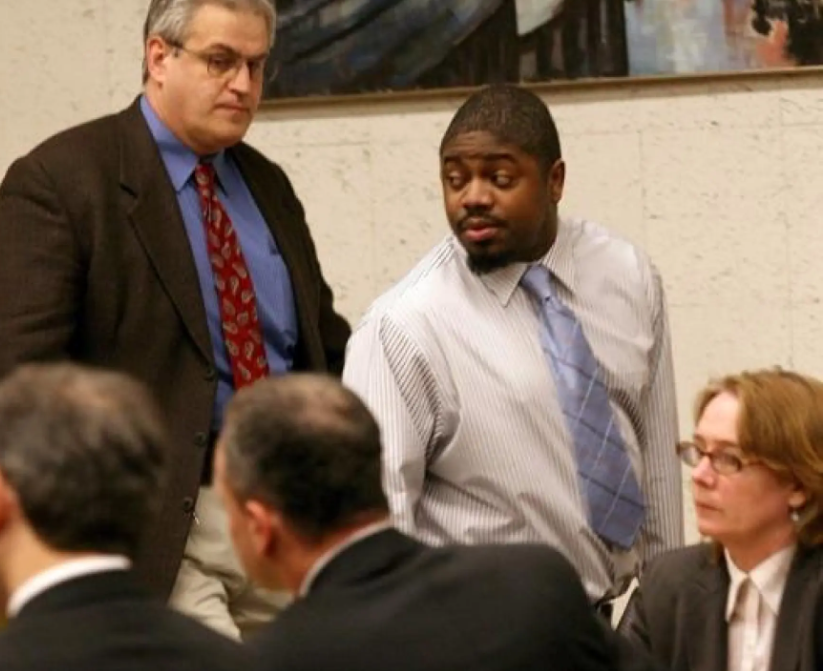
CONCORD, NH — The New Hampshire Supreme Court has dismissed the appeal of the death sentence of Michael Addison, a Black man who in 2008 was convicted of killing Michael Briggs, a white police officer in Manchester.
On Tuesday, three high court justices unanimously issued the order with Justice Melissa Countway writing the opinion and Justices Patrick Donovan and Bryan Gould concurring.
Find out what's happening in Manchesterfor free with the latest updates from Patch.
Countway wrote: “This court accepted this petition for original jurisdiction filed pursuant to Supreme Court Rule 11 by the petitioner, Michael Addison, to determine whether he is entitled to a comparative proportionality review of his sentence of death pursuant to RSA 630:5, X and XI(c) (2016).
“We previously conducted a comparative proportionality review of the petitioner’s death sentence pursuant to the same statute. Because we hold that the statute does not authorize successive comparative proportionality reviews, the petition is dismissed.”
Find out what's happening in Manchesterfor free with the latest updates from Patch.
In 2019, the state abolished the death penalty but included a carve-out exception for Addison, now 46, who was sentenced to death but remains the only person on death row in New Hampshire.
The murder occurred 20 years ago this month, on Oct. 16, 2006, when Briggs was responding to a domestic disturbance. Addison was walking away from him when he was ordered to stop, turned and shot Briggs fatally before Briggs had the chance to draw his weapon. Addison fled but was arrested in the Boston area several days later.
Briggs, 35, was a decorated police officer, a husband and father of two. If the sentence is carried out, New Hampshire would be the only state in the nation to do so after abolishing its death penalty.
New Hampshire has not executed anyone since Howard Long was hanged to death in 1939.
The ACLU wrote that in 2010, the New Hampshire Supreme Court had its first occasion to conduct what is known as “proportionality review,” an appellate procedure aimed at ensuring that death sentences are proportional to sentences given in similar cases, not freakish wanton or random, and not based on race or prejudice.
A link to ACLU’s arguments are here https://www.aclu.org/cases/new-hampshire-v-michael-addison and its amicus brief https://www.aclu.org/cases/new-hampshire-v-michael-addison?document=Addison-Amicus-Brief-%282025%29
The state has maintained that Addison’s death sentence should be carried out.
In 2009, the ACLU-NH and ACLU Capital Punishment Project and Racial Justice Program filed an amicus brief with the Court proposing methods for how the Court can design its proportionality review to accomplish these goals. The Court issued its decision in State v. Addison, 160 N.H. 732 (2010), where it outlined the framework of the comparative proportionality review to be followed.
In 2025, the New Hampshire Supreme agreed to reexamine whether Addison’s death sentence is proportional in light of the legislature’s 2019 repeal of the death penalty.
The ACLU argued the Court should prioritize the evidence of contemporary community values conveyed by the legislature’s 2019 bipartisan and overwhelming repeal of the death penalty; second that the Court should be hesitant to place New Hampshire in the anomalous position it would occupy were it to become the first and only state to execute someone under a repealed death penalty statute; and finally, the Court should consider the legion of social science research explaining the ways that race likely contributed to the death sentence.
The ACLU argued that Addison was a poor, “Black man who did not ‘purposefully kill’ the victim, particularly when the sentence came in the same year that a rich, white man was given a life sentence after purposefully bludgeoning someone to death with a sledgehammer alongside two others he had hired to kill the victim. Should New Hampshire nevertheless execute Mr. Addison—despite the death penalty repeal by its state Legislature, despite every other state declining to execute people under a repealed statute, and despite the likely role that race played in his sentence—the execution would be aberrational and disproportionate several times over.”
Gov. Kelly Ayotte was then the attorney general and she personally prosecuted the Briggs case.
In a press release from her campaign Monday prior to the release of the Supreme Court’s order, her campaign for re-election as a Republican issued a statement that police leaders were backing Ayotte over her Democratic challenger Cinde Warmington, who has criticized the state’s death penalty stance in the Briggs case.
Even though the Legislature repealed the death penalty in 2019, Ayotte said the punishment should remain for Addison.During prior interviews on WMUR Ayotte and Warmington separately spoke on the matter.
“The death penalty was the appropriate sentence there. That’s what the jury came up with. And how important is this? Because we want our law enforcement officers to know that even if they’re confronted with a career criminal, they will face the most serious consequences, because the work that they do every day is so important,” Ayotte said.
If Addison’s last-ditch effort fails, Warmington said as governor she still would not carry out capital punishment.“I will not be proceeding with the application of the death penalty in this state,” Warmington said.
Following the interview, law enforcement leaders across New Hampshire reacted to Warmington’s words.
Manchester Chief of Police Peter Marr said for Ayotte’s statement: “The murder of Officer Michael Briggs remains one of the darkest days in the history of the Manchester Police Department, and its impact is still felt two decades later. Officer Briggs’s murderer was found guilty and his sentence should be carried out. No politician should stand in the way of that. This is about supporting justice and the law enforcement officers who put their lives on the line every day to protect our communities across the state of New Hampshire.”
Stefan Czyzowski, President, New Hampshire Troopers Association said “It is deeply disappointing to hear a candidate for Governor say that she would not hold Manchester Police Officer Michael Briggs’ killer accountable for murdering him in cold blood. The fact that Cinde Warmington would side with a career criminal like Michael Addison speaks volumes about the kind of leadership we can expect if she is elected Governor. For the sake of public safety, voters must reject Warmington in November.”
This story was originally published by InDepth NH.