Politics & Government
Battery Storage Plan Pressed On Flooding, Security, Fire Safety In Bridgewater
Rockland APV is proposing to build a lithium battery energy storage system in Bridgewater Township.


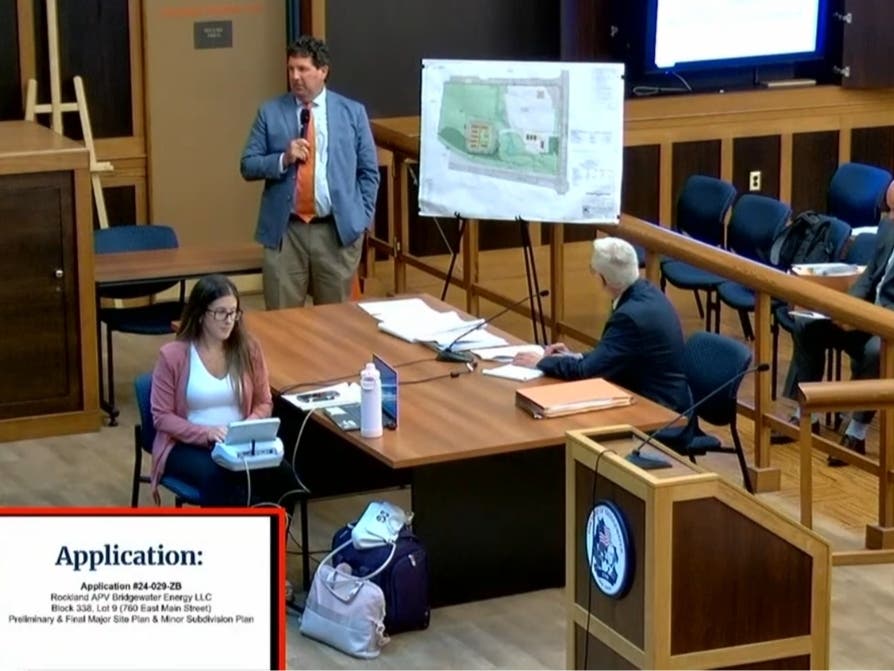
BRIDGEWATER, NJ — A proposed battery energy storage system(BESS) in Bridgewater's Finderne section drew questions over flooding, security, stormwater and fire safety issues tied to the site.
At the July 28 Zoning Board of Adjustment meeting, Rockland APV Bridgewater Energy LLC returned to continue presenting its plan for 760 East Main Street.
The application covers a 7.13-acre tract at the southwest corner of East Main Street and Polhemus Lane, which is owned by Somerset County Improvement Authority (“SCIA”) and is currently used by the County as a maintenance yard.
Find out what's happening in Bridgewaterfor free with the latest updates from Patch.
The Applicant has an agreement with SCIA to lease a portion of the property.
Engineer Craig Styers testified that the property would be divided into two lots, with the energy storage facility on a 2.89-acre parcel.
Find out what's happening in Bridgewaterfor free with the latest updates from Patch.
He also testified that the zoning district requires 20-acre lots and larger width and yard dimensions than the proposal provides.
Glenn Pantel, attorney for the applicant, said the facility is proposed to be large enough to support "20,000 homes for 4 hours of normal electricity supply."
Pantel also said the supplier had installed "some 250 comparable facilities without any fire episodes."
Board members repeatedly returned to whether parts of the property flood and whether emergency or maintenance access could be affected.
Styers testified, "A portion of the lot does flood in the northeast corner. However, where the facilities are proposed, they do not."
He also said the proposed runoff conditions meet the existing runoff conditions, "so we're not increasing runoff at all."
Questions also centered on what changes would occur on the applicant's lot versus county property.
Township traffic engineer Lee Klein said the reduction in coverage appeared closer to about 22,000 square feet, based on the plan cover sheet, rather than roughly 30,000 square feet.
According to the hearing, he also said a significant portion of the shift from stone to grass appeared to be on county property and would require permission because it was off-site work.
Security also remained unsettled.
Board Chairman John Kulak said he thinks "security is an issue that we need addressed."
He noted there are multiple ways to access the site from the Somerset County transportation facility, a garbage truck operator, and also a rail line.
A six-foot chain-link fence is proposed around the battery and metering area.
Styers testified the site would be fenced, gated, monitored "24/7" and equipped with security cameras.
"Our fencing would prohibit access from the main facilities," said Styers.
"When you say the main facility, you're saying I can go up to the fence and look in, and that's it. And I'm saying that if I'm driving a vehicle, I could knock down your fence," said Kulak.
"I'm sure anything's possible," said Styers.
"Anything is possible. It's just we've had terrorist incidents on the West Coast where they came into a substation and did exactly that. Just drove through the fence. The only thing that stopped them was they ran into a reel of wire that stopped the car. So today's world, we're security conscious. I'm just not certain that your fence is going to be adequate," said Kulak.
Kulak was referring to an incident in February where a man rammed his car into an LADWP-owned power facility near Las Vegas.
Fire safety testimony also drew extended review.
Leonard Ganesh Deonarine, an expert in fire safety and firefighting for the applicant, testified that emergency planning was based on New Jersey fire and building codes and NFPA 855.
"Everyone's worried about a fire involving lithium-ion batteries, and they should be worried," said Deonarine.
"This situation with these batteries is rather unique when it comes to suppression because it's monitored. The battery is being monitored remotely. They know is it performing, not performing, is it charging, is it discharging? What's the percent of the charge on the battery right now? And they're tracking what's going on," said Deonarine.
He added there is an air conditioning and a glycol water mixture to keep things cool in the facility as well.
"So far as suppression, the opportunity for a fire is low, but has to be respected," said Deonarine.
Kulak said his focus on the board is "to protect the safety of our citizens, and we're looking at this site specifically as you are and asking ourselves, is it safe for them? Is it safe for a community in an area where we have infrastructure uh that we all in the entire county rely on? And we will ask you to continue and give us some assurances."
One board member asked whether Deonarine would "be comfortable having your mother at a senior citizens facility that's about a quarter mile away if this were to catch fire or to take your kid to a baseball game at a minor league park a little further down the road?"
Deonarine answered, "Personally speaking, the answer is yes."
The hearing will be carried to Oct. 27 at 7 p.m.
Previous Reporting:
- Bridgewater Lithium Battery Storage Proposal Draws Concerns Over Fire Safety
- Lithium Battery Storage Facility Proposed In Bridgewater
Have a news tip? Email alexis.tarrazi@patch.com.
Get more local news delivered straight to your inbox. Sign up for free Patch newsletters and alerts.