Business & Tech
These 88 Large Corporations Paid Zero Federal Income Taxes Last Year: Report
Meanwhile, many New Jersey residents are struggling to afford basic necessities like housing, health care and food, polls say.


Dozens of the nation’s largest businesses didn’t pay a single dollar of federal income tax last year, a new analysis claims.
At least 88 of the largest corporations in the United States paid zero federal corporate income taxes in their most recent fiscal year – even though they raked in “substantial” profits, according to a study from the Institute on Taxation and Economic Policy (ITEP).
The report didn’t accuse any of the named businesses of breaking the law, instead pointing to decades-old federal tax code imbalances and controversial tax cuts passed under the Trump administration.
Find out what's happening in Newarkfor free with the latest updates from Patch.
View the full report and see its methodology here.
Companies on the ITEP’s 2025 list include household names such as Disney, Tesla, CVS Health, Citigroup, PayPal, 3M, and Yum! Brands, the parent company of the fast-food chains KFC, Taco Bell and Pizza Hut.
Find out what's happening in Newarkfor free with the latest updates from Patch.
None of the companies on the list have headquarters in New Jersey. However, several of them have large footprints in the state, including United Airlines, which maintains a hub at Newark Airport, NRG Energy – which works with New Jersey utilities to supply electricity and gas – and Live Nation Entertainment, which the New Jersey Office of the Attorney General has accused of running a “monopoly” at the expense of Garden State residents.
It isn’t only a federal issue, the ITEP says: tax breaks that are claimed at the federal level are routinely available against state tax as well.
“The nationwide state tax rates paid by these 88 companies bear that out: the corporations collectively reported an effective state income tax rate of just 1.4 percent,” researchers said.
Some critics have alleged that the ITEP’s annual study is a “political hit job,” pointing to the Biden administration, which invoked the report in two State of the Union addresses.
“Nobody should be mixing statements about financial accounting profitability with tax liability,” wrote Douglas Holtz-Eakin, president of the American Action Forum.
Holtz-Eakin outlined his concerns with the report in a blog post on Friday:
“First, there is zero, zero, zero evidence of any law-breaking tax evasion or even tax shenanigans in this report. Second, ITEP does not have any tax returns for these corporations, which – properly – are confidential and protected. It relies on financial statements (Securities and Exchange Commission Form 10-K) to guess at taxable income and tax liability… Third, financial accounting profits and taxable profits are related only by the word ‘profits.’ Accounting profits are a forward-looking, multi-year concept in which future profits are booked in the year they become feasible. Tax profits are a cash-flow concept that looks at the difference between revenues and costs in the tax year. Future revenues will be taxed in the future. Fourth, the tax code contains many activities that the policy makers exempt from tax in order to induce corporations to pursue those activities. Want green energy? Litter the tax code with tax credits for wind, solar, and other sources of energy. Companies that do a lot of clean energy will pay no taxes. Want a vigorous investment climate? Allow expensing (100-percent deduction of the cost in the first year) and companies that do a lot of investment will pay no taxes. Ditto for research and development.”
Business taxes continue to be a major issue in New Jersey, with Gov. Mikie Sherrill reporting plans to raise more than $700 million in new revenue from “closing corporate tax loopholes” as part of her proposed state budget.
- Related: Sherrill Looks To End Crisis: 5 Takeaways From NJ Budget Address
- Related: Business Fees In Sherrill’s First Budget Raise Concerns
- Related: ‘Tax The Rich’: NJ Advocates Pressure Lawmakers As Budget Season Heats Up
Article continues below
NEW JERSEY RESIDENTS ARE STRUGGLING, POLLS SAY
Several recent polls have reported that many working families in New Jersey are struggling to pay for basic necessities.
Earlier this week, a Rutgers-Eagleton poll found that about two-thirds of respondents said they are having trouble affording education costs, including student loans (68%, down 3 points from October), followed by utility bills (63%, down 8 points), housing (62%, down 6 points), healthcare (60%, down 4 points), gasoline and transportation costs (59%, up 5 points), and groceries and food costs (59%, down 9 points).
“Even though some of these everyday affordability pressures have eased slightly across all New Jerseyans, the burden is still far greater for some more than others,” Koning said. “Across all six spending areas, nonwhite residents, lower-income households, and those without a four-year college degree consistently report greater difficulty – and in several cases, they are seeing little to no improvement at all.”
A poll released Friday by Advance America found that the rising price of gasoline may force New Jersey residents to cut back on essentials.
According to researchers, if the cost of gas rises 97 cents to $5.06 per gallon, it will mean cutbacks for many Garden State households. More than four in 10 people (41%) said they would cut back on eating out or takeout first, followed by travel and leisure (29%).
Notably, 13 percent of people surveyed said they would reduce grocery spending, while 3 percent would cut back on health care or medications.
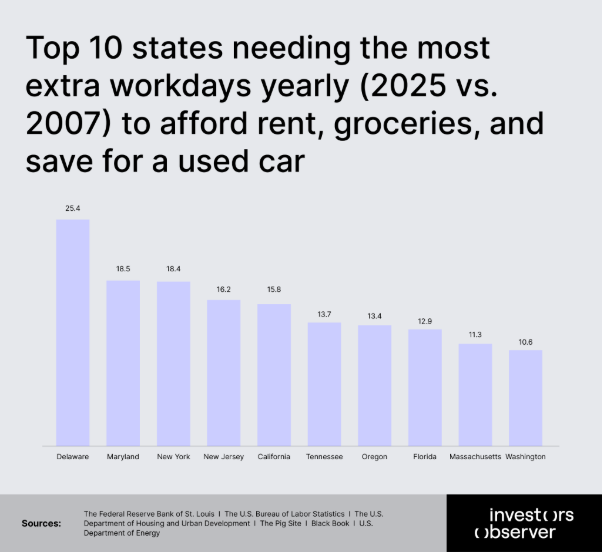
Another study from InvestorsObserver included New Jersey as one of the top four states where residents need the most extra workdays to afford rent, groceries and used cars. In 2025, residents in the Garden State put in 16.2 extra days on average just to pay the same rent, buy the same necessities they could afford in 2007.
Nationally, things are even worse, researchers said.
“People nationwide now have to work up to 25 extra days a year just to cover rent, groceries, and save for a used car – time stolen from vacations, kids’ soccer games, and weekends off,” InvestorsObserver reported.
- Related: NJ Sees Huge Spike In Number Of Workers Postponing Retirement, Study Says
- Related: NJ Home Prices Are Outpacing Paychecks In These Towns
- Related: Here’s Why Rent Is ‘So Damned High’ In New Jersey, Experts Say
Send local news tips and correction requests to eric.kiefer@patch.com. Find out how to post announcements or events to your local Patch site.
Get more local news delivered straight to your inbox. Sign up for free Patch newsletters and alerts.