Neighbor News
Moving from New Jersey to Texas: A Driver's Guide to Everything That Changes Behind the Wheel
Relocating from New Jersey to Texas? Here's your ultimate guide to navigating new roads, laws, and driving habits in the Lone Star State!
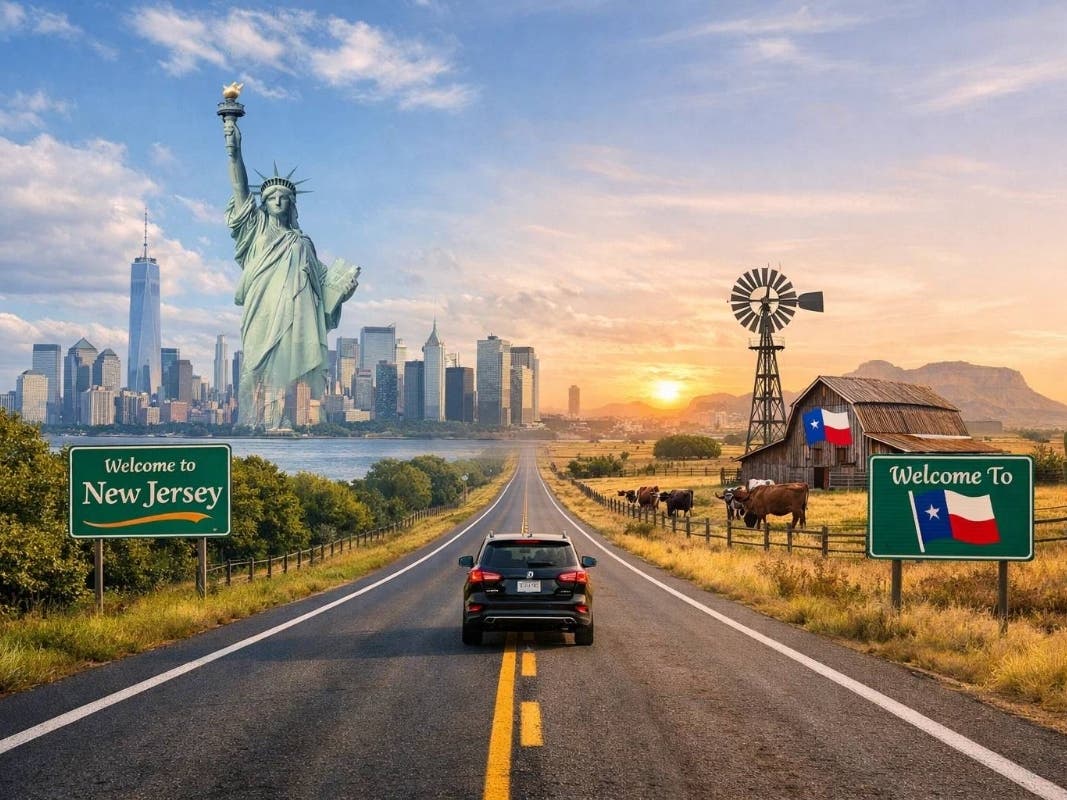
You've done the math on property taxes. You've compared mortgage payments. You've accepted that you're trading bagels and the Shore for breakfast tacos and the Gulf Coast. The decision is made — you're moving from New Jersey to Texas, joining the tens of thousands of Garden State residents who make this move every year.
New Jersey has ranked among the top outbound states in the country for several years running, driven by high housing costs, heavy tax burdens, and a cost of living that squeezes even high earners. Texas, with no state income tax, abundant housing inventory, and a booming job market, has been one of the nation's top destinations. U-Haul's 2025 Growth Index ranked Texas as the number one inbound state in the country for the seventh time in ten years.
But while most New Jersey-to-Texas guides focus on neighborhoods, school districts, and the best BBQ joints, almost none of them cover something that will affect your daily life immediately and profoundly: driving in Texas is a fundamentally different experience than driving in New Jersey, and the legal and insurance frameworks that govern it are not what you're used to.
Find out what's happening in Albanyfor free with the latest updates from Patch.
Here's what changes when you trade the Turnpike for I-35.
The Distances Will Reshape Your Concept of Driving
In New Jersey, the entire state stretches about 170 miles from top to bottom. You can drive from the George Washington Bridge to Cape May in under three hours. In Texas, driving from El Paso to Houston takes roughly 11 hours — and you never leave the state.
Find out what's happening in Albanyfor free with the latest updates from Patch.
This isn't just a fun fact to share at your housewarming party. It changes how you plan your life. A "quick drive" to visit friends in another Texas city might be a four-hour commitment each way. Weekend trips to the coast or the Hill Country can involve five or six hours of highway driving. And daily commutes in sprawling metros like Dallas-Fort Worth and Houston routinely exceed 30 minutes, often on highways moving at 70 mph or faster.
Fort Worth alone now has more than one million residents — it surpassed that milestone in 2024, making Dallas-Fort Worth the only metro area in the country with two cities above a million. The region's population is projected to nearly double by 2050, and the road infrastructure hasn't kept pace. If you're moving to the DFW area, expect to drive more miles, at higher speeds, in heavier traffic than anything you experienced on the Parkway.
Speed Limits Are Higher Than Anything You've Seen
New Jersey's highest posted speed limit is 65 mph, and many of the state's most traveled highways — the Turnpike, the Parkway, Route 80 — are routinely congested enough that you rarely hit that number anyway. The prevailing driving culture in New Jersey is aggressive but relatively slow-speed, characterized by tight following distances, frequent lane changes, and a general contempt for turn signals.
Texas operates on a different scale entirely. Rural interstates are commonly posted at 75 or 80 mph. Parts of State Highway 130 between Austin and San Antonio allow 85 mph — the highest legal speed limit in the United States. Even urban highways in Dallas-Fort Worth and Houston are posted at 60 to 70 mph, and the actual flow of traffic often exceeds those numbers.
The adjustment isn't just about reading new speed limit signs. Higher speeds compress your reaction time, increase stopping distances, and make every collision more severe. A fender bender at 35 mph on Route 17 is a very different event than a collision at 75 mph on I-35W. Nearly 1,500 people died in speed-related crashes in Texas in 2024. If you're accustomed to the relatively contained speeds of northeastern highways, give yourself time to recalibrate.
Your Car Insurance Rules Are Completely Different Now
This is perhaps the most consequential legal difference between New Jersey and Texas, and most transplants don't fully understand it until they're filing a claim.
New Jersey is a no-fault state. Under that system, after an accident, you file a claim with your own insurance company through your Personal Injury Protection coverage, regardless of who caused the crash. Your PIP covers your medical expenses and lost wages up to your policy limits. Your ability to sue the other driver for pain and suffering is restricted unless your injuries meet a "serious injury" threshold — things like permanent disfigurement, loss of a body part, or significant scarring.
Texas is an at-fault state. The difference is enormous. In Texas, the driver who caused the accident — or more precisely, their insurance company — is responsible for paying for the other driver's injuries, medical bills, lost wages, and property damage. If you're injured in a crash that wasn't your fault, you file a claim against the at-fault driver's liability insurance, not your own. And there's no threshold you need to meet to pursue a lawsuit for pain and suffering. If someone else's negligence caused your injuries, you have the right to seek full compensation.
This means several things for your transition. First, you need to update your insurance policy to meet Texas requirements: minimum coverage of $30,000 per person and $60,000 per accident for bodily injury liability, plus $25,000 for property damage. PIP coverage, which was mandatory in New Jersey, is optional in Texas. Second, you need to understand that the claims process after an accident will look and feel very different. Instead of dealing primarily with your own insurer, you may be negotiating with the other driver's insurance company — and their adjusters are working to minimize what they pay you, not to protect your interests.
"Most transplants from no-fault states like New Jersey assume the insurance process works the same way everywhere," says Fort Worth lawyer Benson Varghese, managing partner of Varghese Summersett. "It doesn't. Texas is a fault-based system, which means the stakes of establishing who caused the accident are much higher — and so is the importance of documenting everything at the scene. The first 48 hours after a collision often determine the outcome of the entire claim."
The Statute of Limitations Is Shorter Than You Think
In New Jersey, you generally have two years from the date of an accident to file a personal injury lawsuit. Texas gives you the same window — two years under the Texas statute of limitations for personal injury claims. That sounds like plenty of time, but medical treatment, insurance negotiations, and the general chaos of recovering from a serious accident can consume months before you even start thinking about legal options. Don't assume you can wait.
Property damage claims in Texas also carry a two-year statute of limitations. If you're dealing with both injury and vehicle damage from the same crash, the clock is ticking on both simultaneously.
Texas Uses Modified Comparative Fault
New Jersey follows a modified comparative negligence rule with a 51 percent threshold — you can recover damages as long as you're not more than 50 percent at fault. Texas follows a similar but distinct version: the 51 percent bar. If you're found to be 51 percent or more at fault for an accident, you recover nothing. If you're 50 percent or less at fault, your recovery is reduced by your percentage of fault.
The practical effect is that fault determination matters tremendously in Texas. Insurance adjusters and opposing attorneys will work hard to shift as much blame as possible onto you. That's why documenting the accident scene — photos of damage, road conditions, traffic signals, witness contact information, and a police report — is critical. Every piece of evidence that supports the other driver's fault protects your ability to recover compensation.
You're Sharing the Road with a Lot More Trucks
New Jersey has its share of commercial truck traffic, especially on the Turnpike and I-95 corridor. But Texas is the nation's busiest freight state. Thousands of 18-wheelers travel I-10, I-20, I-35, and I-45 every day, hauling goods between the Mexican border and distribution hubs across the country. I-35 alone carries a massive volume of commercial traffic through Fort Worth and Dallas.
Driving alongside tractor-trailers at 75 mph is qualitatively different from the experience most northeastern drivers are accustomed to. Give trucks wide berths. Never linger in their blind spots. Pass decisively and don't cut in front of them — a fully loaded semi needs significantly more distance to stop than a passenger vehicle. And be especially cautious in construction zones, where lane shifts and narrow corridors amplify the danger of driving near large commercial vehicles.
Weather Will Affect Your Driving in Ways You Didn't Expect
New Jersey drivers are accustomed to snow, ice, and nor'easters. Texas rarely gets snow — but the weather hazards it does produce are arguably more dangerous because they're less predictable.
Flash flooding is the biggest threat. Texas leads the nation in flood-related fatalities, and the state's topography means that low-water crossings and highway underpasses can fill with water in minutes during a heavy storm. If you see standing water on a road, do not attempt to drive through it. Six inches of fast-moving water can knock a person off their feet, and two feet will float most vehicles. The rule is simple: turn around, don't drown.
Severe thunderstorms, hail, and tornadoes are realistic possibilities from spring through fall, particularly in North Texas. And summer heat — routinely above 100 degrees in many parts of the state from June through September — puts extra stress on your vehicle's cooling system, tires, and battery. Keep an emergency kit in your car that includes water, a flashlight, and basic tools. In New Jersey, a breakdown means a tow truck in 30 minutes. In rural Texas, it can mean waiting much longer in conditions that are actively hostile to your comfort and safety.
The Road Culture Is Different
This is harder to quantify but impossible to ignore. New Jersey drivers are famously aggressive — tight spacing, constant horn use, and a general sense of urgency that borders on combat. Texas driving culture is fast but spaced out differently. The highways are wider, the lanes are broader, and the distances between exits are longer. The aggression tends to manifest as speed rather than proximity.
You'll also notice that Texas drivers are less accustomed to the kinds of dense, slow-speed maneuvering that New Jersey drivers excel at. Merging onto a Texas highway means matching speeds of 65 to 75 mph on an entrance ramp — there's no crawling into a gap at 25 mph the way you might merge onto the Cross Bronx. Conversely, Texas drivers can be less attentive at lower speeds in parking lots, suburban intersections, and residential areas, where the pace of driving doesn't demand the same vigilance.
Update Your License and Registration Promptly
Texas law requires new residents to obtain a Texas driver's license within 90 days of establishing residency. You'll also need to register your vehicle in Texas and obtain a Texas vehicle inspection within 30 days of registration. Your New Jersey plates and license won't cut it indefinitely, and driving on out-of-state credentials after the grace period can complicate insurance claims if you're in an accident.
Visit your local Texas Department of Motor Vehicles office with your current New Jersey license, proof of Texas residency, proof of identity, and proof of insurance that meets Texas minimums. The process is straightforward but can involve wait times, so schedule accordingly.
The Bottom Line
Moving from New Jersey to Texas is, for most people, a financial upgrade and a lifestyle shift. Lower taxes, more space, a warmer climate, and a booming economy make the Lone Star State magnetic — and the migration data proves it. But the transition behind the wheel is steeper than most transplants anticipate.
Higher speeds, longer distances, a fault-based insurance system, different weather hazards, and a fundamentally different road culture all require adjustment. The good news is that none of it is unmanageable. Update your insurance. Learn the rules. Respect the distances and the speeds. Keep your documentation habits sharp. And give yourself a few months of conscious recalibration before Texas driving feels like second nature.
You survived the Turnpike and Route 22. You'll survive I-35. Just don't assume they play by the same rules.