Brooklyn, NY|Featured Classified|Gigs & Services|
Merchant Cash Advance Debt Relief Brooklyn New York - MCA Defense Attorney
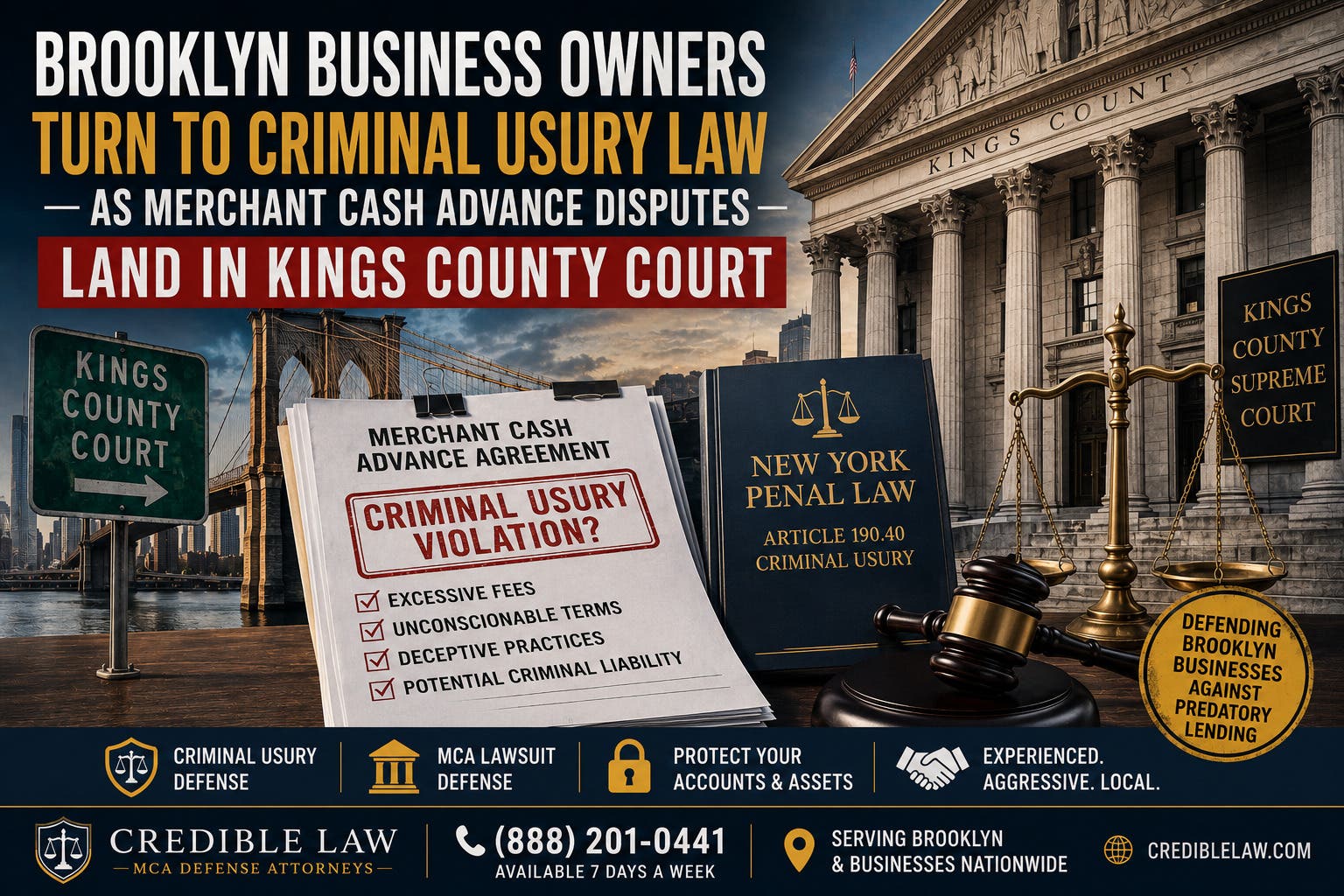
Brooklyn Business Owners Turn to Criminal Usury Law as Merchant Cash Advance Disputes Land in Kings County Court
A growing number of MCA agreements are being challenged as "disguised loans" in Kings County Supreme Court and the Eastern District of New York — and 2026 disclosure rules are adding a new line of defense.
BROOKLYN, N.Y. — For Brooklyn business owners caught in merchant cash advance debt, the legal ground has shifted. Disputes that once seemed unwinnable are now being fought — and in some cases won — in Kings County Supreme Court and the Eastern District of New York (EDNY).
At the center of the shift is a single argument: that many merchant cash advances marketed as "purchases of future receivables" are, in economic substance, loans. When those loans carry effective interest rates of 100%, 200%, or more, they collide with New York Penal Law § 190.40, the state's criminal usury statute. A contract found to be criminally usurious can be rendered void and unenforceable — a far stronger outcome for a business owner than a negotiated payment plan.
That argument now has a second layer. New York's Commercial Financing Disclosure Law requires funders to provide standardized disclosures of the true cost of financing, and the New York Department of Financial Services has been investigating funders who fail to comply. Brooklyn business owners are increasingly raising disclosure failures — no disclosure at all, understated APRs, undisclosed broker commissions, or funders operating unregistered — as a defense that can stand independently of, or alongside, a usury challenge.
The urgency is driven by enforcement speed. Once a funder obtains a judgment, it can serve a restraining notice under New York's CPLR on banks holding a business's operating accounts, freezing funds — often the same day — at Chase, TD Bank, Bank of America, and others. A frozen account can halt payroll within hours.
But a restraining notice tied to a judgment obtained through an improper Confession of Judgment, or a funder that ignored mandatory disclosure rules, can be challenged and potentially vacated. Emergency options include revoking ACH authorization and filing for injunctive relief in Kings County Supreme Court.
For Brooklyn owners juggling multiple stacked positions, defense often means coordinating across several funders at once — a process that turns on the sequencing and priority of competing claims and generally requires experienced counsel.
Brooklyn business owners facing MCA collections, a frozen bank account, or a judgment entered without their knowledge can review their defense options and connect with an experienced attorney through CredibleLaw's Brooklyn network at crediblelaw.com/brooklyn-mca-defense-attorney/.
Credible Law
Phone: (888) 201-0441
crediblelaw.com/about/
Credible Law is a national legal resource and referral network. It is not a law firm and does not provide legal advice.