Neighbor News
Why We Need Empathy More Than Ever
A neighbor shares thoughts from a faith and psychology perspective why we need to have empathy, especially in these times of violence.
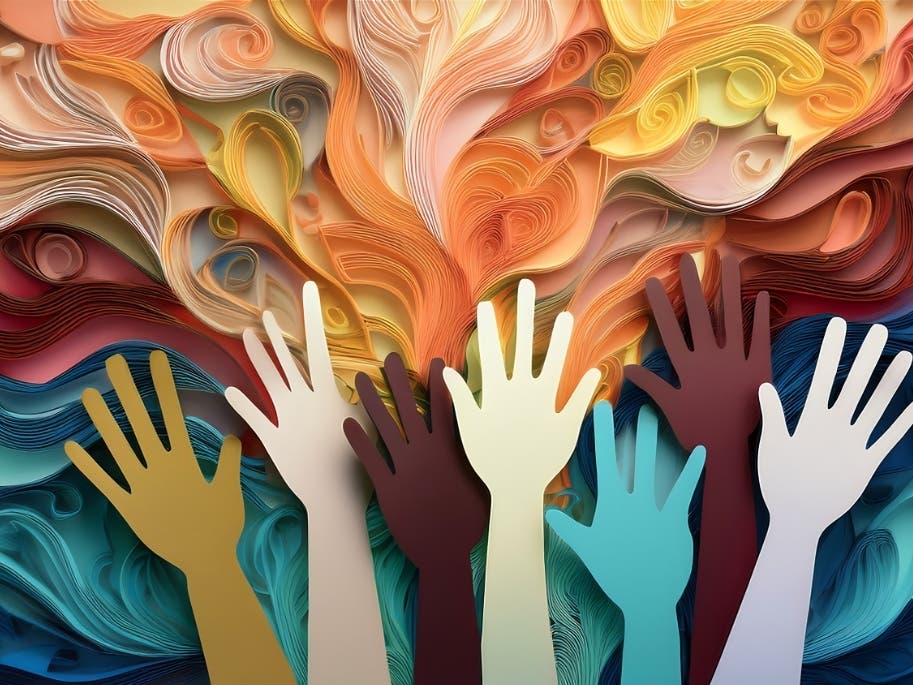
We as humans, in order to be healthy, need to be with other human beings. If we become isolated, we have a greater tendency to become mentally ill and to suffer poorer physical health outcomes. https://pmc.ncbi.nlm.nih.gov/a... It is in our nature to want to be in relation with one another and to be in community.
Even our ability to speak is based on our ability to connect with one another. It is a direct result of our having mirror neurons in our brains, where we can imagine what it is like for another human being; this is how we learn language. It is via these mirror neurons that children watch their parent/caregiver speak, and they in turn will reflect that behavior. It is the same mirror neurons that will light up (on an fMRI) in the same part of the brain when we see someone dancing as it lights up (on an fMRI) in the brain of the dancer. https://www.bu.edu/sjmag/scima... Because our brains can imagine what it is like when watching a dancer, a baseball player, etc., we also can imagine another human being's pain and suffering. We do so all the time when watching a film or a news story. Our ability to feel for one another allows us to care for and love our children, our parents, our friends, our neighbors, and our community locally and globally. This is empathy. The definition according to Oxford Languages is "the ability to understand and share the feelings of another."
If we as humans do not empathize, it will threaten our ability to care for our children, and it will follow that we as a species will have difficulty surviving because if we do not care for our young (their survival will be at risk), let's extrapolate that further—we will not care for our parents, our friends, our neighbors, or our community locally or globally, and we can extend this even further so that we won't care about the planet or the creatures of this world since we will only be caring about ourselves individually.
Find out what's happening in Ditmas Park-Flatbushfor free with the latest updates from Patch.
This lack of empathy puts us in a constant state of survival, with thoughts such as "I need to eat this piece of bread before someone else gets it." We saw some of this during the pandemic, with people hoarding. Yet, on the other end of that spectrum, we also saw great acts of kindness (empathy), with people delivering food and medicine to those that could not get it for themselves. I will not say that the lack of empathy puts us in the realm of animals, as many animals (elephants, for example) can and do work in community for the care and protection of their young and their community. https://www.pbs.org/edens/anam... Certainly, as humans we have the ability to do as well as, if not better than, elephants in caring for our children and our communities.
We have two ends of the spectrum in regard to empathy in the U.S., or maybe it just appears that way. On the one end of the spectrum are some people that believe that in order to retain what they have, they need to expel people from this country, and to do so, there is a need and perhaps for some a perceived justification for the perpetration of cruelty and acts that lack empathy. The detention (imprisoning) of 70,000 immigrants (the vast majority of which have committed no crime) (3,800 children known in 2025), the killing of 53 immigrants while in the custody of ICE detention centers and Custom Border Patrol, the killings of American citizens Renee Nicole Good and Alex Pretti, and the violent terror tactics being used against unarmed American citizens in our cities lack empathy.
Find out what's happening in Ditmas Park-Flatbushfor free with the latest updates from Patch.
A point to consider, as reported by "The Hill" that the Obama administration deported 1.8 million immigrants in his first 3 years, while the current administration has yet to deport more than 260,000 in a year. That was done without the extreme measures being applied today. I am not judging the moral merits of Obama's immigration policies, I am merely stating that the current form of cruelty is absolutely and completely unnecessary if the goal is to solely deport undocumented immigrants. https://docs.house.gov/meeting...
Why then all this merciless and senseless violence? Can it be again that there is a profit to be made if immigrants remain in detention centers since the majority of the detainees are being held in privately owned centers where coerced labor is commonplace? https://su.house.gov/meeting... Detainees have stated that they have been denied food, water, and hygiene supplies or threatened with solitary confinement if they do not work in the detention center's "voluntary" work programs. With confidence I will say this type of treatment is not what we want for ourselves, for our families, or for our friends. How then can "we" permit them to happen to anyone else, or how can "we" physically perpetrate them upon another human being? Let us come to the point: this type of treatment is torture, and forced servitude is slavery. This lacks empathy, and seeking to justify it is another disconnection from empathy. https://www.americanimmigratio" class="redactor-linkify-object">https://www.americanimmigratio......
Very often when we are in survival mode, we have been triggered by fear that puts us into a mental response of fight, flight, or freeze. When there is something that we fear, this fear can play out in a way where we can actually justify the unjustifiable. What is it that we think we have to fear from immigrants? Is it that they will take our jobs? They very often work in professions that Americans do not wish to do, such as construction, restaurant work, and farming. Is because they speak another language? Many American parents, grandparents, or great-grandparents came to this country speaking another language. Is it because they do not pay taxes? Undocumented immigrants paid $100 billion nationally in state and local taxes in 2022, and if they were given a pathway to citizenship, they would pay even more taxes, not to mention that according to one study undocumented immigrants contributed 1.7 trillion dollars in economic activity (their purchasing power). If anything, this is a cut off your nose to spite your face situation, as it will only hurt the U.S. economy to expel the undocumented immigrants. https://docs.house.gov/meeting... Is it because they are performing crimes at a higher rate? Statistically, undocumented immigrants are incarcerated at lower rates than U.S.-born citizens. https://docs.house.gov/meeting... https://pmc.ncbi.nlm.nih.gov/a... https://www.cfr.org/articles/h... And just a reminder that much of the food that feeds us and our families was provided by the labor of immigrants, documented and undocumented, that worked the soil. Our corporal bodies have been enriched and are here because of the labor of their hands. Blessed are the hands that broke the soil, tilled it, and brought forth the fruits of God's earth to feed our hunger (R.I.). Is it because their skin is darker or that they appear different to you? Some of the supporters of this kind of ideology consider themselves Christians (followers of Christ), and yet, I ask them to consider that Jesus was born in Bethlehem, which is in Palestine, and the people from there are darker. So, in essence, they may be persecuting people that look more like Jesus than themselves. So, the conflation of being a white Christian seeking a white society and being a follower of Jesus are ideas that actually conflict with one another. Certainly, Jesus' teachings never said to imprison children or to torture and enslave.
Matthew 25: 31-40 (NRSVUE)
31 “When the Son of Man comes in his glory and all the angels with him, then he will sit on the throne of his glory. 32 All the nations will be gathered before him, and he will separate people one from another as a shepherd separates the sheep from the goats, 33 and he will put the sheep at his right hand and the goats at the left. 34 Then the king will say to those at his right hand, ‘Come, you who are blessed by my Father, inherit the kingdom prepared for you from the foundation of the world, 35 for I was hungry and you gave me food, I was thirsty and you gave me something to drink, I was a stranger and you welcomed me, 36 I was naked and you gave me clothing, I was sick and you took care of me, I was in prison and you visited me.’ 37 Then the righteous will answer him, ‘Lord, when was it that we saw you hungry and gave you food or thirsty and gave you something to drink? 38 And when was it that we saw you a stranger and welcomed you or naked and gave you clothing? 39 And when was it that we saw you sick or in prison and visited you?’ 40 And the king will answer them, ‘Truly I tell you, just as you did it to one of the least of these brothers and sisters of mine, you did it to me.’
Conversely, we have empathy at the other end of the spectrum in this country, where people are imagining what it is like to have your loved one not come home from work—only to find that they have been captured—or they are imagining what it must be like for a child to live in fear of going to school because their parent might not be home when they return, or fear of taking your child to the hospital if they are sick, or what it must be like for a child to be taken away from their school and friends only to find themselves in prison (why should a child ever be in prison?), or to have your loved one killed at the hands of the authorities or to be forced into slavery. These people that are imagining another human being's pain are just ordinary people, and yet they have decided to speak out, march out, and show out for those that are vulnerable and for those that can't speak, march, or show out for themselves.
James 1: 27
27 Religion that is pure and undefiled before God the Father is this: to care for orphans and widows in their distress and to keep oneself unstained by the world. (NRSVUE)
Whatever the religion or non-religion of the people that are standing in the gap and risking their safety to protect their "neighbors," they understand what God requires. To care for the most vulnerable (as widows and orphans were the most vulnerable and unprotected in Jesus' era and prior...).
In Luke 10:25-37, Jesus explains who is our "neighbor" in the parable (story) of "The Good Samaritan," not as the person who is the neighbor next door to you, but as a person who had been beaten, robbed, and left to die by the side of the road. (It doesn't say whether he was Black, white, gay, or straight because he was stripped of his clothing—no identification—he was an any man.) It was not the pious or the person of high status who had walked past the beaten man that understood who their neighbor was; instead, it was an ordinary person, a Samaritan (Samaritans having been considered religiously impure by the Jews at the time, since they had intermarried with Assyrians—they were shunned by the Jewish community). This is the person that had stopped to help his neighbor.
Today, we are being shown by people in Minnesota, Los Angeles, Illinois, Oregon and more not known how empathy works in caring for the vulnerable, in caring for each other as they stand together, in caring for their community, and for calling out injustice and cruelty.
There is a deep need to cultivate empathy not only to call out injustices but also to see the humanity, the pain, and the fear of those that want to hurt, because ultimately, we hurt ourselves when we pull away from God's Love. We are All God's children, and we all share a common humanity.
About the author: Raquel Irizarry has an MSSW from Columbia School of Social Work and a Master of Divinity from Union Theological Seminary. She is also a lay minister with the United Church of Christ.