Neighbor News
Suffolk Has Most Lyme Cases In NY; Sen. Schumer Seeks $273M To Fight Tick-Borne Disease
New data shows Suffolk County recorded 3,152 Lyme disease cases in 2024, the most of any county in New York, Schumer said.



HUNTINGTON, NY — Sen. Chuck Schumer said Wednesday that he is seeking $273.5 million in federal funding to combat tick-borne diseases as new state data shows Suffolk County continues to report more Lyme disease cases than any other county in New York.
Standing at West Hills County Park in Huntington, where hikers, horseback riders and families regularly enjoy Suffolk County’s trail system, Schumer was joined by Suffolk County Executive Ed Romaine, Stony Brook Medicine infectious disease specialist Dr. Luis Marcos, Legislator Rebecca Sanin and Shirley resident Michael Larkin.
The senator said the growing prevalence of ticks on Long Island demands a stronger federal response focused on research, surveillance, testing, treatment and public education.
Find out what's happening in Huntingtonfor free with the latest updates from Patch.
In 2024, Suffolk County recorded 3,152 reported Lyme disease cases, according to data released by Schumer’s office. Across the region stretching from Manhattan to Montauk, officials said more than 6,600 Lyme disease cases were reported.
“Families do things that make summer special here on Long Island,” Schumer said Wednesday. “But ominously, the ticks like to be here too, and right now they’re swarming Long Island.”
Find out what's happening in Huntingtonfor free with the latest updates from Patch.
While Lyme disease remains the most recognized threat, Schumer said it is only one of several tick-borne illnesses affecting residents. Powassan virus, babesiosis and Bourbon virus are also emerging concerns, with many questions still unanswered because of limited research and testing.

Five years ago, Larkin became New York’s first confirmed case of Bourbon virus after being bitten by a Lone Star tick while doing yard work.
Schumer said Larkin’s ordeal exposed significant gaps in the nation’s ability to diagnose rare tick-borne diseases.
“Unfortunately, there is no commercial test for it, there is no vaccine and there is no specific treatment,” Schumer said. “That’s what makes this disease so scary. No cure, no vaccine. Testing a patient for Bourbon virus can take nearly a month, and that’s not nearly fast enough.”
Because so few confirmed cases exist nationwide, Schumer said researchers still do not know how widespread the virus may be.
“That’s what we’re up against — new threats, new ticks, not enough tools to fight them,” he said.
To address those shortcomings, Schumer said he will seek $273.5 million during the fiscal year 2027 appropriations process. According to Schumer’s office, the request includes $135 million for Lyme and tick-borne disease research at the National Institutes of Health; $74.5 million for CDC Lyme and tick-borne disease programs; $50 million to stand up an ARPA-H TICK Clinical Trials Network for faster tests and better treatments; and $9 million for Department of Defense tick-borne disease research.
In total, Schumer’s office said, the request would invest $273.5 million in the fight against ticks, nearly $90 million more than current federal funding.
“No one should have to wait five years for a diagnosis like Michael,” Schumer said. “Long Island summers should be about the beach, the backyard, hiking, the trails, not fear.”
Romaine described ticks as an ongoing public health crisis for Suffolk County. Having contracted Lyme disease twice himself, he said he understands firsthand how debilitating tick-borne illnesses can become.
“It’s debilitating, and it’s something that needs to be addressed,” Romaine said. “We’ll work with everyone, regardless of party, to make sure that our constituents here in Suffolk County are protected.”

Romaine said existing methods of reducing tick populations include 4-poster deer treatment systems, which apply tick-killing pesticide to deer as they feed.
Dr. Marcos, director of the Adult Lyme and Tick-Borne Disease Center at Stony Brook Medicine, said Long Island sits at the center of one of the nation’s most significant tick-borne disease hotspots.
“We are at the epicenter of Lyme disease in our country,” Marcos said. “We have more than 12 tick-borne diseases that may affect humans.”
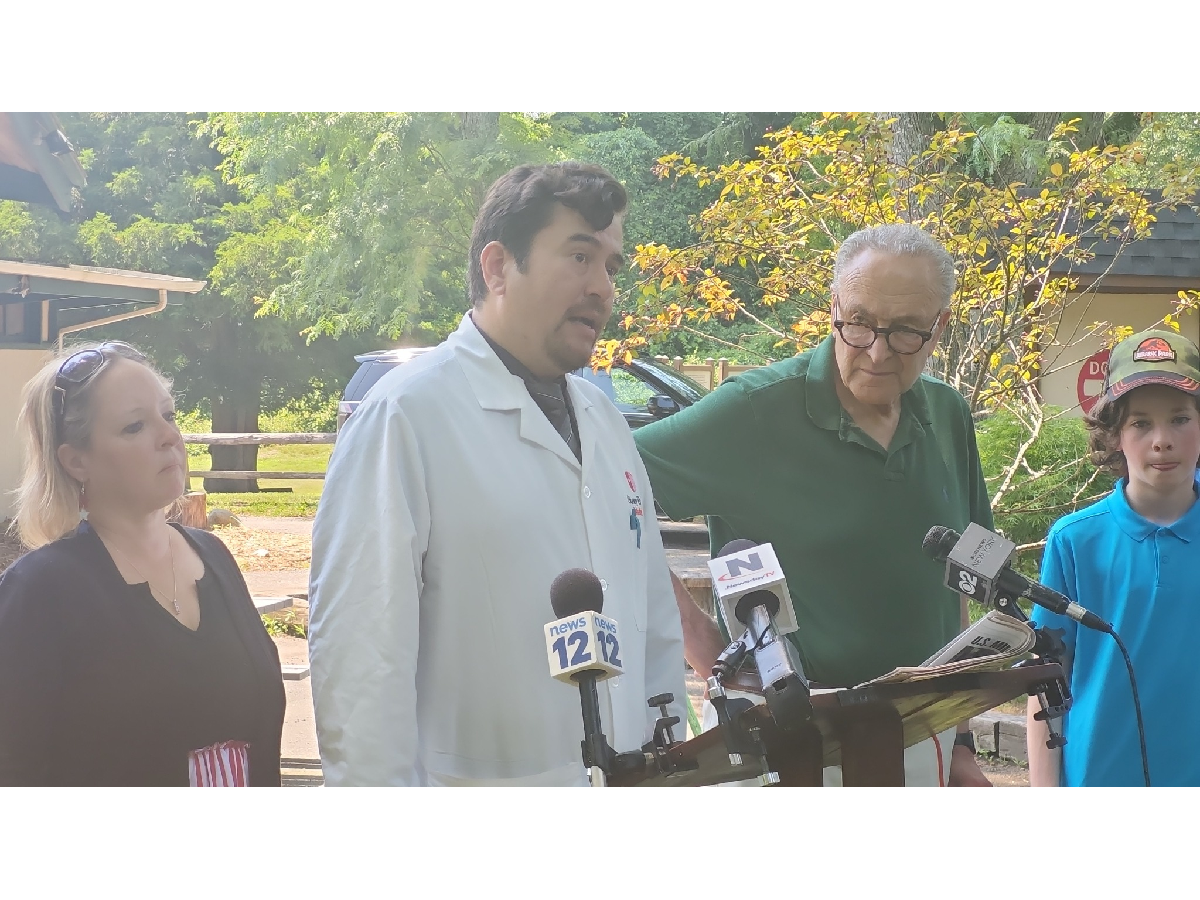
Marcos said limited funding has slowed efforts to identify emerging diseases and develop new therapies.
“With this funding that hopefully can get done, we can diagnose more people, and we can at least develop more treatments for them, or perhaps vaccines in the future,” he said.
Larkin was treated at Stony Brook Medicine, which later identified the virus through years of research.
“The virus is obviously very rare,” Larkin said. “From what I’ve read and learned, it could be very deadly. It’s very important to have more information, more studies and more money put into tick disease.”
Now healthy, Larkin said residents need to remain vigilant every time they spend time outdoors.
“I want to make everybody aware that the ticks are so prevalent on Long Island, especially Suffolk County, always to check yourself,” Larkin said. “Check your person in a bright light, a mirror, whatever, because prevention like that is just as important as education.”
‘They Wanted To Send Me Home’
Larkin described to Patch the frightening days that began shortly after finishing a yard project at his home.
He discovered ticks on his body before symptoms appeared. Soon afterward, he developed a fever and an intense headache. Believing he had contracted a tick-borne illness, he began taking doxycycline on the advice of a physician friend.
The medication did not help.
Instead, Larkin said his illness followed an unusual pattern.
“I would get really down with bad fever and bad headache, and then after several hours I would feel fine, like nothing’s wrong,” he said.

By the time he reached the emergency department, he happened to be in one of those periods when his symptoms temporarily subsided.
“I was not looking sick, and they wanted to send me home,” Larkin recalled.
Through blood tests, doctors discovered abnormal laboratory values, admitted him to the hospital and began treatment under Marcos’ care.
Larkin, 67, said he endured repeated blood draws, IV antibiotics and extensive testing while physicians searched for answers.
“It seemed like three or four times a day they would come in to draw blood,” he said. “After a couple of days, there are lots of holes in the arms from all of that.”
Despite participating in a year-long Stony Brook research study that included regular blood tests and follow-up appointments every three months, doctors still could not determine exactly what had made him sick until four years later.
“They said they found out what it was,” Larkin said.
Researchers had identified the Bourbon virus. His wife, Cheryl, said watching her husband suffer was terrifying.
“It was scary,” she said. “I didn’t like seeing him lying down with such a bad headache and the fever. I wanted him to go to the hospital sooner.”
.jpg)
Today, Larkin has changed his routine whenever he spends time outdoors.
He said he carefully examines himself every day using a bright light and mirror, wears permethrin-treated clothing while working in his yard and encourages everyone on Long Island to perform thorough tick checks after spending time outside.
For Schumer, stories like Larkin’s illustrate why federal investment cannot wait.
“So this is the plan,” the senator said. “Real dollars, track them, treat them, tackle them. Time’s ticking. Time to beat back the bite.”
Get more local news delivered straight to your inbox. Sign up for free Patch newsletters and alerts.