Neighbor News
With All Dame Dash’s Drama, Why Use Harlem Holiday’s Work Without Credit?
As bankruptcy threatens Dame Dash's life-story rights, Harlem Holiday asks why The Harlem Plug appeared on BET without permission or credit.

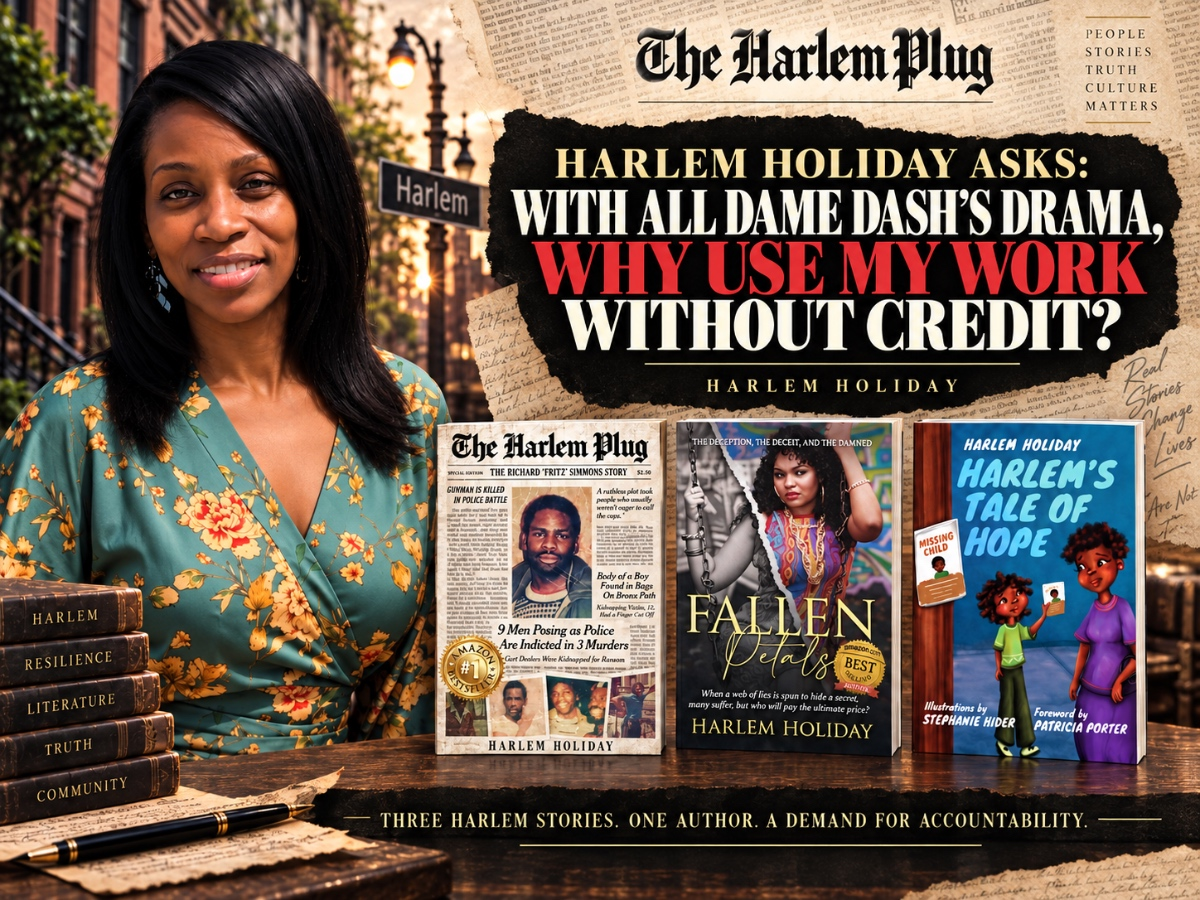
As bankruptcy proceedings threaten the ownership of Dame Dash’s own life story, Harlem Holiday asks why material connected to The Harlem Plug appeared in his BET series without permission, payment or acknowledgment.
Damon “Dame” Dash has never lacked material for a compelling story. His rise as a co-founder of Roc-A-Fella Records, his influence on hip-hop, his fractured business relationships, courtroom battles and financial collapse could fill an entire documentary franchise.
Today, the drama is no longer confined to entertainment headlines.
Find out what's happening in New York Cityfor free with the latest updates from Patch.
Dash filed for Chapter 7 bankruptcy in September 2025, reporting more than $25 million in liabilities and only $4,350 in assets. The filing paused enforcement proceedings against him in at least one federal case. In 2026, a bankruptcy trustee moved to sell a package reportedly including Dash’s life-story rights and unreleased footage to help repay creditors. A $37,000 opening bid was submitted, and a federal bankruptcy judge approved an auction process. People, Bloomberg Law, federal court order
The irony is difficult to ignore: As Dash fights through proceedings that could determine who has the right to tell—or profit from—his own life story, Harlem author Harlem Holiday is asking who respected her rights as a writer, researcher and publisher.
Find out what's happening in New York Cityfor free with the latest updates from Patch.
A Harlem Story Appears on BET
Harlem Holiday, the pen name of author and publisher Tiffany Simone Fulton, wrote The Harlem Plug: The Richard “Fritz” Simmons Story. The nonfiction book was built through research, interviews, historical records and personal photographs supplied by people close to Simmons.
Her concern centers on OG Stories: My Paid in Full, the documentary series created and hosted by Dash. The first episode, featuring Michelle Smalls as the “Queen of Harlem,” aired on BET. Public episode listings confirm that Season 1, Episode 1 focused on Smalls and featured Dash as interviewer and host. Rotten Tomatoes, Tubi
Harlem Holiday says the cover of The Harlem Plug and personal photographs connected to Richard “Fritz” Simmons appeared in that episode without anyone first requesting her authorization. She says she received no payment, attribution or acknowledgment for the use of her work.
This is not an objection to Michelle Smalls telling her own story. Nor is it a claim of ownership over Harlem’s collective history. It is a direct question about identifiable creative material: Who obtained it, who placed it in the production, and why was its source not credited?
The distinction matters.
Harlem belongs to its people, but a published book remains the intellectual and creative labor of its author. A photograph may document community history, but that does not automatically make it free for a television production to use without identifying or contacting its source.
There Was No Shortage of Material
That is what makes this situation so troubling.
Dash has decades of his own experiences to explore: the creation and collapse of major business partnerships, the Roc-A-Fella legacy, disputes over films and copyrights, multimillion-dollar judgments, tax obligations, bankruptcy proceedings and the possible sale of his life-story rights.
There is no shortage of drama. There is no shortage of headlines. There is no shortage of Dame Dash material.
So why use Harlem Holiday’s work without asking?
Why display a recognizable book cover without crediting the author?
Why incorporate personal family photographs without contacting the people who provided them?
Why build a program around ownership, survival and “paid in full” narratives while leaving the creator whose material appeared on-screen unpaid, uncredited and unheard?
These are fair questions—not only for Dash, but for BET and everyone involved in researching, editing, clearing and producing the episode.
Credit Is More Than a Courtesy
For an independent Black woman author, proper attribution is not ceremonial. It affects discoverability, book sales, professional opportunities and the historical record.
Major entertainment figures and television networks possess reach that independent writers rarely have. When their work enters a nationally distributed production without attribution, audiences may assume the material originated with the production itself. The author who spent years gathering the story can disappear from the very narrative she helped preserve.
That disappearance has consequences.
The Harlem Plug, Fallen Petals and Harlem’s Tale of Hope demonstrate the range of Harlem Holiday’s storytelling—from documented street history and adult fiction to a children’s story centered on safety, community and hope. These are not disposable images or anonymous pieces of internet content. They are part of an author’s body of work and legacy.
A Demand for Accountability
Harlem Holiday is seeking something straightforward: acknowledgment, an explanation of how her material entered the production, proper credit and a meaningful response from Dash, BET and the producers of OG Stories.
The larger issue reaches beyond one author, one book or one television episode. It concerns a culture in which independent creators are expected to accept “exposure” while larger platforms benefit from the work they produced.
Ownership cannot be defended selectively.
A person cannot demand control over his own name, image, story and legacy while treating another creator’s work as though it has no owner. The principle must apply in every direction—whether the creator is a famous entertainment executive or an independent Harlem author working from her computer.
Dame Dash has more than enough material in his own life to tell powerful stories.
Harlem Holiday’s question remains:
With all that drama, why use my work without permission, payment or credit?