Neighbor News
Dame Dash’s Life Rights Up for Sale—Harlem Holiday Questions Who Respected Hers
As Dame Dash's life rights face auction, Harlem Holiday alleges The Harlem Plug material appeared on BET without permission, pay, or credit.

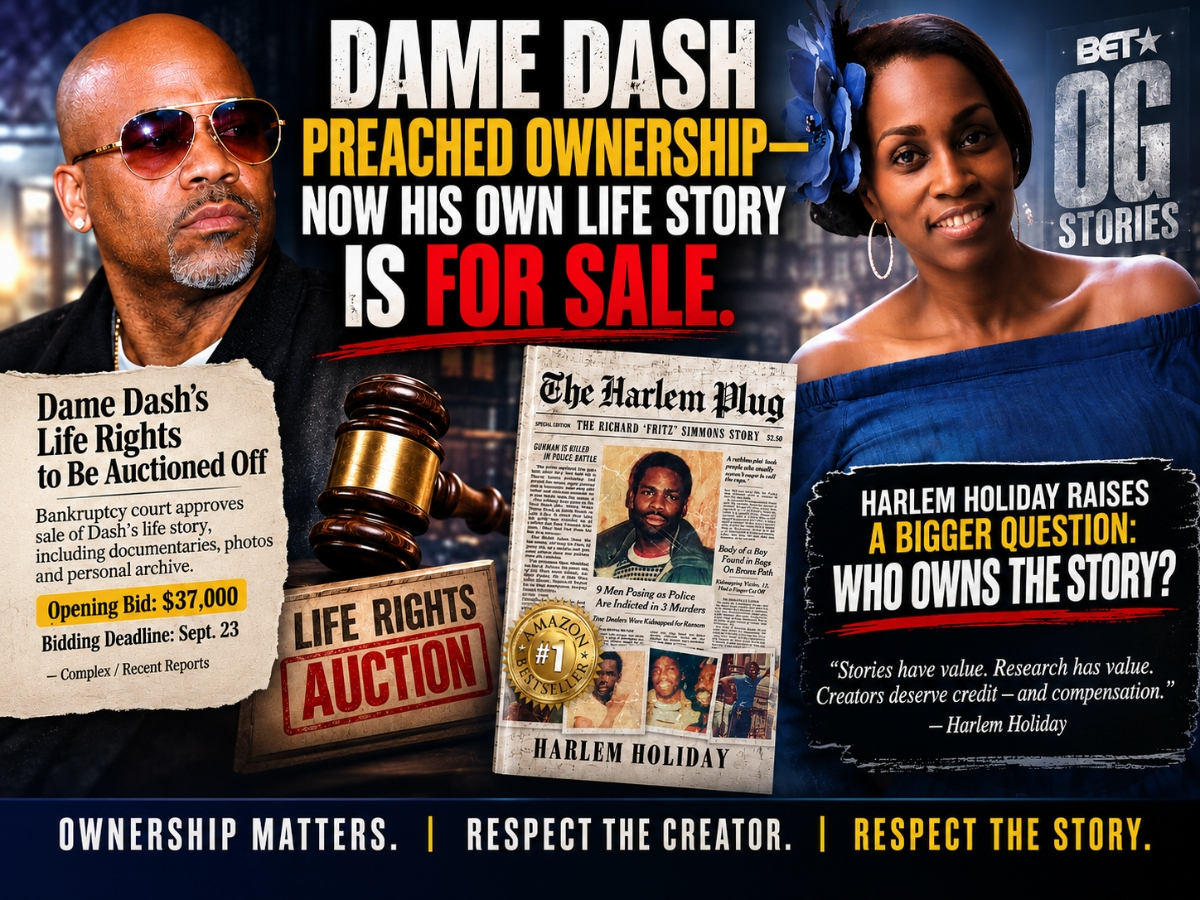
As Dame Dash’s life rights head toward a bankruptcy auction, Harlem author Harlem Holiday renews allegations that material tied to The Harlem Plug: The Richard “Fritz” Simmons Story appeared in BET’s OG Stories without her permission, payment or credit.
NEW YORK, NY — September 3, 2026 — The latest chapter in Damon “Dame” Dash’s financial troubles presents an extraordinary irony for Harlem author and publisher Tiffany Simone Fulton, professionally known as Harlem Holiday.
Dash, the Roc-A-Fella Records co-founder who built a career around ownership, independence and controlling one’s creative legacy, is now facing the potential sale of rights connected to his own life story as part of his bankruptcy proceedings.
Complex reports that a Florida bankruptcy judge has approved a process to auction Dash’s life rights, with bidding scheduled to close September 23. The package reportedly includes exclusive worldwide rights to his life story, more than 100 hours of video, photographs and memorabilia, along with rights connected to an unreleased documentary/film project. An opening bid of $37,000 has already been submitted.
Find out what's happening in New York Cityfor free with the latest updates from Patch.
For Harlem Holiday, the news raises a pointed question:
If ownership of Dame Dash’s story has monetary value, what about the ownership of the stories, photographs, interviews and research created by independent authors?
Find out what's happening in New York Cityfor free with the latest updates from Patch.
That question sits at the center of Fulton’s ongoing dispute involving Dame Dash Presents: OG Stories: My Paid in Full, which premiered on BET in June 2026.
“MY PAID IN FULL”—BUT WHO PAID HARLEM HOLIDAY?
Fulton alleges that the cover of her book, The Harlem Plug: The Richard “Fritz” Simmons Story, along with a personal photograph of the late Harlem figure Richard “Fritz” Simmons provided to her by his sister Sheila, appeared in the Michelle Smalls “Queen of Harlem” episode of OG Stories without Fulton’s authorization, attribution or compensation.
Fulton has documented her concerns through what she calls Exhibits A–C, addressing not only the BET program but what she describes as a broader pattern of online creators repurposing her research, photographs, interviews and published material without properly identifying her as the author and original source.
Her concerns also extend to apparent AI-generated content involving Fritz’s image and voice and material she says can be traced back to years of original research and interviews conducted for The Harlem Plug.
The allegations have not been adjudicated by a court, and Fulton’s claims regarding unauthorized use remain her account of the dispute.
But the latest news surrounding Dash has given the controversy a striking new context.
WHEN YOUR OWN STORY BECOMES AN ASSET
Dash has spent decades publicly advocating entrepreneurship, ownership and independence. Now, according to published reports, rights connected to his own identity, biography and personal archive are being treated as assets that can potentially be sold to satisfy creditors.
Fulton says that development underscores the very principle she has been fighting to protect:
Stories have value. Research has value. Photographs have value. Intellectual and creative labor have value—and ownership should matter whether the creator is a multimillion-dollar entertainment brand or an independent Harlem author.
“There is an irony that cannot be ignored,” Fulton said. “Dame Dash has spent years talking about ownership, and now the rights to tell his own life story are being assigned a dollar value. That should make everyone understand why creators fight so hard to protect their work. My question remains simple: if ownership matters when it is Dame Dash’s story, why shouldn’t it matter when it is mine?”
THE STORY BEHIND THE HARLEM PLUG
Fulton says The Harlem Plug was not assembled from internet searches or recycled social-media content.
Fritz’s family approached her to document his story. She spent years conducting interviews, collecting photographs, researching Harlem history and speaking with people who actually knew him. She interviewed Fritz’s sisters, Sheila and Evelyn, and traveled to Barbados on two separate occasions to interview Ace, whom she describes as Fritz’s right-hand man.
That work ultimately became The Harlem Plug: The Richard “Fritz” Simmons Story, along with related interviews, video content and published material.
Fulton argues that once her work became publicly available, portions of that research and imagery increasingly appeared across digital platforms without meaningful acknowledgment of where the material originated.
“AI didn’t conduct those interviews. Social media didn’t sit with Fritz’s family. Content creators didn’t travel with me while I researched this story,” Fulton said. “I did the work. Fritz’s family trusted me with their memories and photographs. That history should not become a digital free-for-all simply because somebody finds it online.”
TWO OWNERSHIP STORIES COLLIDE
The timing creates a larger conversation extending beyond Dash and Fulton.
On one side is a famous entertainment entrepreneur whose biography, image, likeness, archival footage and personal history have become valuable assets in a federal bankruptcy proceeding.
On the other is an independent Black woman author from Harlem arguing that material connected to years of her research and storytelling entered a major entertainment production without permission, payment or acknowledgment.
For Fulton, that contrast is precisely why the issue deserves attention.
“This is bigger than me asking for a credit,” she said. “This is about who gets to own Black stories, who profits from them, and whether independent creators are expected to simply watch while larger platforms turn our work and our communities’ histories into content.”
Fulton says she is seeking acknowledgment, accountability and appropriate compensation concerning the alleged use of her material and remains prepared to explore legal remedies if the dispute cannot be resolved.
Her message is straightforward:
Respect the research. Respect the family. Respect the creator. And if someone’s work helps tell your story, give them the credit they earned.
ABOUT HARLEM HOLIDAY
Tiffany Simone Fulton, professionally known as Harlem Holiday, is a Harlem-born author, publisher, filmmaker and community advocate. She is the author of The Harlem Plug: The Richard “Fritz” Simmons Story and founder of Harlem Westside Publishing. Her work focuses on preserving Harlem stories, documenting overlooked histories and ensuring that the people behind those stories are not erased from the narratives they helped make possible.
The Harlem Plug: The Richard “Fritz” Simmons Story is available in hardcover, paperback, Kindle and audiobook formats through major booksellers.