Schools
Briarcliff Manor Middle School Medical Detectives Put Science To The Test
What happens to your heart rate when you run, jump rope, or sit quietly and journal? 7th graders put these questions to the test.


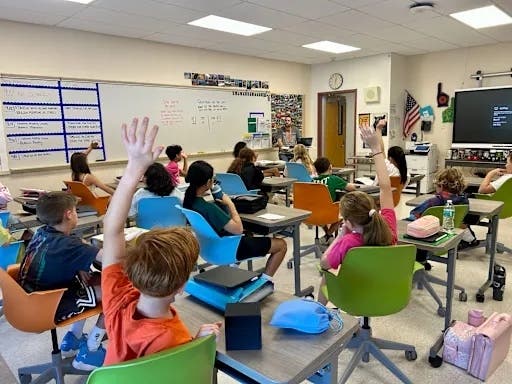
What happens to your heart rate when you run, jump rope, or sit quietly and journal? Seventh graders in Jessica Loprieno’s Medical Detectives enrichment class put these questions to the test, designing their own experiments, collecting data, and presenting their findings to classmates.
Working in groups, the student medical detectives developed hypotheses about how different activities might affect heart rate. They identified independent and dependent variables, established controlled conditions, and conducted multiple trials to test their predictions.
Find out what's happening in Pleasantville-Briarcliff Manorfor free with the latest updates from Patch.
Some groups took their experiments outdoors, running laps around the track or jumping rope before measuring their heart rates. Others explored whether a quieter activity, such as journaling, would produce different results.
For Annie, Caitlin, Harley, and Zoey’s group, consistency was an important part of the experimental process. The students considered factors such as distance, the amount of time spent measuring heart rates, rest periods between laps, the number of trials, and environmental conditions.
Find out what's happening in Pleasantville-Briarcliff Manorfor free with the latest updates from Patch.
The jump rope group also found that physical activity increased participants’ heart rates, supporting their original hypothesis. However, the students recognized that their experimental conditions were not entirely consistent. With only one jump rope available, some participants rested longer than the planned two minutes.
“If we can redo this experiment, we would make the activity time longer to see a more gradual increase in heart rate,” the students explained.
Both experiments offered opportunities to consider not only what the data revealed, but also how changes to the experimental design might produce different results.
Perhaps the most unexpected findings came from Sophia, Olivia M., Olivia S., and Carina, whose experiment, “Life with Journaling,” explored whether journaling would lower a person's heart rate.
Their results told a different story. Of the four students, only Carina experienced a decrease in heart rate, dropping 17 beats per minute. The other students recorded increases of 7, 16, and 23 beats per minute.
When Ms. Loprieno asked whether the results were what they expected, the students acknowledged that Carina was the only member of the group who particularly enjoyed journaling.
Ms. Loprieno encouraged the group to consider whether the duration of the activity might have influenced the results.
“Maybe if you had more than three minutes, maybe you needed a little more time to get into that state of mind to relax into the moment before journaling or drawing,” she suggested.
The discussion illustrated an important part of scientific inquiry: Unexpected results can raise new questions about how an experiment was designed, conducted, and interpreted.
Throughout the project, students used their iPads to collect and analyze data. The Clock app's stopwatch helped them time 30-second intervals as they measured their heart rates, while the Numbers app allowed them to organize their findings into tables and create bar graphs. Working collaboratively, students designed presentations to communicate their methods, results, and conclusions to their classmates.
For Jesse, whose group investigated the effects of running, the hands-on approach made the project especially memorable. His group used an app to track their results and measured heart rates by counting pulses for 30 seconds and multiplying by two.
“I would say this is definitely up there because it's fun,” he said, comparing the experience with other classroom presentations. “We got to actually do something, not just sit down in a chair. We got to go outside and run, and it was something new and different for presentations.”
On presentation day, Ms. Loprieno reminded students that communicating their findings was just as important as conducting the experiments. She emphasized speaking clearly, making eye contact, facing the audience, and positioning themselves so their classmates could see the data being presented. Students also practiced being attentive audience members, listening respectfully and saving their questions until the end.
The project is part of Project Lead the Way (PLTW) Medical Detectives, a course that connects concepts from Life Science to real-world applications in medicine and healthcare. Through hands-on investigations and case studies, students take on the role of medical professionals, learning to examine evidence, analyze scientific data, and draw conclusions.
Following their vital signs experiments, students will move into simulated medical case studies, practicing how to diagnose patients using scientific evidence. Later in the quarter, they will explore the nervous system and regions of the brain, culminating in a sheep brain dissection.
From collecting data on the track to presenting their findings in the classroom, the students are discovering that thinking like scientists involves much more than finding the right answer. It requires asking questions, working together, testing ideas, and being willing to reconsider what the evidence reveals.
This press release was produced by the Briarcliff Manor Union Free School District. The views expressed here are the author’s own.
Get more local news delivered straight to your inbox. Sign up for free Patch newsletters and alerts.