Politics & Government
Suffolk Supervisors Call For Albany To Address Unfunded Mandates And Property Tax Pressures
Their joint letter asks for a constructive meeting with Hochul's office and state lawmakers to discuss potential adjustments to the tax cap.


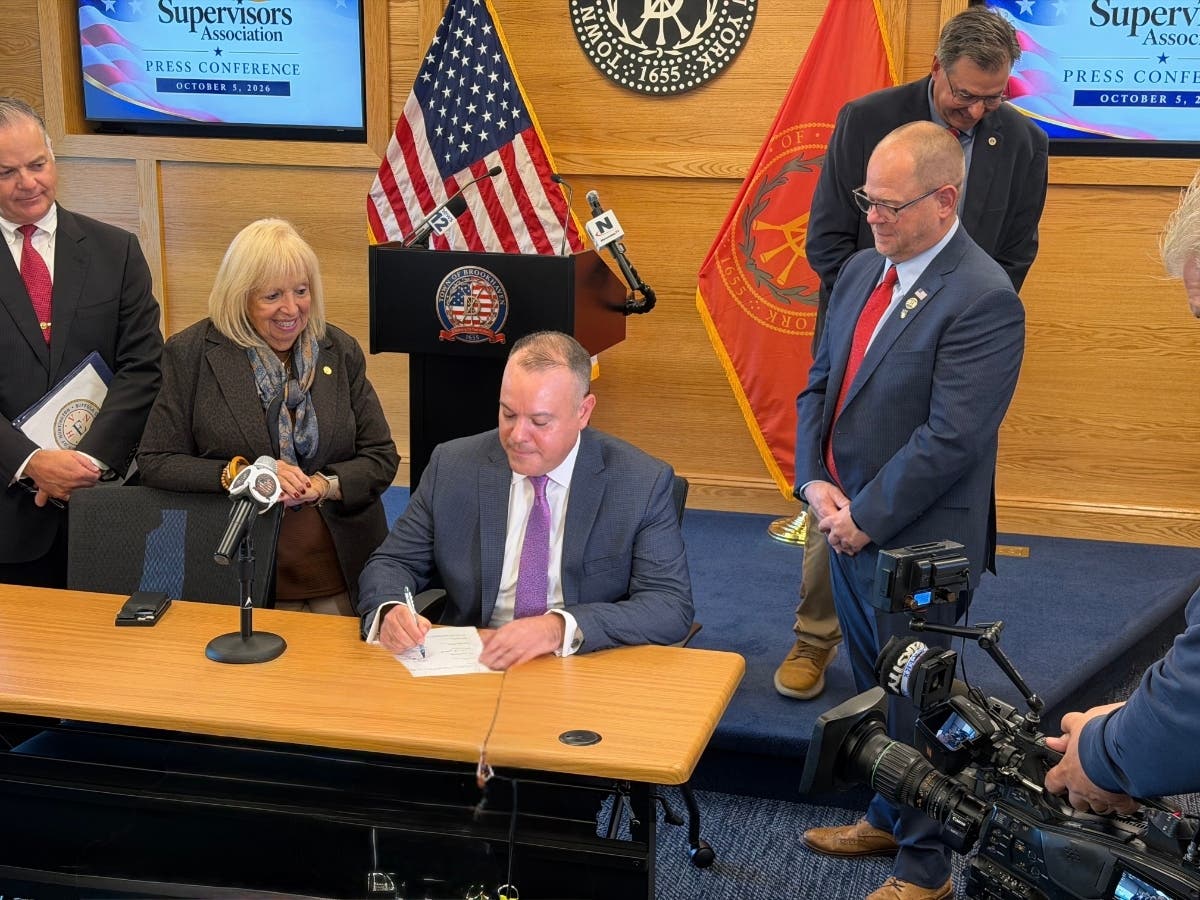
FARMINGVILLE, NY — Suffolk County's town supervisors called on Albany on Monday to address unfunded mandates and property tax pressures at a news conference at Brookhaven Town Hall in Farmingville.
The message for Albany was clear that "local governments cannot continue being held solely responsible for controlling property-tax growth while being required to absorb mounting costs they have no vote, voice, or authority to determine, officials said.
The bipartisan group of supervisors jointly signed a letter to Gov. Kathy Hochul and members of the state's Legislature requesting an open dialogue on the property tax-cap formula, unfunded mandates, and potential relief for municipal governments.
Find out what's happening in Sachemfor free with the latest updates from Patch.
The group, which was headed by Brookhaven Supervisor Dan Panico, included Huntington Supervisor Ed Smyth, Islip Supervisor Angie Carpenter, Smithtown Supervisor Edward Wehrheim, Southampton Supervisor Maria Moore, and Southold Supervisor Albert Krupski, along with representatives from other Suffolk municipalities.
At the center of the discussion was "a growing contradiction" in state fiscal policy as Albany "demands local governments control property taxes while simultaneously imposing or influencing substantial costs that towns have little or no ability to control."
Find out what's happening in Sachemfor free with the latest updates from Patch.
The group addressed how the state comptroller calculated the 2027 inflation factor at 3.13 percent, yet the allowable levy growth factor remains limited to 2 percent. The comptroller has also acknowledged the challenge municipalities face in continuing to provide essential services while managing higher costs, the group said.
Also discussed was how pension obligations continue consuming a significant share of municipal budgets. Comptroller Thomas DiNapoli reported that average employer contribution rates for the Employees’ Retirement System increased from 16.5 to 17.6 percent of payroll for 2026–27, while the Police and Fire Retirement System rate increased from 33.7 to 36.5 percent. The Comptroller identified investment performance, higher salaries, recent legislative changes and retirement patterns among the factors affecting those rates.
The expenses are not discretionary, according to the group.
Town boards "cannot simply decline" to make required pension contributions, as they must be incorporated into municipal budgets alongside health insurance, contractual obligations, court-ordered expenses, and other costs that can increase regardless of the tax cap, the group said.
At the same time, municipalities and school districts are confronting changes involving Payment In Lieu of Taxes, or PILOT payments, on LIPA-owned properties, while Long Island faces a looming solid-waste crisis and uncertainty surrounding the future economics of its waste-to-energy infrastructure, according to the group.
The supervisors said "the issues demonstrate a broader problem: costs imposed, affected, or left unresolved at the state level eventually arrive at the local level — where property taxpayers are expected to pay the bill."
The Supervisors’ joint letter calls for a constructive meeting with Hochul's office and state lawmakers to discuss potential adjustments to the tax-cap formula and greater flexibility for extraordinary or externally imposed expenses, essential infrastructure, and other costs municipalities are legally required to absorb.
Patch has reached out to Hochul's office for comment.
Panico said, “Governor Hochul cannot claim affordability as a priority without acknowledging the costs Albany continues to impose or shift onto local governments and ultimately our taxpayers."
"We are required to balance our budgets, live within the tax cap and explain every increase directly to the residents we serve," he said. "Yet Albany can enact mandates, change benefits or leave major regional problems unresolved, and the resulting costs eventually find their way into municipal budgets."
"You cannot make New York more affordable by making local government more expensive," he added.
Wehrheim said, "Town governments are operating with our hands and feet tied."
"Before we put a single line into an operating budget, costs imposed by decisions in Albany can already consume or exceed the entire 2 percent tax cap," he said. "We have no vote on those decisions, yet local officials are the ones who must answer to taxpayers."
“Governor Hochul has always been responsive when we have brought important issues to her attention, and we are hopeful we can work together with that same spirit to find a better solution — one that protects taxpayers, maintains our workforce, preserves essential services, and helps keep Long Island families here," he added.
Smyth said that no municipality wants to pierce the tax cap, but "it is impossible to maintain the parks, beaches, roads and garbage collection, along with other lifesaving services, without exceeding the 2 percent tax cap."
"Costs are rising everywhere," he said. "We hope the State will abandon the arbitrary 2 percent tax cap and establish a formula that recognizes economic reality."
Carpenter said that town governments "are committed to fiscal responsibility, but we also need the tools to manage costs we do not control."
"We’re asking Albany for a constructive conversation about greater flexibility, so we can protect taxpayers while continuing to provide the essential services on which our communities depend," she added.
Krupski said that "the level of communication with the public is critical, as our residents ultimately foot the bill.”
Get more local news delivered straight to your inbox. Sign up for free Patch newsletters and alerts.