Politics & Government
2026 PA Budget Passed Into Law: What It Does, What It Doesn't Do
Weeks of partisan gridlock have resulted in an unhappy compromise.


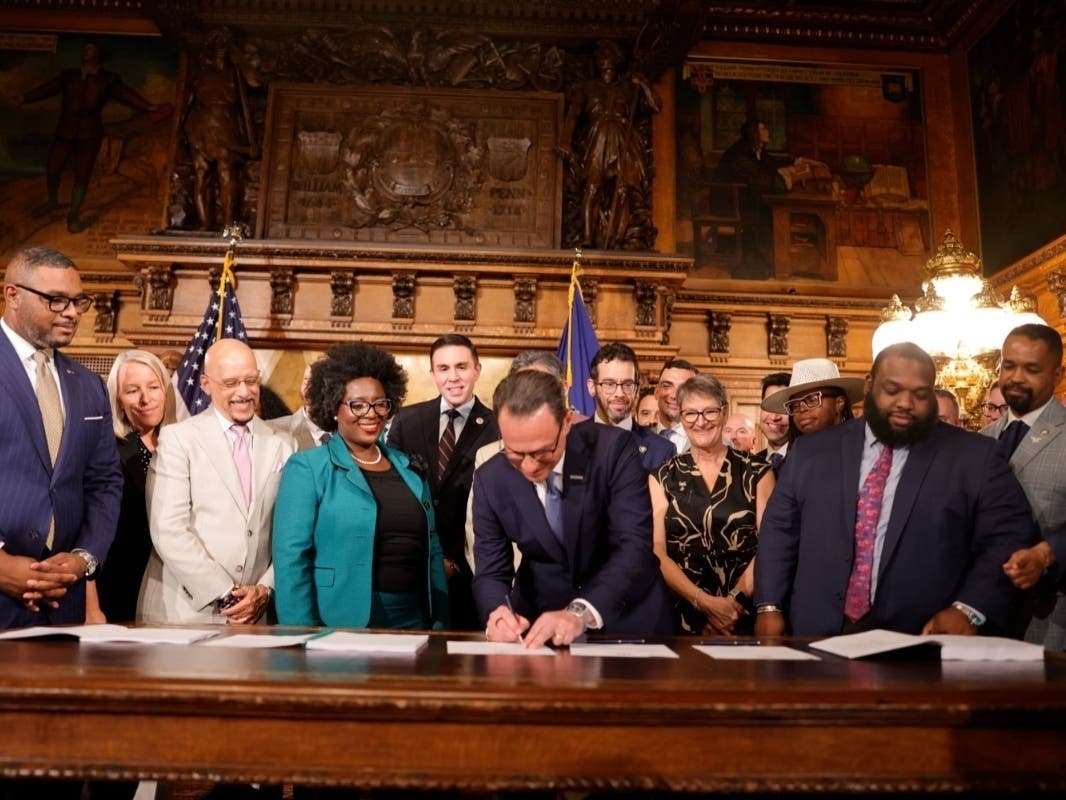
HARRISBURG, PA — Pennsylvania lawmakers passed into law Sunday the $50.8 billion budget for 2026 following weeks of debate and partisan gridlock, an agreement which left factions just about everywhere on the political spectrum grumbling.
It marks the fourth consecutive budget that has not been passed on time in Pennsylvania, comprising every year Gov. Shapiro has been in office.
The budget's inclusions are as notable as its exclusions. Democrats are hailing education investment in poorer school districts, including a $565 million increase in equity funding, as a major win. Critics on the right have pointed to its failure to meaningfully balance the budget.
Find out what's happening in Across Pennsylvaniafor free with the latest updates from Patch.
More notably, the budget makes no movement on long-simmering controversial issues like how the state should regulate and tax "skill games", minimum wage, marijuana legalization, and a host of other issues Democrats have cited a priorities for years.
Cadres of Democrats and Republicans are calling this budget a successful compromise. Indeed, it passed 44-6 in the senate, and 167-35 in the house. "No" votes come from both sides of the aisle, where legislators are finding increasing common ground on issues like data centers, which are championed by Democratic leadership despite overwhelming opposition from the public.
Find out what's happening in Across Pennsylvaniafor free with the latest updates from Patch.
Below is a closer glance at some of the budget's major inclusions and exclusions and how they could affect life in Pennsylvania over the coming year and into the future.
Ignoring the skill games drama, again
The budget does nothing to address skill games and unregulated gambling machines, some 70,000 of which exist around Pennsylvania.
Skill games corporations have argued for years, mostly successfully, that because their games require some degree of skill, they should not be considered gambling. At least not in the same way as casinos. That means that they cannot be taxed at the high rate that gambling establishments are taxed.
But a June ruling by the Pennsylvania State Supreme Court ruled that skill games are indeed gambling, and they handed down a mandate to the state legislature to build out a framework for taxation and regulation by October.
It was widely assumed this budget, passed just two and a half months before that deadline, would take steps in that direction.
Anne Radakovits, president of the AFSCME Local 1979 which represents state employees, said that it was massive missed opportunity to generate long term income.
"Pennsylvania cannot continue kicking the can down the road when it comes to generating sustainable revenue," Radakovits said in a statement. "Our members understand better than anyone that strong public services require stable funding."
Despite the ruling, pressure from the casino industry and lobbyists has been massive. It remains unclear how the legislature will comply with the high court's mandate under a tight deadline.
Funding poorer school districts
The budget assigns $11.8 billion in funding to education. The major increases here are $58 million more for "basic education," covering a wide swath of essential school services, and $55 million for special education.
The centerpiece is the $565 million in new investments for poorer school districts, specifically those that have been historically underfunded.
The plan won the approval of Pennsylvania State Education Association President Aaron Chapin.
“This state budget reflects a remarkable commitment to K-12 public education in Pennsylvania and reminds us how important it is to elect pro-public education leaders,” Chapin said in a statement. “The budget continues a multiyear plan to improve school funding adequacy and equity, helping more students in more communities reach their full potential."
Deborah Gordon Klehr, executive director of Education Law Center PA, cautioned that while it's a step in the right direction, the state needs to move faster to fund needy districts. For some schools, she warns, the additional funding is just barely enough to help them keep pace.
“Our schools remain billions of dollars short of the funding the General Assembly identified as needed," Klehr said in a joint statement put out alongside the Public Interest Law Center. "And until every child, wherever they live, has access to a well-funded public school, Pennsylvania’s constitutional obligation remains unmet.”
Beyond that, Chapin also praised the budget's funding of a Student Teacher Support Program, which provides a cash stipend to certain eligible student teachers.
The budget maintains funding levels for mental health programs, and establishes a mandated 30 minutes of daily recess for students in kindergarten through fifth grade.
Long awaited pension increases
The budget provides an increase in pensions for thousands of retired state employees, including teachers, school staff, emergency response workers, and more.
The increases are cost of living (COLA) adjustments, which officials said covered many retirees from before 2001 who have been living off outdated pension levels.
"While it should have happened much sooner, we are grateful that lawmakers finally recognized the need to provide relief to the men and women who spent their working lives serving this Commonwealth," Jeanne Weaver, President of the Retired Public Employees of Pennsylvania Chapter 13, shared in an announcement following the budget. "This COLA won't erase more than two decades without an increase, but it is an important and long-overdue step forward."
But many critics, including groups like AFSCME, say it's a bandaid, and that taxation on things like skill games and marijuana is required to fund these COLA increases in the long run.
Chapin was more optimistic about what the 2026 budget would mean in the immediate future.
"For too long, these dedicated Pennsylvanians, many now in their 80s and 90s, have struggled to make ends meet amid the skyrocketing costs of housing, gas, groceries, and medicine," he said. "Now, after decades of waiting, they will finally receive the modest increases they deserve.”
A GOP victory: the Rainy Day Fund
A major priority for Republican legislators was preserving the state's roughly $8 billion rainy day fund. The 2026 budget does not touch that savings account.
The fund is essentially earmarked to cover emergencies like natural disasters and economic recessions. Advocates for maintaining a large rainy day fund say it guards against the need to suddenly raise taxes to cover the response to a disaster.
Shapiro's original budget proposal back in February called for borrowing more than half of the total fund, some $4.5 billion, in an effort to cover the state's annual deficit. At the time, it was excoriated by Republicans.
"I am deeply concerned about the illegitimate use of the Rainy Day Fund to create a $100 million slush fund that obscures the lines of federalism," House Republican Leader Jesse Topper (R-Bedford/Fulton) said in February. “Our number one priority must be providing the foundation for substantial economic growth in the Commonwealth to balance any future state budgets."
Critics say the practice is bad business and does not attack the root of the issue: as long as Pennsylvania has a "structural deficit," meaning the state spends more than it is able to collect in tax revenue, then the rainy day fund evaporates very quickly.
No hum on data centers
Perhaps the defining issue of a chaotic gubernatorial election that has redrawn allegiances, the data center crisis was relatively ignored in the budget. Bipartisan legislation has advanced in the state senate that would place a three year moratorium on data center construction.
But the budget's only word on data centers was instituting a requirement that they report their annual energy and water consumption to the state.
“Instead of regulating the development of data centers, our government continues recklessly to incentivize it," State Sen. Nikil Saval said. "Their proliferation across the Commonwealth (is) emerging as a key obstacle to our transition away from a fossil fuel economy."
Critics on both sides of the aisle have called for new tax policies and regulatory reform so that ratepayers are not saddled with the strain that massive corporations place on the grid.
About 74 percent of Pennsylvania residents oppose building AI data centers, according to the latest Quinnipiac University polling, while 84 percent show it no support.
The nonprofit Food and Water Watch calls it a sharp rebuke of Gov. Shapiro, reflective of a broad bipartisan for the moratorium.
“Time and time again, Gov. Shapiro has proven willing to give away water, energy, land, and even tax breaks, to corporate developers who don't care about Pennsylvanians," Alex Beauchamp, the Northern Regional Director for Food & Water Watch, told Patch. "The budget was a chance for him to rewrite the record. He failed, leaving Pennsylvanians out to dry, again. This poll provides even more evidence that this approach will not fly with people of all political persuasions."
The controversy with Medicaid deferrals
This budget postpones the payment of $1.3 billion in Medicaid payments to next year. This helps fund this year's budget while making the budget as a whole appear more balanced. While it's received bipartisan praise as a savvy accounting move, it's also been pilloried as more smoke and mirrors designed to give the appearance of a long term plan.
Recreational marijuana is now 0-4
A total of 24 states and Washington D.C. have legalized recreational marijuana. Pennsylvania leaders on both side of the aisle, including Gov. Wolf, U.S. Sen. John Fetterman, and Republican legislators like State Sen. Dan Laughlin and State Rep. Abby Major, have been advocating for legalization for years, if not decades.
Shapiro has advocated for legalizing it as well, but critics worry it's been deprioritized. Proposals were included in the original proposal in February, marking the fourth straight Shapiro budget proposal which included a framework for legalization, and also the fourth straight final amended budget which failed to include it.
It ties to the biggest thematic issue with the budget as a whole: on a swath of the most important issues, it's either mum or it passes responsibility on to future governors and legislatures. This is as true for skill games and the deficit as it is for minimum wage, mass transit, and marijuana legalization.
Other new investments of note
- A one time $20 million investment in the Hazardous Sites Cleanup program, to address toxic waste sites
- A one time $19 million investment in the oil well-plugging program, to resolve abandoned oil and gas wells around the state
- $50 million increase in the county child welfare system
- $16.2 million for four more Pennsylvania State Police cadet classes
- $1 million increase for Aging Our Way, PA to support older adults
- $10 million to for Fruit Grower Freeze Impact Grants to help farmers hurt by this spring's freeze
- $5 million to expand education for farmers on bird flu
Get more local news delivered straight to your inbox. Sign up for free Patch newsletters and alerts.