Schools
URI Professor's Study Uses 'Augmented Reality' To Help Amputees Use Prosthetics
The augmented reality game was designed to motivate amputees to undertake prosthesis training.


KINGSTON, RI — An associate professor at the University of Rhode Island developed a method to help amputees adjust to using their prosthetics.
"One of the main reasons amputees give for not using their body-powered prosthesis is a lack of motivation or knowledge of how to properly use them," the university explained in a media release.
Susan D’Andrea, an associate professor of kinesiology in the University of Rhode Island College of Health Sciences, recently undertook a study aimed at bolstering this motivation.
Find out what's happening in Across Rhode Islandfor free with the latest updates from Patch.
See also: URI Professor Studies Suicide, Alcohol Use Disorder Connections
“The quality and quantity of prosthetic training have a significant influence on prosthetic acceptance,” D’Andrea said. “However, there’s no consensus on the most effective delivery for this training.”
Find out what's happening in Across Rhode Islandfor free with the latest updates from Patch.
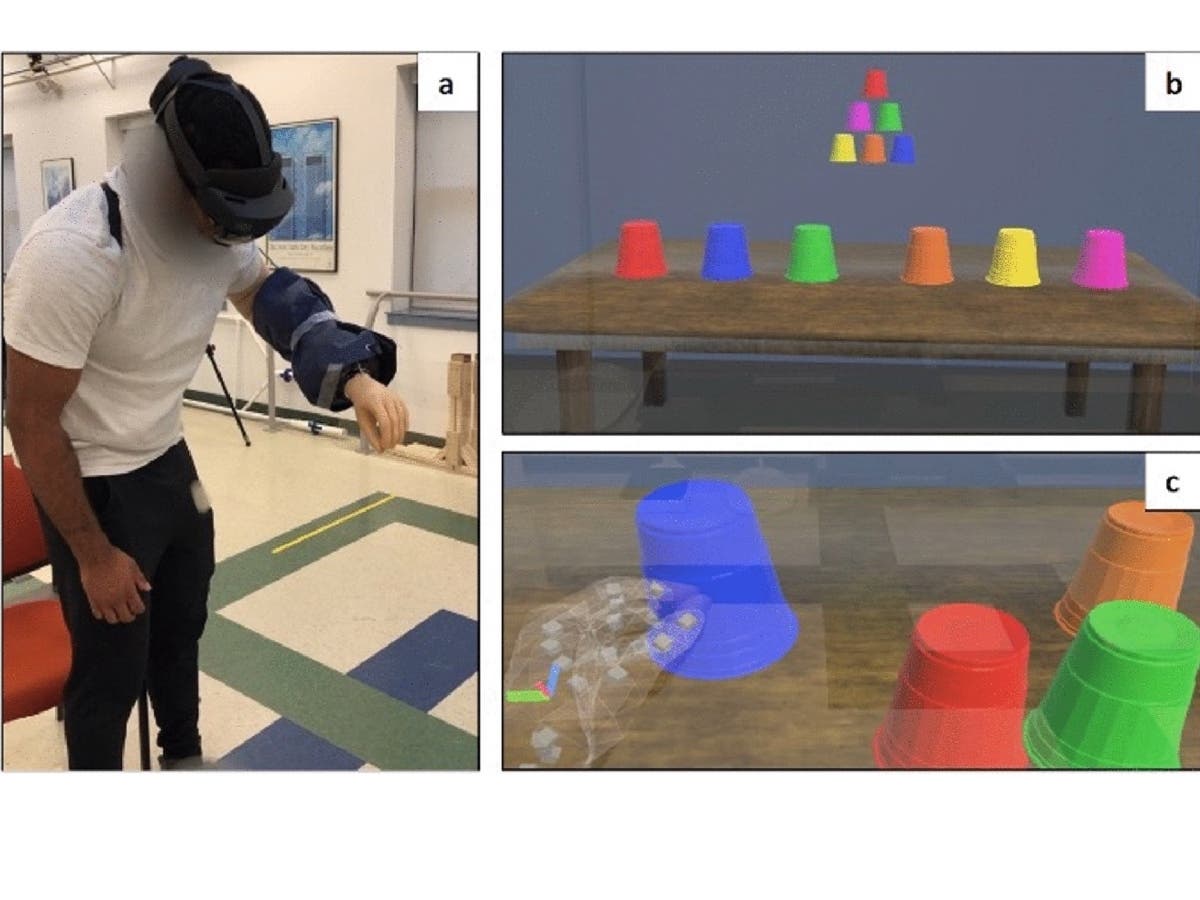
D’Andrea's study used an augmented reality game to keep participants engaged and motivated during training or rehabilitation.
See also: URI Prof Leading Study Aimed At Helping Grocery Shoppers Make Healthier Choices
"With sports, with anything, the more you di it, the better you get," D'Andrea said.
D’Andrea recruited 32 healthy, able-bodied participants for the study, ranging in age from 18-65. Wearing a bypass body-powered prosthetic device, participants performed functional task assessments in D’Andrea’s MotionVR Biomechanics Lab.
Half the participants in the study were randomly assigned to an augmented reality intervention group and the other half to a control group. Participants in the augmented reality group used the ARm-Strong training game, which was developed at URI by kinesiology and biomedical engineering students. The game challenges participants to stack holographic cups while wearing a Microsoft HoloLens2 headset. They were tested during three visits, with four to six days between each visit.
See also: URI-Led Research Project Calls On Public To Report Bobcat Sightings
Participants in the control group received no training between pre- and post-measurements of hand function and were instructed not to use a prosthesis between visits to the lab.
During their two visits, which were 8-12 days apart, they were instructed to complete a seven-task functional assessment using the prosthesis only. One task was to turn over five index cards on a table, while being timed.
See also: URI Student Develops Custom Amplifier
“On average, individuals in the augmented reality group were significantly more efficient at using the bypass prosthesis to complete functional tasks compared to the control group,” D’Andrea said. “Individuals who engaged in the augmented reality training had positive feelings of engagement, engrossment, and immersion towards the application.”
The next step, D'Andrea said, is for individuals with upper-extremity amputations to participate in the study.
She also said a more interesting, Jenga-type augmented reality game was in development.
See also: University Of Rhode Island Prof Participates In Methadone Study
Get more local news delivered straight to your inbox. Sign up for free Patch newsletters and alerts.