Politics & Government
Judge Blocks Trump's Arch Near Arlington Cemetery After 8-4 Vote
A federal judge blocked work on Trump's proposed arch for 14 days after a planning commission approved the project in an 8-4 vote.


ARLINGTON, VA — A federal judge early Friday blocked the Trump administration from beginning construction on a proposed 250-foot triumphal arch near Arlington National Cemetery for 14 days, hours after a federal planning commission approved the controversial monument in an 8-4 vote.
U.S. District Judge Tanya Chutkan issued a temporary restraining order after Virginia and the District of Columbia argued that allowing construction to begin could cause immediate harm. According to The Associated Press, the judge cited concerns about traffic disruptions, emergency response coordination and costs that local governments could not recover.
The decision came after the National Capital Planning Commission approved the project Thursday following a lengthy public hearing that drew opposition from veterans, local officials and residents. U.S. Rep. Don Beyer (D-8th), whose district includes Arlington National Cemetery, testified against the project and welcomed the court's decision.
Find out what's happening in Arlingtonfor free with the latest updates from Patch.
Judge Blocks Construction After 8-4 Commission Vote
The National Capital Planning Commission approved the arch Thursday night after a hearing lasting more than nine hours. The vote divided largely along federal and local lines, with Trump administration representatives and allies supporting the project and representatives of the District of Columbia opposing it, according to AP.
The administration had indicated that construction could begin shortly after final approval from the commission and the Interior Department, along with the required National Park Service notification.
Find out what's happening in Arlingtonfor free with the latest updates from Patch.
Chutkan's temporary restraining order prevents that work from beginning for 14 days while legal challenges continue. The judge also ordered the federal government to submit a compliance report Monday, according to AP.
The ruling followed a lawsuit filed Oct. 31 by Virginia and the District of Columbia, which was consolidated with an earlier challenge brought by Vietnam veterans and an architectural historian.
The administration has maintained that a 1925 law provides authorization for the monument. Chutkan rejected the argument that the century-old law authorized construction of the massive arch at the proposed site, according to AP.
Before Thursday's commission hearing, Justice Department attorneys disclosed that a contractor had performed site preparation work Oct. 31, apparently without authorization from the National Park Service, AP reported.
Beyer Welcomes Ruling, Pledges To Continue Opposition
Beyer, who represents Arlington and other Northern Virginia communities, praised the judge's decision in a statement Thursday night.
"I am thankful that District Judge Tanya Chutkan swiftly barred the Trump Administration from moving forward with its illegal plans to ram this project through," Beyer said.
Beyer argued that the administration had attempted to move ahead despite legal objections, public opposition and evidence that the monument could damage the historic setting surrounding Arlington National Cemetery.
"This fight is not over," Beyer said.
He called for permanent legal protections to prevent the monument from being constructed.
Earlier Thursday, Beyer testified before the National Capital Planning Commission, criticizing the project for its potential effects on the cemetery, regional transportation and public safety.
"In my time in Congress, I have never seen a project with such profound, widespread opposition from the very people who it will affect most," Beyer told the commission.
Beyer said his parents, grandparents and sister are buried at Arlington National Cemetery.
He also cited a National Park Service assessment finding that the proposed arch would adversely affect dozens of historic properties, including Arlington National Cemetery, Arlington Memorial Bridge, the Lincoln Memorial and the George Washington Memorial Parkway.
Arlington Officials, Veterans Protest Proposed Monument
Opposition to the project extended beyond the commission hearing.
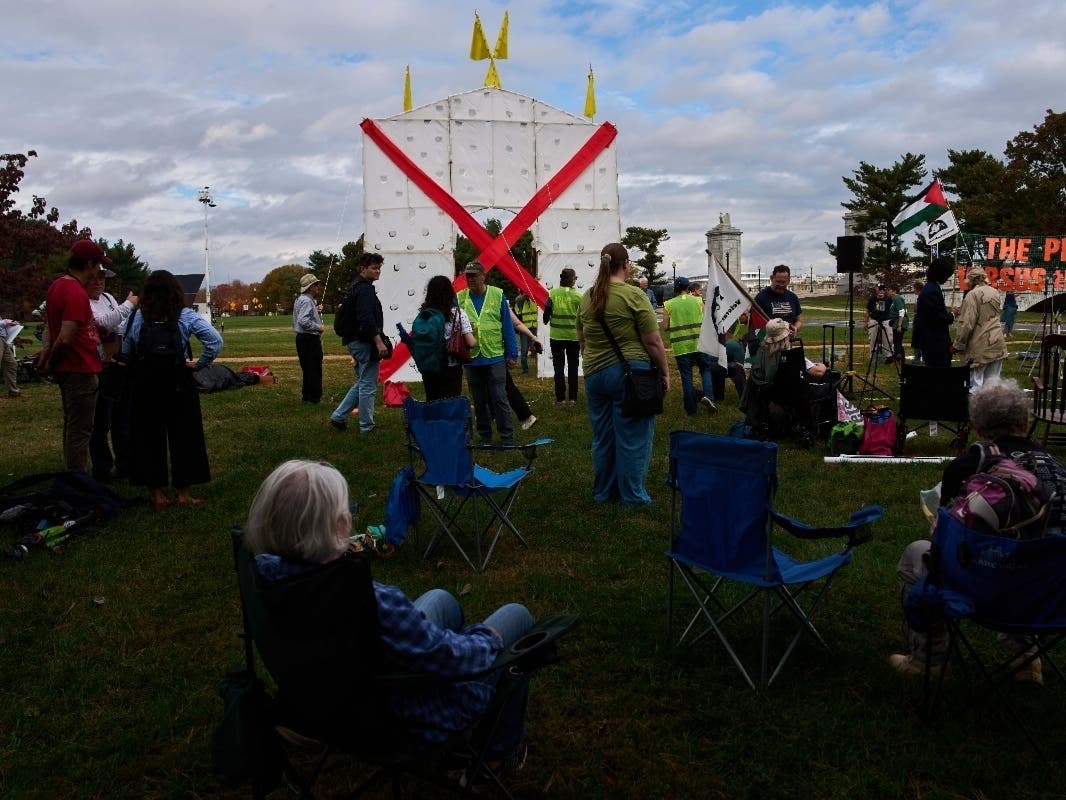
A group of protesters gathered Thursday near Memorial Circle, the proposed site of the monument, according to AP.
Arlington County Board member Julius Spain, an Iraq War veteran, addressed the demonstrators and characterized opposition to the arch as a matter of civic responsibility.
U.S. Rep. James Walkinshaw (D-11th), who also attended the protest, pledged to continue opposing the monument even if it is constructed, AP reported.
Veterans and relatives of people buried at Arlington National Cemetery also testified against the proposal.
Jamie Langston, a Gulf War veteran whose father-in-law is buried at the cemetery, objected to the possibility that the monument could turn the surrounding area into a tourist attraction that would detract from the cemetery's solemn character.
Martha O'Connell, whose brother is buried at Arlington, expressed concern about the enormous structure overshadowing the graves of military service members.
Opponents have also questioned the project's impact on historic sight lines connecting Arlington National Cemetery, the Lincoln Memorial and other landmarks along the Potomac River.
Trump Administration Defends Monument As Tribute To Veterans
Supporters of the project have described the arch as a monument celebrating American history, military service and national identity.
Mark Paoletta, chairman of the National Capital Planning Commission and general counsel for the White House Office of Management and Budget, defended Trump's proposal during Thursday's hearing.
Paoletta pointed to monumental arches in cities such as Paris, Rome and London as examples of prominent national landmarks, according to AP.
Commissioner Paul Ingrassia, an attorney for the General Services Administration, also defended the project as a tribute to the country's history and veterans rather than a political monument.
Opponents questioned whether the administration had obtained the necessary congressional authorization and funding.
D.C. Council Chairman Phil Mendelson, who serves on the planning commission, said Congress had neither approved the proposed structure nor appropriated money for its construction.
The project's estimated cost remains uncertain, although estimates have reached as high as $100 million, according to AP.
Proposed Arch Would Include Observation Deck, Offices
The Trump administration submitted a 106-page plan for the monument that includes features beyond the arch itself.
According to AP, the proposed structure would include a large bronze depiction of a winged Lady Liberty holding a torch with an eternal flame.
The plans also call for an observation deck, two mezzanines, office space, rooms for programs, a staff lounge, staircases, elevators and a fire command center.
Construction would require changes to nearby roads and traffic patterns, including rerouting vehicles around the site.
The administration has also said the monument would serve a national security function.
Beyer raised concerns during Thursday's hearing about statements from Trump suggesting the arch could be used as a base for drones and snipers.
"While the President has called for the project to be 'converted' to a base for drones and snipers, that appears nowhere in this Commission's consideration of the project," Beyer testified.
He argued that the commission had failed to adequately consider the implications of such a use near tourists, commuters and other people traveling through the area.
Arlington, Virginia And D.C. Pursue Legal Challenges
The temporary restraining order is the latest development in a series of legal challenges to the project.
As Patch previously reported, Arlington County filed a lawsuit seeking to block construction of the monument near Arlington National Cemetery.
Virginia and the District of Columbia also filed suit, challenging the federal government's authority to proceed with the project.
Beyer has introduced the Arlington National Cemetery Viewshed Protection Act, legislation intended to prohibit construction of the arch.
The proposed monument is among several projects Trump has pursued to reshape Washington, including changes to federal landmarks and public facilities.
Those initiatives could face additional congressional scrutiny following Democratic gains in the November midterm elections, AP reported.
Although Thursday's planning commission vote cleared a major administrative hurdle, Chutkan's order prevents construction from beginning immediately.
The 14-day restriction does not permanently block the project. Its future remains subject to ongoing litigation and any additional court orders.
Reporting from The Associated Press contributed to this story.
Get more local news delivered straight to your inbox. Sign up for free Patch newsletters and alerts.