Community Corner
Healdsburg Residents, Council Challenge Vine Street SMART Station Push
SMART announced a move to a Vine Street stop, reviving disputes over housing, parking, and Healdsburg's transportation future.


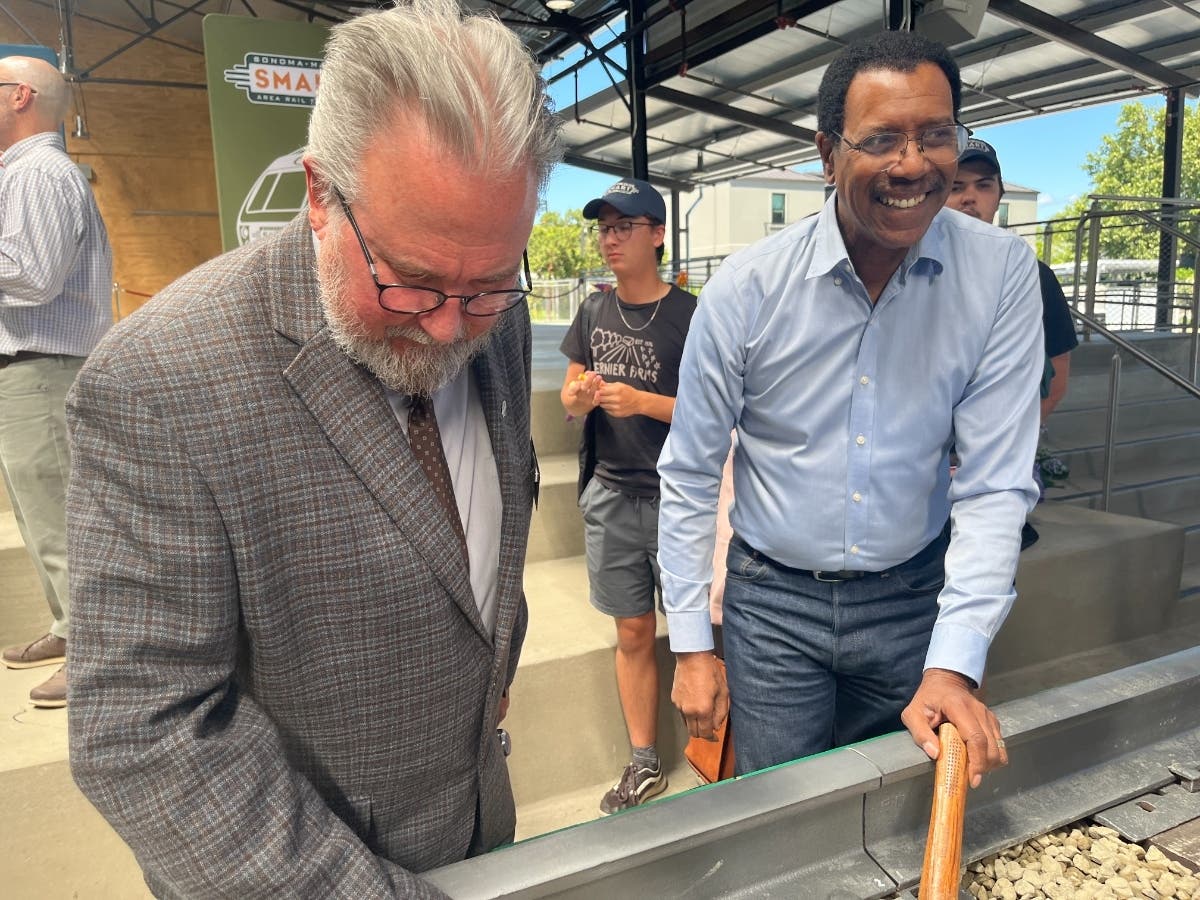
HEALDSBURG, CA — Healdsburg residents challenged SMART’s push to reconsider the city’s train station location Monday, arguing that moving the planned stop from Hudson Street to Vine Street could sacrifice future housing opportunities for a shorter walk to downtown businesses.
SMART staff favors the Downtown West Plaza site on Vine Street. But residents and council members questioned why the agency had reopened a debate they believed the council settled with its 4-1 vote in February 2024 to proceed with the Hudson Street depot location.
The final decision belongs to SMART’s board of directors, agency officials told the council. The board directed staff Sept. 16 to gather more public feedback before choosing a location.
Find out what's happening in Healdsburgfor free with the latest updates from Patch.
“First, this is not a done deal,” SMART’s general manager, Eddy Cummins, said Monday. “The SMART board wants to hear public feedback.”
The two potential locations sit just under a half-mile apart. Their competing advantages prompted arguments over access to jobs, future development, parking, walking distances, and whether the station should primarily serve people arriving in Healdsburg or residents traveling elsewhere.
Find out what's happening in Healdsburgfor free with the latest updates from Patch.
SMART officials said the fully funded, $269 million Healdsburg extension, increased ridership, and progress toward extending service farther north warrant another look at the station location.
They expect Healdsburg to function largely as a destination station, bringing workers and visitors into town.
Planning Manager Zoe Unruh said 84 percent of Healdsburg’s workforce lives outside city limits, and the West Plaza location has 84 percent more jobs within a quarter-mile walk than the Hudson Street site.
Council members challenged the analysis for emphasizing existing conditions over future development. Unruh said the comparison used 2023 jobs data, existing census data, 2025 travel data, and the current street network.
Council Member Evelyn Mitchell questioned how SMART’s funding gains and ridership growth changed the choice between the two sites.
“I still don’t understand how that impacts the decision for where the station goes, whether it’s the depot or downtown,” Mitchell said.
Residents who support Hudson Street argued that the depot anchors years of planning for housing and development around the station and south of the Russian River.
Mark McMullen traced that work through successive city plans and urged officials to preserve the opportunity to connect future development with rail service.
“We’ve been working 30 years to get there, and we’re here,” McMullen said. “Let’s not lose that opportunity.”
Richard Berg likewise challenged the focus on current population and employment patterns, saying the Hudson Street area offers development opportunities that could unfold over the next 25 or 30 years.
Others questioned whether SMART had adequately considered residents who would use the train to commute south.
Nancy Norton said the presentation concentrated too heavily on the plaza as passengers’ destination and gave too little attention to Healdsburg residents traveling to jobs in Santa Rosa and Rohnert Park.
Vine Street supporters argued that a station closer to existing businesses would make the train more useful immediately.
Connor McKay, a city planner and longtime Healdsburg resident, said the location would connect passengers with shops, restaurants, offices, housing, and services.
“A station is most useful when people can easily walk or bike to the places they are already going,” McKay said.
Healdsburg Farmers’ Market Manager Janet Ciel, speaking for herself rather than the market’s board, said a nearby stop would help vendors attract customers who might otherwise balk at carrying grocery bags to a more distant station.
“I can’t help but think that moving the location of the stop would be incredibly advantageous to the market,” Steele said.
The renewed debate also threatens to interrupt the city’s station area planning effort.
The city manager said Healdsburg received between $1.1 million and $1.2 million from the Metropolitan Transportation Commission after the 2024 vote to prepare a plan centered on the depot. The planning area includes land south of the river.
City officials have received positive, but unofficial, indications that MTC would work with them if the station location changes. Options could include retaining the planning boundaries, expanding them, or creating separate planning areas.
The city manager recommended pausing that work until the station question is resolved, including an anticipated October community meeting on the plan.
SMART’s general manager promised that the agency’s upcoming open house would present advantages and disadvantages of both sites. Officials also said they could separate Healdsburg residents’ survey responses from regional results.
The agency rejected suggestions for multiple Healdsburg stops, saying additional stops would lengthen trips and make rail less competitive with driving.
Regardless of the station location, SMART committed to a crossing connecting the depot area with the Ward Street neighborhood, cooperation on development of SMART-owned depot property, and efforts to find resources to restore the depot buildings. Restoration currently has no dedicated funding.
SMART plans an October community meeting and a public survey running through Nov. 30. Staff expects to return to the City Council and SMART board in December with an analysis of the feedback.
Meanwhile, the agency is targeting an October construction contract award for the extension from Windsor to Front Street, including the Russian River bridge, with work expected to begin in spring 2027. A subsequent construction package would cover the section containing the two potential station sites.
Get more local news delivered straight to your inbox. Sign up for free Patch newsletters and alerts.