Community Corner
Judgment Of Paris: Wine's Power Shift 50 Years Later
The "Judgment of Paris" was a geopolitical event in food culture that still reverberates 50 years later.


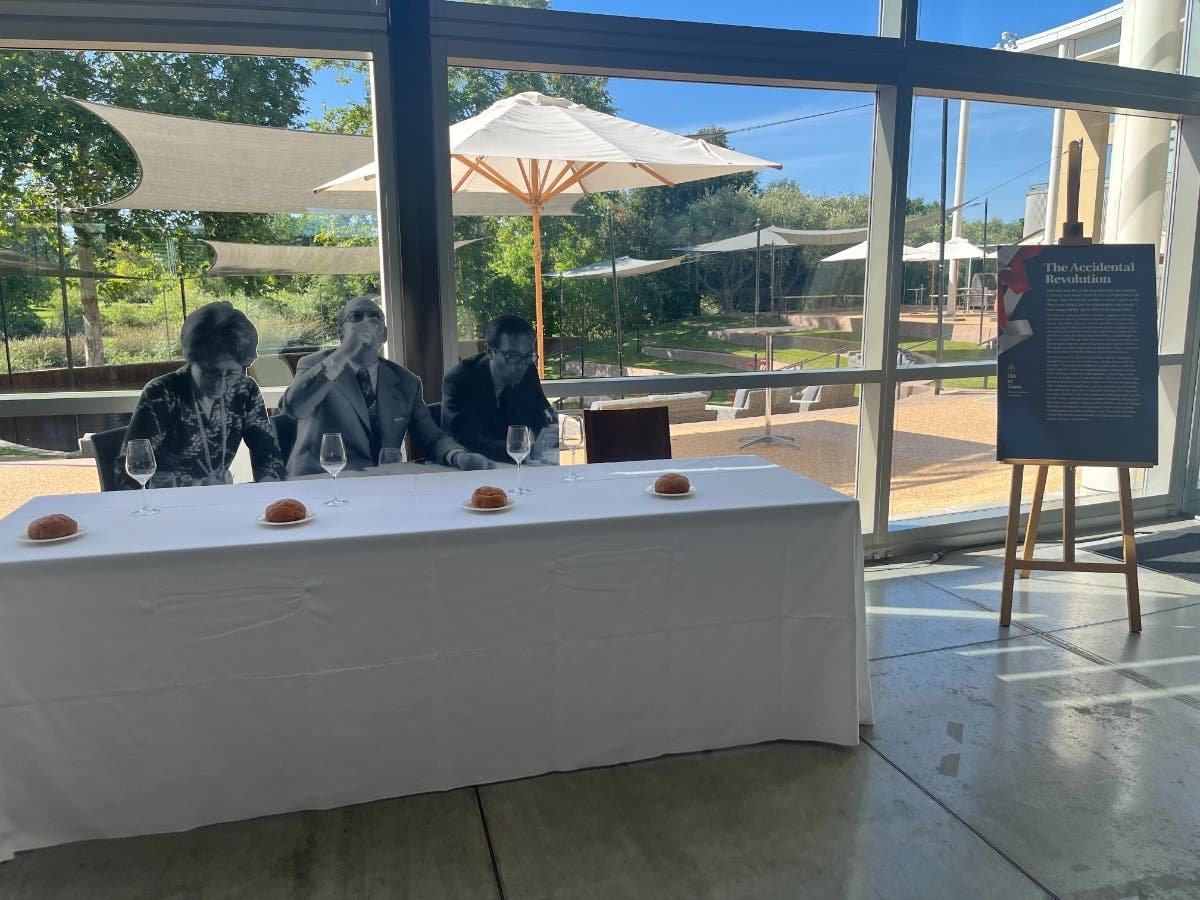
NAPA VALLEY, CA — Nearly half a century ago, 11 wine judges assembled in a Paris hotel for a blind tasting between French and California wines. Most among them weren't expecting much of the tasting or the California wines.
One by one the judges sipped and swirled and spat their way through 20 bottles little-known on either continent. By the end of the afternoon, they returned their judgment.
The results would loosen France’s domination over the wine world and launch Napa as an unlikely global wine destination.
Find out what's happening in Napa Valleyfor free with the latest updates from Patch.
The tasting, which acquired the grave title "The Judgment of Paris," slowly rippled through the wine world.
Now, 50 years later, winemakers, sommeliers, and historians say the blind tasting reshaped Napa and Sonoma, sometimes overshadowing the deeper network of growers, women, and vineyard workers who made the moment possible.
Find out what's happening in Napa Valleyfor free with the latest updates from Patch.
The May 24, 1976 Judgment of Paris entered wine mythology as a David-versus-Goliath showdown: unknown California wines defeated France’s best in a blind tasting that stunned critics and vaulted Napa Valley to global fame.
On the golden anniversary of the tasting, those who lived it —and live in the shadow of 1976 — are telling the story of a reality far messier, more collaborative, and more consequential than the neat Hollywood version preserved in popular memory.
Chateau Montelena’s 1973 Chardonnay outscored top white French Burgundies, and the 1973 Stag's Leap Wine Cellars S.L.V. (Stag's Leap Vineyard) Estate Cabernet Sauvignon outscored France's top Bordeaux wines to win first place in the red wine category.
“This was a turning point not just for Chateau Montelena, but for America as a whole,” said Chateau Montelena president and winemaker Matthew Crafton.
Before 1976, he said, California wines were treated internationally as “curiosities rather than serious contenders.”
The now-famous Paris blind tasting organized by British wine merchant Steven Spurrier changed that.
Crafton said the tasting forced a reexamination of what California was capable of.
Despite the legend, several figures connected to the anniversary argue that the Judgment of Paris did not suddenly create California wine excellence — although it did put New- World wine on the map.
Instead, they describe it as the culmination of decades spent rebuilding after Prohibition, the Great Depression, and the two World Wars—periods that nearly dismantled American wine culture.
Cathy Corison, one of Napa’s pioneering winemakers, said advances in grape growing and cellar techniques had already accelerated globally before 1976, driven by research at the University of California, Davis, and centers in Australia, New Zealand, and Germany.
Early improvements focused on gentler winemaking equipment from harvest through bottling, Corison said. “At the same time, research on canopy management taught the world how to grow better grapes.”
Then Paris detonated demand.
“Overnight, the whole world knew that we could make world-class wine that speaks of time and place,” Corison said.
"The Sipping Point"
In a series that dissects the tasting, The Swirled Cup, Napa Valley sommelier Andrea Robinson called 1976 a "sipping point," borrowing from Malcolm Gladwell’s book,“The Tipping Point.”
In other words, the tasting was both an event and a catalyst for a movement already underway and poised to take off. The results provided the confidence and notoriety to help make it happen.
But the win by Napa also opened up winemaking in new regions, from Argentina to Oregon, by shattering the idea that only France could claim to have terroir, a distinctive regional character that shapes wine.
Piero Antinori, the 25th generation of a winemaking dynasty, said that no one believed it possible to compete with the great wines of France. The 1976 decision broke the spell and inspired him to break with regional rules to create the Super Tuscan red wines.
The French realized it was “no fait accompli” the French vintner and entrepreneur, Jean-Charles Boisset, said in the show. Boisset and Gina Gallo preside over some of the most iconic properties in Napa Valley and abroad.
Blind tasting did not eliminate bias, critics now argue, but it forced experts to confront their own assumptions. That surprise still echoes through the industry a half-century later.
Capital flowed into Napa and Sonoma. Sommeliers emerged as cultural gatekeepers. Wine tourism exploded. Small wineries sold bottles to customers worldwide. Corison said her own independent winery now exports to 18 countries.
Improvised Chaos
Today the Judgment of Paris is rich in mythology. But in 1976, the reality was improvised chaos held together with string: wine makers carried their wine to Paris in boxes held together with twine.
The anniversary also reopens an increasingly contentious question: who actually built the Judgment of Paris story, and who disappeared from it.
Omissions flattened the institutional, intellectual, and organizational labor — particularly the contributions of women — behind the tasting.
One of the most disputed examples is Patricia Gastaud-Gallagher, a director at the Académie du Vin who introduced Spurrier to California wines and served as one of the event’s judges.
In dramatizations such as the film "Bottle Shock," Gastaud-Gallagher’s role was largely erased and redistributed into fictional characters and comic side plots.
Her role folded into fictional composites, including a made-up, blonde enology student (played by Rachael Taylor) named “Sam," and a plaid-suited caricature played by Dennis Farina.
Spurrier later threatened to sue the producers of Bottle Shock, writing angrily to them that, "There is hardly a word that is true in the script and many, many pure inventions as far as I am concerned."
The 2nd Judgment of Paris
The original “Judgment of Paris” comes from Greek mythology. It was the story of a contest among three goddesses — Hera, Athena, and Aphrodite — who asked the Trojan prince Paris to decide who was the fairest.
The 2nd "Judgment of Paris might have gone untold if not for the reporter George Taber and his notebook.
Despite sending invitations widely to journalists, Taber, a Time Magazine editor, was the only one to show up for the blind tasting of French and California bottles selected by Spurrier and Gastaud-Gallagher.
However, Taber didn't get out his notebook until he heard tasters confusing Napa wines with French wines, and then he started to take notes. The short article ran in Time Magazine, wedged next to a tire ad. His 2005 book, "Judgment of Paris: California vs. France," helped to cement the event in popular lore.
The lore grew, some say out of proportion to the reality. The dispute over visibility extends to places. Wine consultant Karen Hannah calls it a myth that Napa alone "put Napa on the map." “There shouldn’t be any competition between the two valleys,” Hannah said. “Partnerships are going to be paramount.”
The winning Chardonnay, she noted, relied heavily on grapes grown by Bacigalupi Vineyards in Sonoma County’s Russian River Valley.
The same Chardonnay vineyard block that contributed fruit to the winning 1973 Chateau Montelena wine still exists on Westside Road in Healdsburg and remains farmed by the family today. But California wine country has changed since 1974 and is in the midst of what might be another "sipping point."
This one is less triumphant than in 1976.
50 Years Later
Veterans question whether wine has gone too far into luxury and exclusivity. Long-building trends are colliding at once, with a decline in consumption, rising costs, and generational shifts. But no one knows if the changes are temporary, and the picture is uneven: some parts of wine are struggling badly while others remain strong. Modern Napa and Sonoma tasting rooms now focus on hiking, casual experiences, nonalcoholic options, and multigenerational travel, rather than elite tastings. But consumers are fickle.
Hannah takes a bigger picture look by arguing that the post-Paris wine boom accelerated a dangerous shift toward commodification.“We took an industry steeped in passion, artistry, and farming and forced it into a more capitalistic mindset,” she said.
Environmental pressures now also shape nearly every vineyard decision — or should, an increasingly number of growers say. That means not just how wine is made, but which grapes can be grown, when they are picked, and whether certain vineyards remain viable at all.
Growers are juggling regenerative farming, organic practices, heat protection, drought management, and shifting harvest conditions.
Crafton said Napa faces a new challenge. “The question now isn’t whether we belong,” he said. “It’s whether we can continue to evolve.”
The mythology of the 2nd "Judgment of Paris" frames it as a grand contest. In reality, it was small, loosely organized, and initially overlooked—a trade event more than a geopolitical battle.
Its symbolic power endured because the tasting challenged something larger than wine: the idea that prestige, geography, and inherited reputation automatically determine quality.
The Judgment of Paris now looks less like a final verdict than a fermentation still unfolding — shaped by scientists, immigrant growers, vineyard laborers, sommeliers, marketers, winemakers, and the people history often leaves outside the frame.
Get more local news delivered straight to your inbox. Sign up for free Patch newsletters and alerts.