Crime & Safety
Half Of Santa Monica's Aggravated Assaults Occur In Just 5 Percent Of City, Study Finds
A 20-year analysis found serious violence rose sharply downtown, while crime across most of the rest of Santa Monica remained stable.


SANTA MONICA, CA — More than half of Santa Monica's aggravated assaults are concentrated in just 5 percent of the city, overwhelmingly downtown, according to a new RAND study that found stark differences in crime depending on where in the city it occurs.
Researchers found that 50.6 percent of aggravated assaults recorded from 2023 through 2025 occurred within just 5 percent of Santa Monica's geographic area. Robbery was even more concentrated, with 71 percent of offenses occurring within 5 percent of the city.
The findings are part of RAND's new report, "Santa Monica's Recent Economic and Social Trends: A Case Study with Regional Comparisons", which examined the city's economy, homelessness, crime and housing and compared trends with several nearby communities. The study was independently initiated by RAND and funded through its own resources,
Find out what's happening in Santa Monicafor free with the latest updates from Patch.
But its crime analysis also found an important counterpoint: The increase in serious violence was overwhelmingly a downtown phenomenon. Across most of the rest of Santa Monica, violent and property crime are generally as low as they have been at any point in the past two decades.
Violence Rose Before The Pandemic
RAND examined Santa Monica crime data from 2006 through 2025 across eight offenses: homicide, aggravated assault, simple assault, robbery, burglary, larceny, grand theft auto and vandalism.
Find out what's happening in Santa Monicafor free with the latest updates from Patch.
The records came from a combination of publicly available SMPD incident data and more recent records provided directly to RAND by the department. Santa Monica's public dataset itself dates to Jan. 1, 2006. Aggravated assault increased by more than 100 percent beginning in 2013, peaked in 2018 and then remained elevated, RAND found. Robbery roughly doubled beginning in 2013 and also peaked in 2018, although it remains less common than it was 20 years ago.
That chronology means the increases cannot simply be attributed to COVID-19: Both began years before the pandemic and peaked in 2018. Grand theft auto followed a different pattern, spiking around 2020 and increasing across the city rather than principally downtown. RAND said that rise was consistent with national trends.
Hotspots Cluster Downtown
To examine where crimes occurred, RAND covered Santa Monica with a grid of 1,144 500-foot hexagons. The 57 hexagons with the most aggravated assaults represented 5 percent of the city's area and together accounted for 50.6 percent of aggravated assaults from 2023 through 2025.
Those hotspots were overwhelmingly clustered alongside one another downtown, particularly west of Lincoln Boulevard, according to the study. Researchers found similar concentrations for robbery, simple assault and larceny. About half of incidents for those offenses occurred within 5 percent of the city, while 71 percent of robberies occurred within 5 percent.
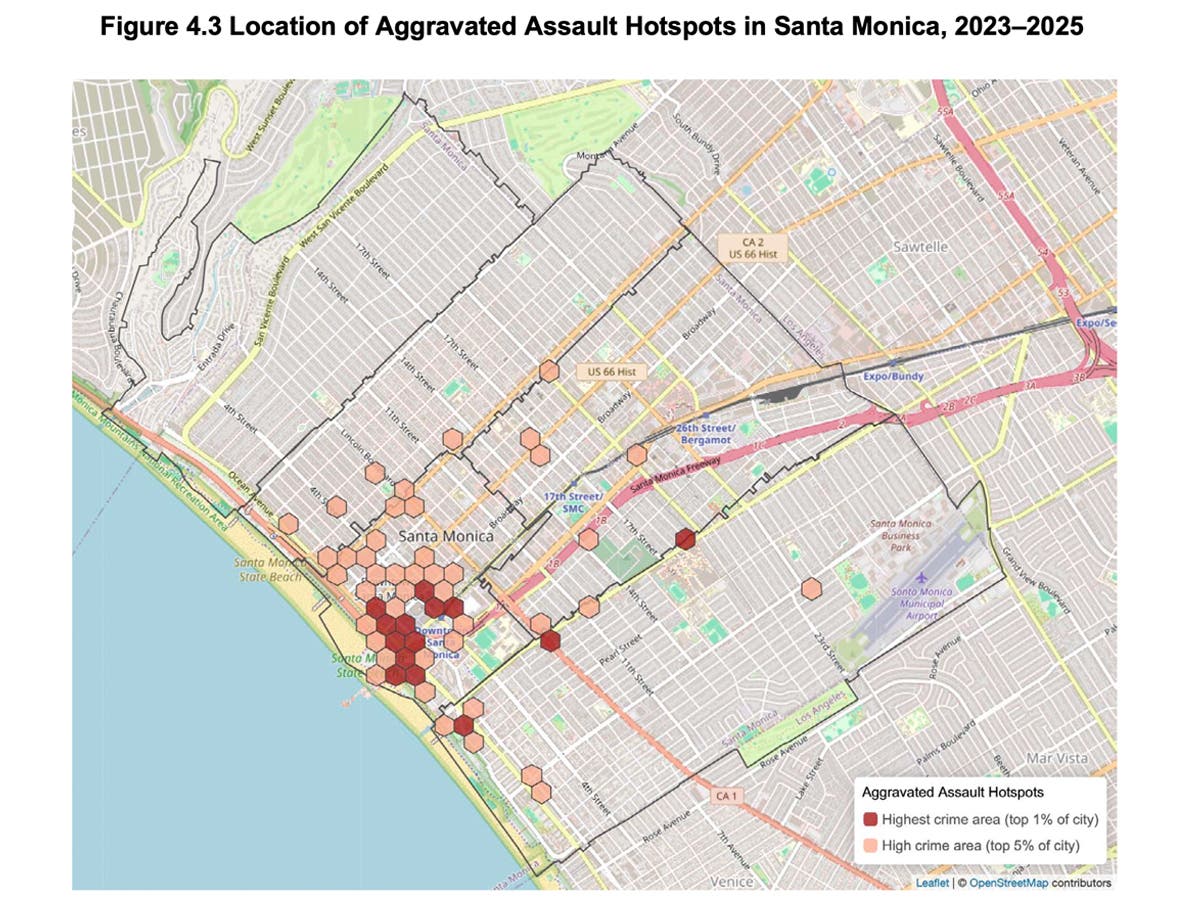
Other crimes were less concentrated. RAND found grand theft auto hotspots were more dispersed across Santa Monica, while burglary and vandalism also had hotspots outside downtown.
Overall, researchers concluded that the deterioration in serious violent crime was principally being driven by downtown. Outside the area, violent and property crime have generally remained stable over the past decade or two.
Venice Saw Similar Increase
RAND also compared Santa Monica's crime trajectory with neighboring Venice and West Hollywood between 2010 and 2023. Researchers found Venice experienced an even larger proportional increase in aggravated assault since 2010, while West Hollywood did not experience an increase. RAND characterized Santa Monica's overall crime trends in the regional comparison as "unexceptional."
The study includes some caveats. SMPD switched to the National Incident-Based Reporting System in 2024, which records considerably more detail about individual crimes than the department's previous reporting system. RAND adjusted the newer records to make them consistent with earlier data but said the transition may still have caused slight changes in crime-reporting practices.
Researchers also cautioned that crime totals do not necessarily measure an individual's risk of becoming a victim. If fewer people are downtown, for example, the same number of crimes could represent greater risk for each person there. RAND said it could not obtain sufficiently reliable downtown foot-traffic data to calculate that exposure-adjusted risk.
The study also noted that police crime statistics do not capture every form of public disorder that can influence perceptions of safety, including behavior that may appear threatening but is not criminal.
RAND's conclusion was clear: Aggravated assault and robbery have risen substantially from their early-2010s levels, but those increases have been overwhelmingly concentrated downtown. Across most of the rest of Santa Monica, violent and property crime has remained broadly stable.
Get more local news delivered straight to your inbox. Sign up for free Patch newsletters and alerts.