Schools
Local students developed improved spectrometer
Three local students hope to improve on existing an NASA product
Josie Kropfl – Mustangs Ahead
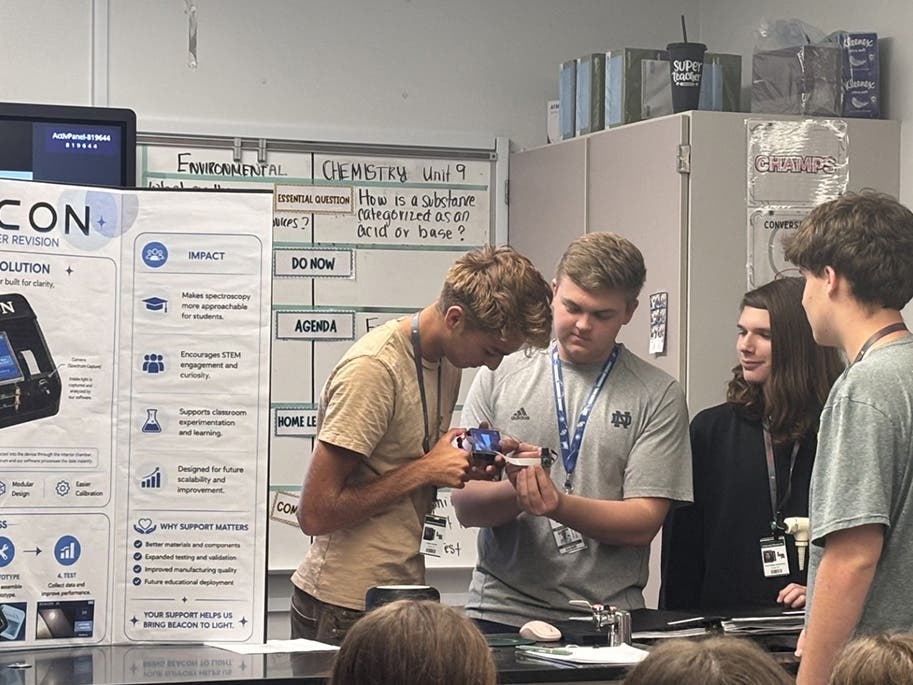
(LAKEWOOD RANCH, FL) – Lakewood Ranch High School (LRHS) students sophomore Colton McGill, junior Nickolas Darpino, and sophomore Evan Repp-Apostolico recently developed their very own spectrometer, BEACON.
For reference, a spectrometer is a complex, scientific “device that measures the wavelength between objects,” said McGill. He further explained they intend BEACON to be an “educational system used in schools” and consists of a “touchscreen, iron sensor, and camera.”
Find out what's happening in Bradentonfor free with the latest updates from Patch.
These Mustangs were inspired by a local enrichment program, COATWISE, in the Science and Technology Society (STS). STS is a Sarasota and Manatee non-profit organization which facilitates STEM-based community engagement and provides eager students with scientific educational programs.
The program, COATWISE, involves students analyzing, building, and discussing spectrometers. They then use their knowledge acquired from the course to evaluate environmental geography from the past and present.
Find out what's happening in Bradentonfor free with the latest updates from Patch.
Their project has also been fostered by LRHS’s Technology Student Association (TSA), which allowed them to further network, connect, and boost Beacon.
Stay updated on more LRHS news by following us on Facebook, Instagram, YouTube or follow the Mustangs Ahead Podcast on Spotify
They began their project in October of 2025 and have “managed their time well” enough to present their final product today, according to McGill. They developed three different prototypes, V1, V2, and V3.
When asked about trial and error, McGill responded by detailing their meticulous journey where they dropped their initial prototype, V1; then discovered V2 had a faulty power source; and finally developed BEACON’s final version, V3.
They are now out of the prototype phase, and currently in the BETA phase of developing BEACON. The team plans to further test BEACON and file a patent over the summer.
Another driving point to create BEACON stemmed from the lack of easy-to-operate, student-friendly devices.
McGill, Darpino, and Repp-Apostolico recognized the need for a new and efficient spectrometer, hence why they created Beacon.
BEACON is “more educational focused” explained McGill.
LRHS science teacher Alexandra Wilcoxson remarked, “it’s pretty phenomenal...what you guys are actually capable of doing” and “you don’t have to be in college and PhD programs to be doing this awesome stuff” after learning about Darpino, McGill, and Repp-Apostolico's outstanding achievement.
On the whole, Darpino, McGill, and Repp-Apostolico's development of Beacon is a remarkable accomplishment, and shines light on what students can be capable of.
Correction - Colton McGill's name was misspelled in the original version of this article. The author apologizes for any inconvenience.