Community Corner
Every Buyer in Lakewood Ranch asks the same question about the HOA. Until Now, Nobody Had a Real Answer.
A Florida-based AI platform for HOAs just scored its first communities.
This is a paid post contributed by a Patch Community Partner. The views expressed in this post are the author's own, and the information presented has not been verified by Patch.
There is a question that gets asked inside every home tour in Lakewood Ranch, Sarasota, Tampa, every showing in Palmer Ranch, every open house in Wellen Park. The buyer turns to the agent, lowers their voice slightly, and says it:
"How's the HOA?"
The agent pauses. Because the honest answer is: nobody knows. Not really.
There are HOA documents, CC&Rs, budgets, reserve studies, but those are legal filings, not quality signals. There are anonymous complaint sites where one angry resident can make any community look like a disaster. There are realtor descriptions that make every community sound like paradise. And there is the buyer, standing in the middle, with no neutral source telling them the truth. That gap is what FairHOA was built to close.
What FairHOA actually does
FairHOA is a community intelligence platform that scores HOA communities on a 0–100 scale called the Harmony Score. The score is built entirely from public data, not from the HOA's own paperwork or from anonymous complaints. From the public record. State filings, court records, resident reviews on platforms like Nextdoor and Google, Reddit or Yelp, realtor community guides, builder documentation, photo evidence of community upkeep, fee history across multiple independent sources, and more.
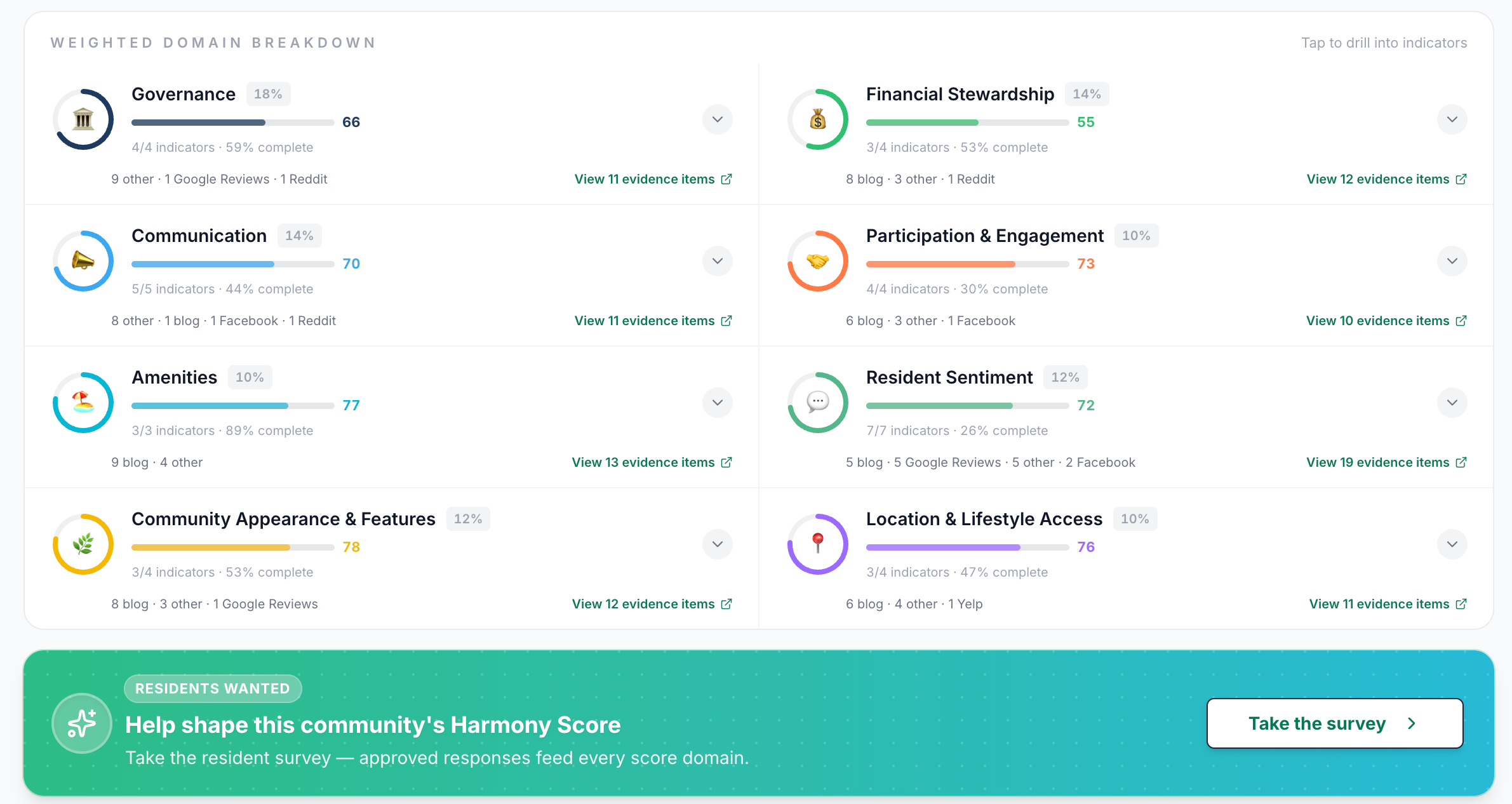
Each community is evaluated across eight domains of community life. 
Governance — Is the board responsive? Is management professional? Are filings current?
Financial Stewardship — Are fees transparent, predictable, and competitive? Do multiple sources agree on the number?
Communication — Can residents reach the HOA? Are there public channels? Do residents say the board communicates clearly?
Resident Sentiment — What do the people who actually live there say about it, not on the HOA's own site, but across Nextdoor, Google, Facebook, and independent review platforms?
Community Appearance & Features — Does the community look maintained? Is there photo evidence? Has restoration or upkeep work been publicly documented?
Participation & Engagement — Are there events, clubs, social gatherings? Do multiple independent sources describe an active calendar, or is it one developer press release repeated everywhere?
Amenities — How many amenities exist, and do residents use them? Pool, clubhouse, fitness center, courts, trails, dog parks, counted and verified across sources.
Location & Lifestyle Access — Schools, parks, retail, healthcare, walkability. The surrounding context that shapes daily life.
Every domain requires a minimum of five independent public sources before a score is assigned. If the evidence isn't there, the domain is marked as insufficient; the score doesn't get fabricated from thin air. That rule is non-negotiable.
The first scores are in
FairHOA launched largely within Sarasota-Manatee counties, the fastest-growing real estate market in Florida and home to Lakewood Ranch, one of the best-selling master-planned communities in America. The first communities scored tell a story that no listing page would ever tell you. 
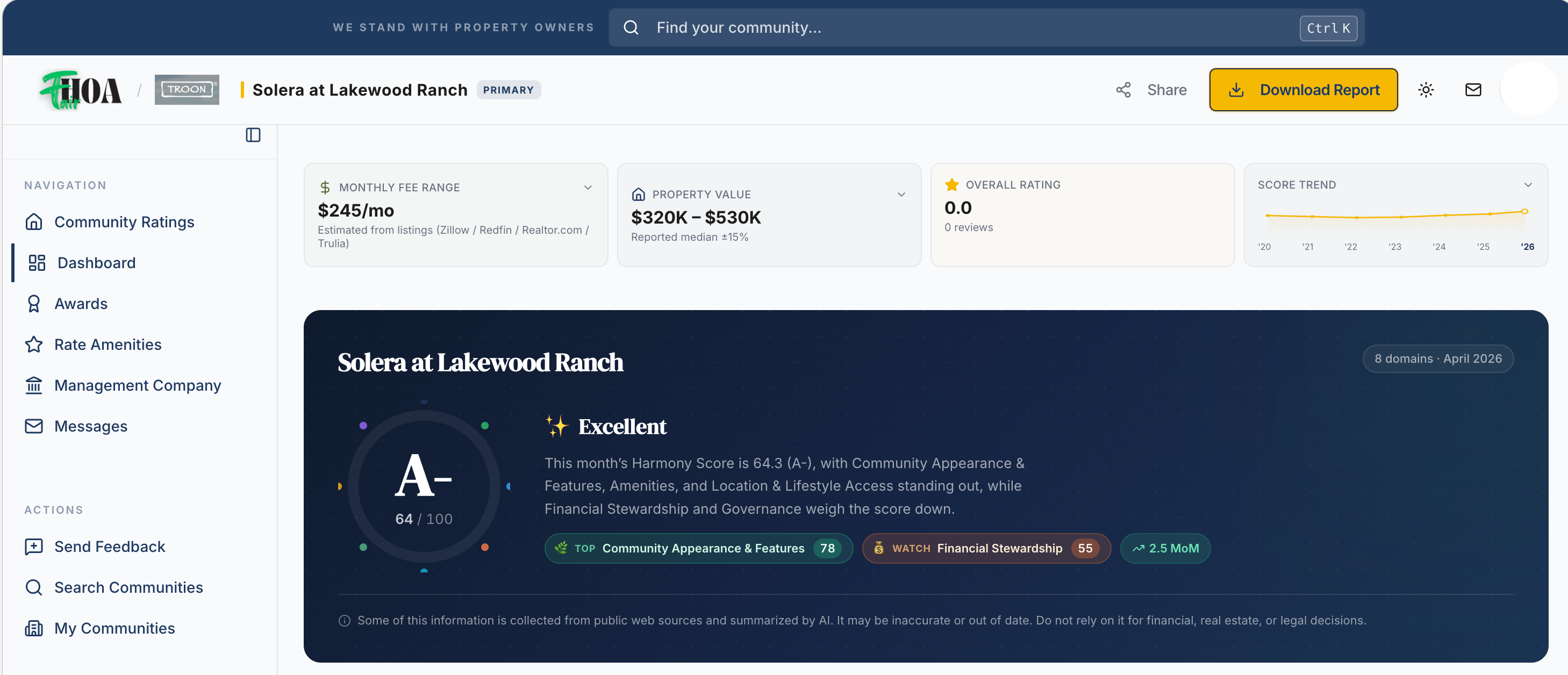
Solera at Lakewood Ranch scored 66 out of 100 — an A, rated across eight domains. The data revealed something the listing pages don't emphasize: Solera's strongest signal isn't its homes or its price point. It's the community's visible upkeep. Community Appearance & Features scored 78, the highest of any domain. Amenities followed close behind at 77. The honest watch-out the data surfaces is Financial Stewardship, which scored 55 and remains the main drag on the overall number. Even so, the community's score is trending upward, posting a 1.8-point month-over-month gain.
Arbor Grande at Lakewood Ranch scored 67 out of 100 — an A, also rated across eight domains. Its profile is amenity-driven: Community Appearance & Features scored 89, Amenities 86, and Location & Lifestyle Access 85, three of the strongest domain scores in the corridor. As with Solera, the watch-out is Financial Stewardship, scoring 56. Arbor Grande is climbing faster than its neighbor, up 2.8 points month-over-month.
Beyond the score, FairHOA.com is built as a living platform for the people who actually live in these communities. Every resident gets free access to community messaging, the ability to leave reviews and upload photos of their neighborhood, and a Harmony Score for their management company, not just the community itself, but the company running it. Board members can see how their community compares to neighbors. Residents can document what's working and what isn't, with photos attached. Over time, the platform becomes something that hasn't existed before. An operating system for HOA life where the people who live there have a voice, the data is transparent, and the community's reputation is built on evidence, not marketing.
Why this matters now
Florida has 50,000 HOA communities. More than nine million residents live inside one. And the state just went through a period that changed everything about how people think about community governance, from the Surfside building collapse in 2021 to the wave of HOA reform legislation that followed, to the ongoing insurance crisis that is repricing risk across every community in the state.
Buyers are no longer content with "the HOA is fine." They want to know. Is the board responsive? Are the reserves funded? Is there active litigation? Are residents happy or quietly leaving? Is the community improving or declining?
These are answerable questions. They just require someone willing to do the work of gathering evidence from dozens of public sources, weighing it honestly, and publishing the result, even when the result isn't flattering. That's what FairHOA does. Not for one community at a time, in response to a crisis. For every community, on a rolling basis, so the information exists before it's needed.
The Harmony Score for every rated community is free and visible to anyone at fairhoa.com with a free registration. Buyers browsing communities, residents checking their own score, board members benchmarking against neighbors all free. For anyone who wants the full report, the complete eight-domain breakdown with all evidence citations, source URLs, strengths, watch-outs, and the AI-generated summary is available as a downloadable PDF for about $10 per 3 communities. The same report a real estate agent can hand to a buyer at a showing, or a board president can bring to a meeting.
The quarterly awards
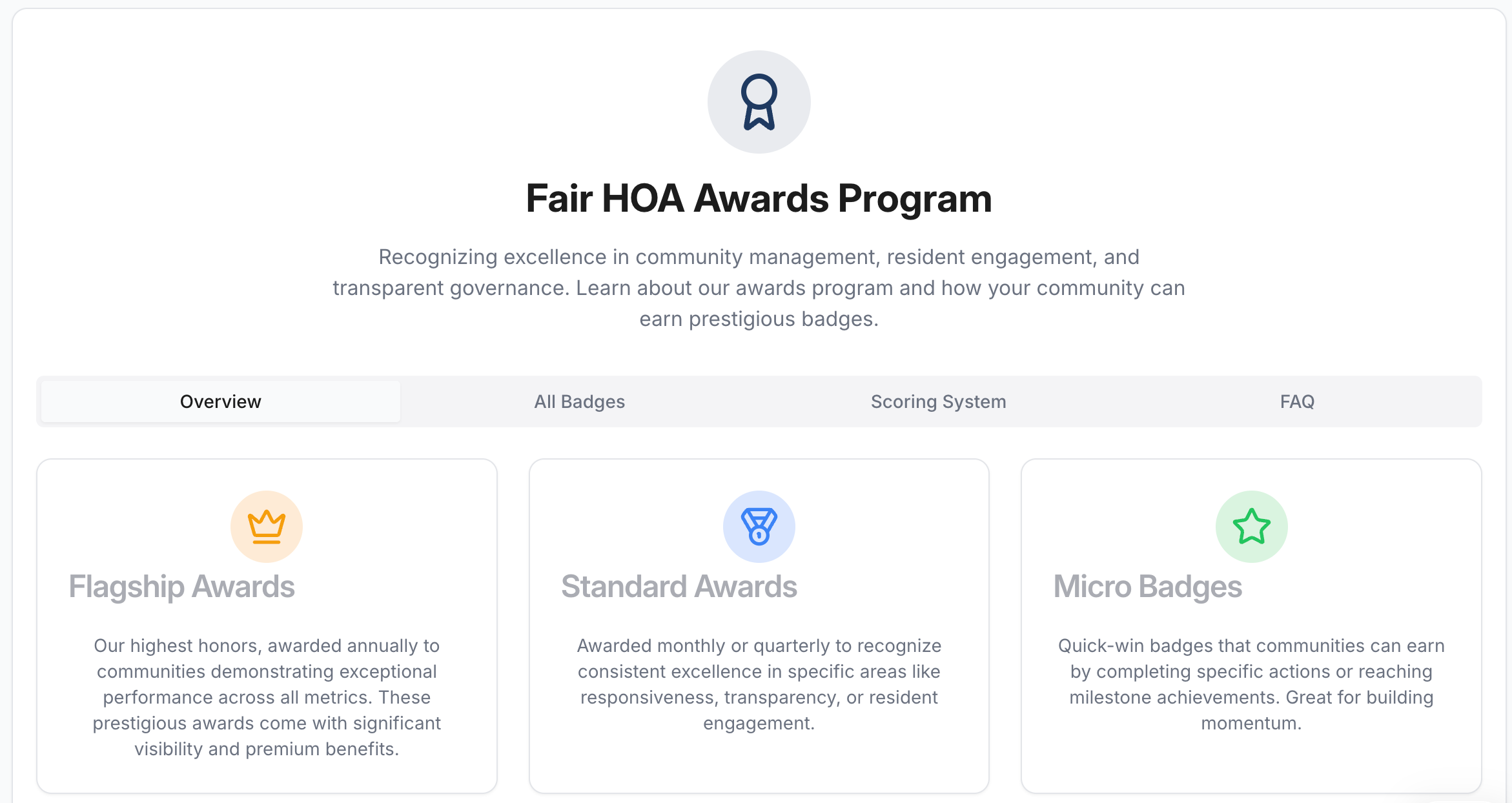
Starting this quarter, FairHOA is recognizing the communities that are doing the most for the people who live in them. Three awards per quarter. Harmony Champion (highest Harmony Score in the area, Most Improved Community (largest score increase quarter over quarter), and Resident's Choice (highest resident sentiment sub-score). Plus one annual Community of the Year announced in Q4.
The awards are not purchased. They are not nominated by the HOA. They are earned by the evidence. A community that scores well does so because dozens of public sources independently say it's a good place to live.
Communities that receive awards will be featured on FairHOA's website, recognized with a digital badge they can display on their own website, and covered in local press. The first winners will be announced in the coming weeks.
What comes next
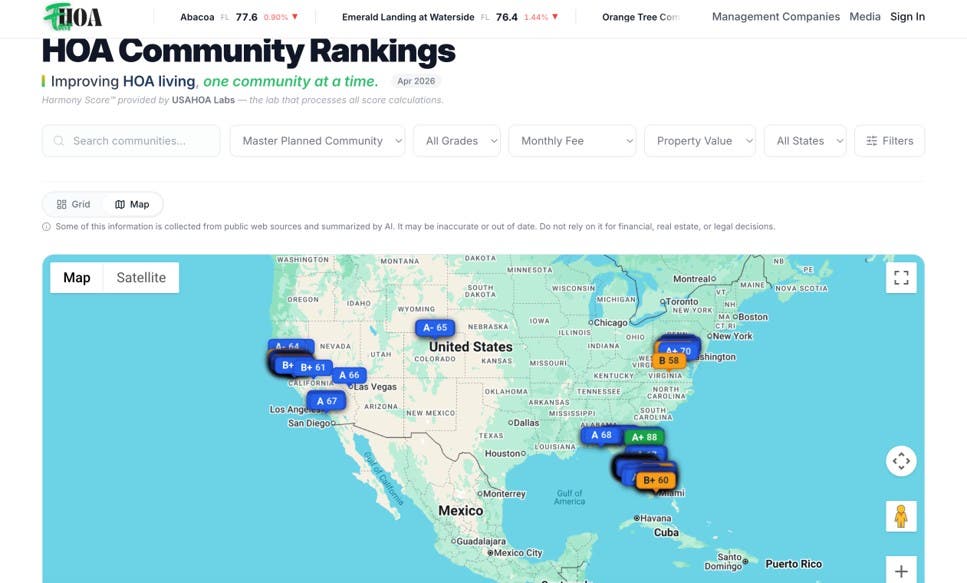
FairHOA launched in Florida and already has over 400 communities on the platform. Most are in Sarasota-Manatee and the broader Gulf Coast area, with communities from other states beginning to join as well. The methodology scales because the inputs are universal. Every HOA generates a trail of public filings, reviews, fee disclosures, court records, and resident sentiment across the open web. The same eight-domain scoring framework that works for Lakewood Ranch works for Tampa, Orlando, Jacksonville, Naples, Miami, and anywhere else people live inside an HOA. 
With mobile apps in development and new resident features shipping monthly, FairHOA is betting on transparency, and once it's introduced into a market, it rarely retreats. For the nine million Floridians living inside an HOA and the millions more across the country whose communities will eventually be scored, the era of guessing what lies behind the gates may be drawing to a close.
This post is an advertorial piece contributed by a Patch Community Partner, a local brand partner. To learn more, click here.