Neighbor News
The Devil Is in the Details: Representatives Explain Why They Voted No on HB 1199
The Devil Is in the Details: Representatives Explain Why They Voted No on HB 1199



FOR IMMEDIATE RELEASE
The Devil Is in the Details: Representatives Explain Why They Voted No on HB 1199
Atlanta, Georgia — Representatives Viola Davis, Kim Schofield, and Sandra Scott are issuing this statement to explain their vote against House Bill 1199, despite their strong support for tax relief for Georgia families and businesses.
Find out what's happening in Tuckerfor free with the latest updates from Patch.
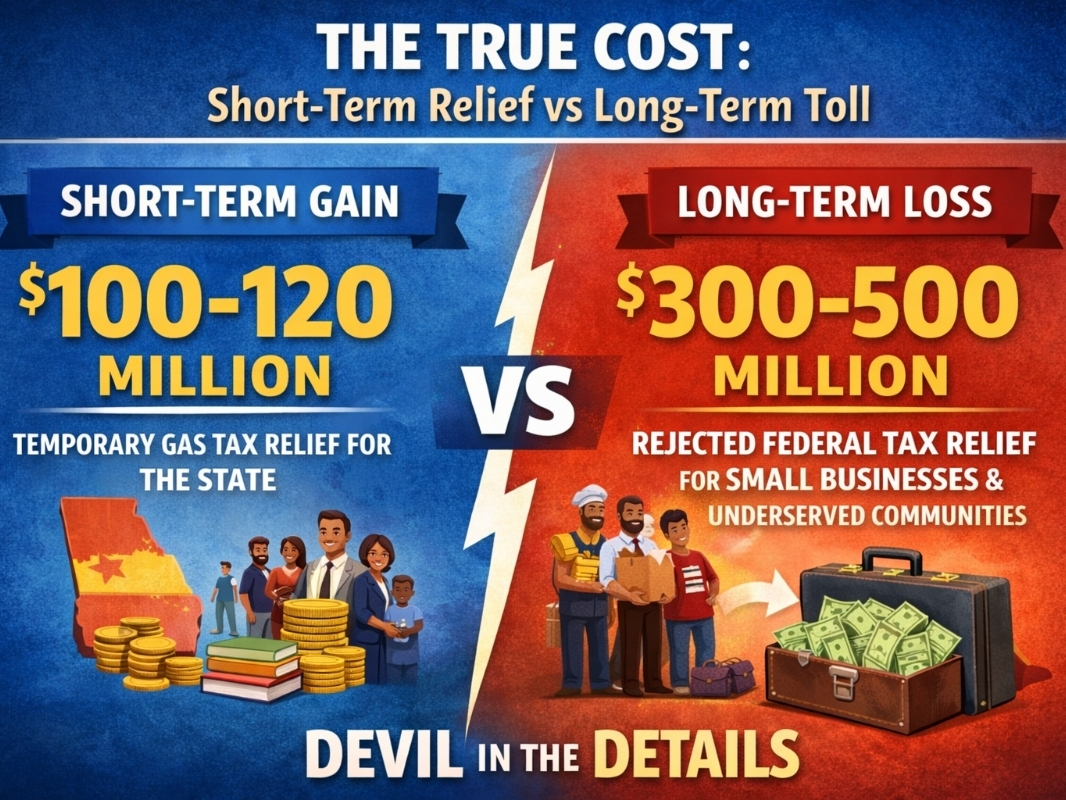
House Bill 1199 was widely presented to the public as a bill providing short-term relief through a 60-day suspension of the state gas tax. While the legislators support efforts to provide relief at the pump, they raised serious concerns about additional tax policy changes included in the bill through last-minute substitutes presented on the day of the vote.
“The gas tax suspension provides visible, short-term relief that people can see immediately,” the legislators said. “However, the same bill also included complex tax code changes that could have long-term impacts on businesses, housing, and state revenue. When legislation includes both immediate relief and long-term policy changes, it is our responsibility to examine every detail.”
Find out what's happening in Tuckerfor free with the latest updates from Patch.
Prior to and after the vote, Representative Davis formally requested a legal review and clarification from Legislative Counsel regarding the substitutes and tax code implications included in HB 1199.
The letter requested clarification on whether the substitutes:
- Changed the original intent of the bill beyond routine tax conformity;
- Modified Georgia’s treatment of certain federal tax provisions;
- Reduced tax relief at the state level compared to federal law;
- Introduced provisions related to federal laws such as the CARES Act and the American Rescue Plan Act;
- Created fiscal or legal implications that were not fully explained prior to the vote.
The purpose of the request was to ensure accurate and transparent communication with the public regarding the bill and its long-term impact.
In response, Legislative Counsel indicated that questions regarding fiscal implications should be directed to the Office of Planning and Budget and the Department of Audits and Accounts, and that a full comparison to federal law would require additional analysis beyond the scope of their office during session.
This response confirmed that additional analysis from multiple state agencies may be necessary to fully understand the long-term fiscal and tax policy implications of HB 1199.
According to Legislative Counsel’s explanation of the bill’s final version, HB 1199 included:
- A cap on the Low-Income Housing Tax Credit of $100 million annually for 2026–2028;
- Suspension of the motor fuel excise tax for 60 days;
- Changes to Georgia’s conformity with portions of the Internal Revenue Code, including removal of certain deductions related to business interest, research expenses, tips, overtime, and charitable contribution treatment tied to federal law changes. Changes to Georgia’s conformity with federal tax law, including provisions connected to the CARES Act and the American Rescue Plan Act.
These provisions represent long-term tax policy decisions that extend beyond the short-term gas tax suspension.
The legislators expressed concern that changes to tax deductions, business expenses, and housing tax credits could disproportionately affect:
- Small businesses
- Minority-owned businesses
- Developers working on affordable housing
- Underserved and under-resourced communities
- Businesses still recovering from economic downturns
“These are not just technical changes. Tax policy decisions affect who receives relief, who pays more, and who can grow their businesses. Those decisions deserve transparency, time, and full analysis.”
The legislators emphasized that their vote was not against tax relief, but rather a vote for transparency and responsible policymaking.
“The headline gave relief at the pump, but the fine print contained long-term tax policy changes. We believe major tax policy decisions should not be made through last-minute substitutes without full fiscal analysis and public understanding.”
They concluded with a message to constituents:
“In government, the smallest details can have the biggest consequences. That is why we read every bill carefully and why we say — the devil is in the details.”