Weather
North Shore Still In 'Critical Drought,' Spurring Water Restrictions
A hot, dry stretch ahead could add to drought concerns across Massachusetts.


SALEM, MA — The North Shore remained in a "critical drought" with a long stretch of hot, dry weather forecast for the next 7 to 10 days.
Much of the rest of the state was in "significant drought" following a state review of conditions through the end of June. Analysis continued to show below-average rainfall, declining streamflow and falling groundwater levels.
"Massachusetts has been managing ongoing drought conditions for nearly two years," said state Energy and Environmental Affairs Secretary Rebecca Tepper, "and while this week's rain was welcome, we still have a long way to go.
Find out what's happening in Salemfor free with the latest updates from Patch.
"We appreciate the efforts municipalities and residents have already made to conserve water during this time. As the summer progresses, we continue to ask that everyone work together to ensure our supplies remain available by using water wisely."
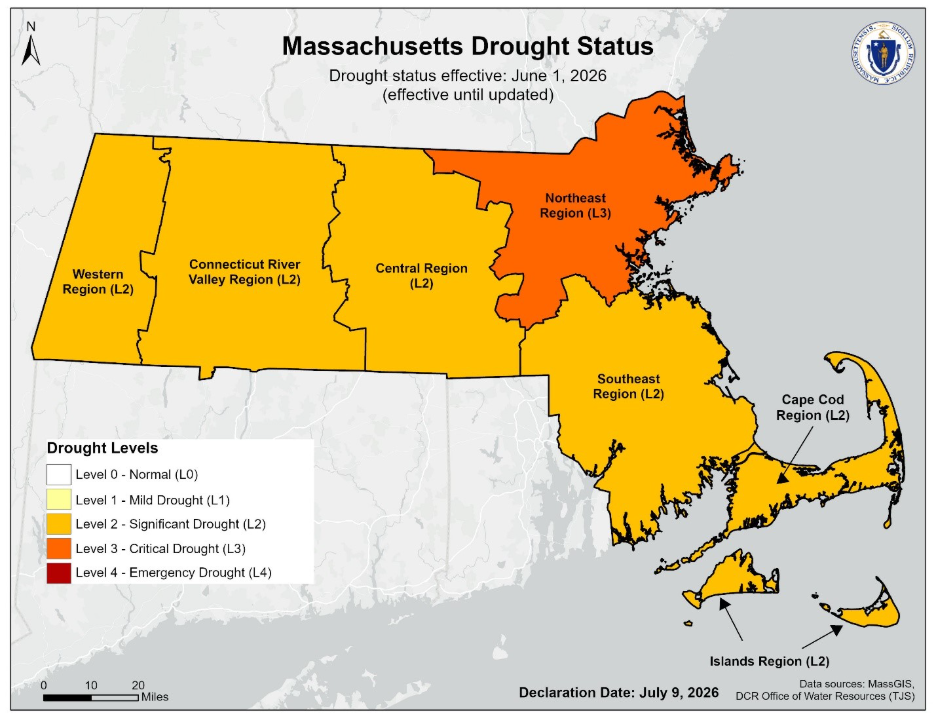
A Level 3 – Critical Drought requires communities to ban all nonessential outdoor water use and allow only hand-held watering.
Find out what's happening in Salemfor free with the latest updates from Patch.
Residents are encouraged to report dry environmental conditions and upload photos through the Massachusetts Water Impact Reporter to help the state monitor drought impacts in real time.
Private well owners experiencing problems such as dry wells should contact their local Board of Health, which is also asked to report local well conditions to the state.
For Regions in Level 3 – Critical Drought
Residents and Businesses:
- Minimize overall water use;
- Stop all non-essential outdoor watering;
- Follow state water conservation actions and any local water use restrictions;
- Monitor total household water use shown on your water bill for sudden increases, which often indicate leaks. Use the MA Home Water Use Calculator tool to evaluate household water use;
- Fix any toilet or faucet leaks immediately. Check for leaks in homes and businesses regularly by:
- Checking water meters for constant dial movement
- Using dye tabs to check for toilet leaks
- Conducting regular inspections of all pipes and fixtures, including those located in utility rooms, crawlspaces, and other hidden areas
- Use dishwashers rather than handwashing dishes. Run the dishwasher only on a full load;
- Aggressively reduce indoor water use by:
- Taking showers and avoiding baths
- Reducing shower length and consider using a shower timer
- Running washing machines only on a full load
- Not letting water run while brushing and shaving
- Replacing old fixtures and appliances with water-efficient ones. Make sure toilets, faucets, and showerheads are WaterSense labeled
Immediate Steps for Local Governments:
- Adopt and implement the state’s nonessential outdoor water use restrictions for drought; Level 3 restriction calls for a ban on all nonessential outdoor water use.
- Provide timely information on the drought and on water conservation tips to local residents and businesses taking advantage of the state’s library of outreach materials;
- Enforce water use restrictions with increasingly stringent penalties;
- Strongly discourage or prohibit installation of new sod, seeding, and/or landscaping; washing of hard surfaces (sidewalks, patios, driveways, siding); personal vehicle or boat washing (unless needed for invasives control); and,
- Establish or enhance water-use reduction targets for all water users, identify top water users and conduct targeted outreach to help curb their use.
Get more local news delivered straight to your inbox. Sign up for free Patch newsletters and alerts.