Neighbor News
Rep. Stanley, Massachusetts House Pass Environmental Bond Bill
Bill strengthens climate preparedness, streamlines permitting, and protects natural resources
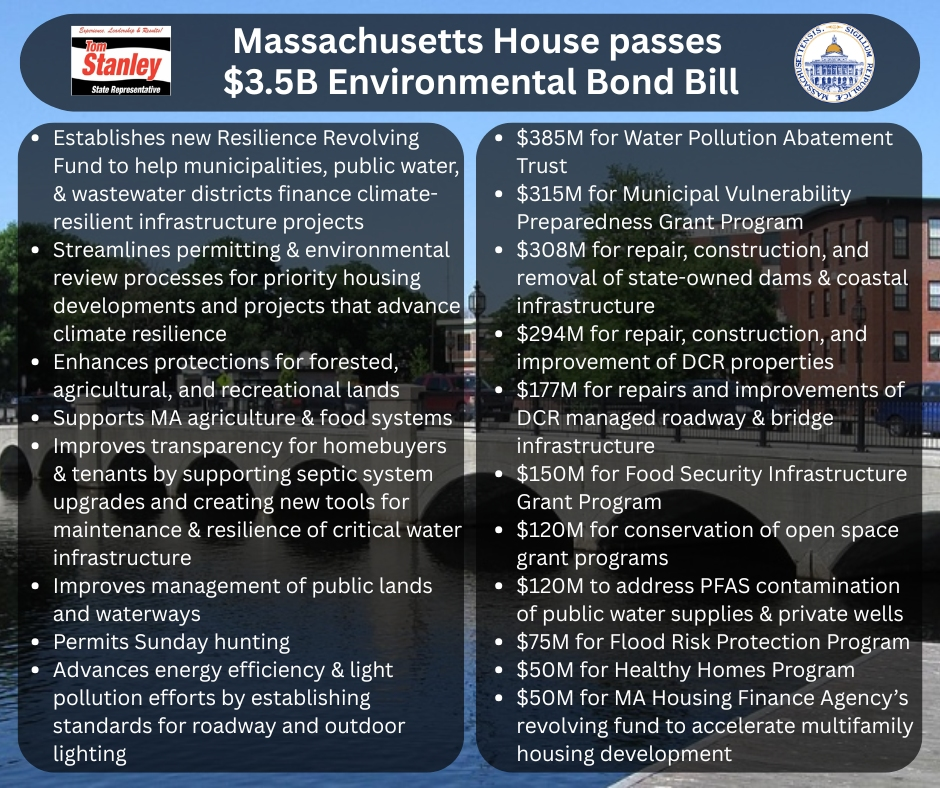
BOSTON – Wednesday, June 17, 2026 – The Massachusetts House of Representatives passed a $3.5 billion bond bill that will modernize environmental laws, strengthen climate resilience, support agricultural and food systems, streamline permitting processes, and improve the management of the Commonwealth’s natural resources. The bill advances a broad set of reforms designed to help communities prepare for the impacts of climate change, accelerate critical infrastructure projects, improve environmental protections, and support Massachusetts’ cities and towns.
“This legislation makes significant investments in keeping our infrastructure modernized and efficient while also ensuring the health and safety of residents across the Commonwealth,” Representative Thomas M. Stanley (D-Waltham). “Between authorizations for addressing PFAS contamination, repairing DCR properties, and supporting municipalities with climate resilience projects, the House continues its commitment on implementing environmental protections,” said Representative Thomas M. Stanley (D-Waltham). “I want to thank Speaker Mariano, Chair Michlewitz, and Chair Barber for all of their hard work on this critical legislation, and my fellow House members for recognizing the need to pass the bill.”
Among its major provisions, the bill establishes a new Resilience Revolving Fund to help municipalities, tribal governments, and public water and wastewater districts finance climate-resilient infrastructure projects and technical assistance. The legislation also creates new commissions and advisory bodies focused on flood mitigation, air quality, coastal resilience, and long-term climate preparedness.
Find out what's happening in Walthamfor free with the latest updates from Patch.
To help address urgent housing and environmental challenges, the bill streamlines permitting and environmental review processes for priority housing developments, nature-based solutions projects, culvert replacements, wetland restoration efforts, and other projects that advance climate resilience while maintaining environmental protections.
The legislation further strengthens land conservation efforts by creating clearer pathways for the designation and management of forest reserves, enhancing protections for forested, agricultural, and recreational lands, and recognizing carbon sequestration and storage as a valuable forest product under state law.
Find out what's happening in Walthamfor free with the latest updates from Patch.
The bill also includes significant measures to support Massachusetts agriculture and food systems. It returns remaining funds from the Milk Producers Security Fund to dairy farmers through grant programs, expands representation on the Massachusetts Food Policy Council, modernizes commercial feed regulations, and strengthens enforcement tools for agricultural programs.
Additional provisions improve transparency for prospective homebuyers and tenants by requiring flood risk disclosures, modernize waterways and wetlands permitting processes, strengthen environmental enforcement authority, support septic system upgrades in nitrogen-sensitive watersheds, and establish new tools to improve the maintenance and resilience of critical water infrastructure.
The legislation also improves management of public lands and waterways, and creates more efficient regulatory processes while preserving public access to outdoor recreation and natural resources.
The bill updates Massachusetts’ hunting laws by permitting Sunday hunting, expanding legal crossbow use, modernizing archery regulations, and reducing certain hunting setback requirements near occupied dwellings.
The bill advances energy efficiency and light-pollution reduction efforts by establishing standards for state and municipal roadway and other outdoor lighting, and helps realize savings from newly installed low-wattage light fixtures by requiring the Department of Public Utilities to establish a new rate for such fixtures.
The bill includes $3.5 billion in bond authorizations. New authorizations include:
- $120 million to address PFAS contamination of public water supplies and private wells
- $75 million for the Flood Risk Protection Program to proactively reduce risk, protect lives and property, and restore natural floodplains and wetlands as climate buffers
- $50 million for the Healthy Homes Program to provide grants and zero-interest to homeowners and landlords to eliminate habitability hazards like lead paint, asbestos, mold, and pests, while promoting energy efficiency and decarbonization
- $50 million for the Massachusetts Housing Finance Agency's revolving fund to accelerate mixed-income and multifamily housing development through low-cost financial assistance
- $20 million for the modernization and decarbonization of the McLaughlin Hatchery in Belchertown, which generates revenue, supports recreational opportunities, and provides a safe food source to the people across the Commonwealth
- $20 million to implement the 2023 Biodiversity Executive Order via grants for planning and implementation of community biodiversity plans and project implementation
- $5 million to implement new marine resources conservation and restoration efforts to support the commercial fishing sector, ensure public safety, increase food security, and provide public recreational opportunities.
Major reauthorizations include:
- $385 million for the Water Pollution Abatement Trust to support wastewater, stormwater, and drinking water projects
- $315 million for the Municipal Vulnerability Preparedness (MVP) Grant Program for cities and towns to assess climate risks
- $308 million to repair, construction, and removal of state-owned dams and coastal infrastructure including seawalls, docks, culverts, and salt marshes
- $294 million to repair, construction, and improvement of Department of Conservation and Recreation (DCR) properties
- $250 million for the construction and/or repair of coastal infrastructure including seawalls, living shorelines, and other nature-based solutions
- $177 million for repairs and improvements of DCR-managed roadway and bridge infrastructure
- $150 million for the Food Security Infrastructure Grant program to support initiatives that improve food security and ensure equitable access to locally grown, raised, harvested, and caught foods by strengthening Massachusetts’ food supply chain
- $120 million for conservation and open space grant programs including land protection, watershed remediation, coastal habitat preservation, parks development in underserved areas, brownfield remediation, and carbon sequestration initiatives
The bill passed the House of Representatives 151-0 and now goes back to the Senate for further consideration.
###