Lakeview, MI|Local Classified|Other|

What Mount Pleasant Homeowners Get Wrong About Removing a Dead Ash Tree?
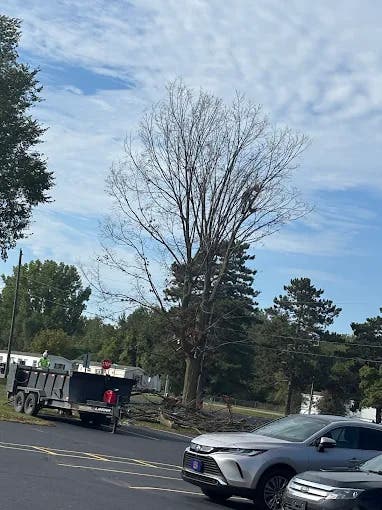
A property near the Chippewa River corridor in Mount Pleasant held a green ash that lost canopy density two summers back. The homeowner assumed stress, left it standing, and by the time the call came in, emerald ash borer had been working through the cambium layer for 18 months. Bark separated from the stem in 6- to 10-inch sections. The scaffold branch system had shed terminal bud growth points across the upper crown.
The Assumption That Creates the Problem
Most homeowners in Mount Pleasant assume a dead ash falls the same way a healthy tree does. Dead wood differs from live wood in every way that matters to a rigging calculation. Emerald ash borer larvae destroy the phloem and inner bark, eliminating the fiber cohesion that gives a live stem its load-bearing integrity, according to Michigan State University Extension research on Agrilus planipennis.
What a Crew Actually Checks First?
Hazard assessment on an EAB-killed ash in Isabella County starts with bark integrity, not canopy condition. A resistograph drill measuring wood density variation in a compromised stem returns readings 30 to 50 percent below those of a sound hardwood of equivalent diameter. A crew using an aerial lift truck with a bucket height of 40 to 65 feet inspects scaffold branch collar attachment points for dry-set included bark union failure before any rigging block and sling is set. Dead attachment points do not hold rigging loads the way live wood does.
Decay column boundary mapping using an increment borer determines how far internal deterioration has reached from the outer sapwood inward. A stem with a decay pocket spanning more than 35 percent of its basal cross-section requires a speedline rigging system and a lowering device such as a Port-a-Wrap rather than standard section cutting. That controls each descent without shock-loading the base, where Isabella County's loam-over-clay soil near the floodplain may already be soft.
Warning Signs Worth Checking Before You Call
Field observations that indicate structural compromise beyond early EAB stress:
- Bark plates lifting from the stem in sections larger than 6 inches
- Epicormic shoot clusters along the lower trunk that have since died back
- Woodpecker activity concentrated on the upper crown third
- Scaffold branches snapping at the branch collar under light wind load
Justin Crabb, owner of Highline Tree Service, has assessed and removed EAB-killed ash trees across Isabella County and Central Michigan for more than 15 years. Homeowners who want to understand how dead ash removal differs from standard tree work can read more before requesting an estimate.
What the Tree Tells You Before You Decide?
Structural integrity in a dead ash declines progressively from the year of full EAB mortality forward, and removal complexity increases with each season the tree remains standing. Homeowners who measure that timeline against the drop zone hazard on their specific lot make better decisions than those who wait for a branch failure to prompt the call. Reviewing the service area and business history before scheduling a site visit is a reasonable first step; homeowners can check our page to do that.
Justin Crabb
Owner, Highline Tree Service
11923 N Vining Rd, Lakeview, MI 48850
989-339-7070
https://highlinecraneandtreeservices.com/