Politics & Government
Do Education Freedom Accounts Raise New Hampshire Property Taxes? Fact Check: 'No.'
While it is true NH has some of the highest property taxes in the nation to fund local schools, this has been true for decades, before EFAs.

Democratic gubernatorial candidate Cinde Warmington says New Hampshire’s Education Freedom Account (EFA) program is picking taxpayers’ pockets and driving up local property taxes.
Josiah Bartlett Center President Drew Cline has a one-word fact check: “Ridiculous.”
Find out what's happening in Bedfordfor free with the latest updates from Patch.
“That’s one of the more ridiculous claims that comes out in politics,” Cline told NHJournal during a recent podcast interview. “It really doesn’t have any bearing on reality whatsoever.”
Democrats have made the claim that GOP state education policy is “downshifting” costs onto local taxpayers, driving up property taxes, central to their 2026 messaging.
Find out what's happening in Bedfordfor free with the latest updates from Patch.
Warmington has called the EFA program “a pickpocket scheme taking money out of the pockets of working people” and “driving up everybody’s property taxes.”
“NH GOP wants to raise YOUR property taxes and bankrupt YOUR public school to fund private school tuition for the ultra-wealthy,” the House Democratic caucus posted on X.
But is it true?
It is true that New Hampshire has among the highest property taxes in the United States, and most of that money goes to local schools. It’s also true that New Hampshire has the lowest share of state funding paying for local schools of any state. But that has been true for decades. EFAs weren’t signed into law until 2021.
Here’s what the facts say about EFAs, public schools and property taxes.
State Per-Pupil Spending Is at an All-Time High
Democrats call it “downshifting,” but the budget numbers show the state’s per-pupil spending has never been higher.
New Hampshire’s state funding for public schools has declined overall after inflation but increased per student as enrollment has fallen. While K-12 enrollment plunged by 18% between 2010 and 2025, state spending per pupil increased 25%.
Going back to 2000, the numbers are even more dramatic.
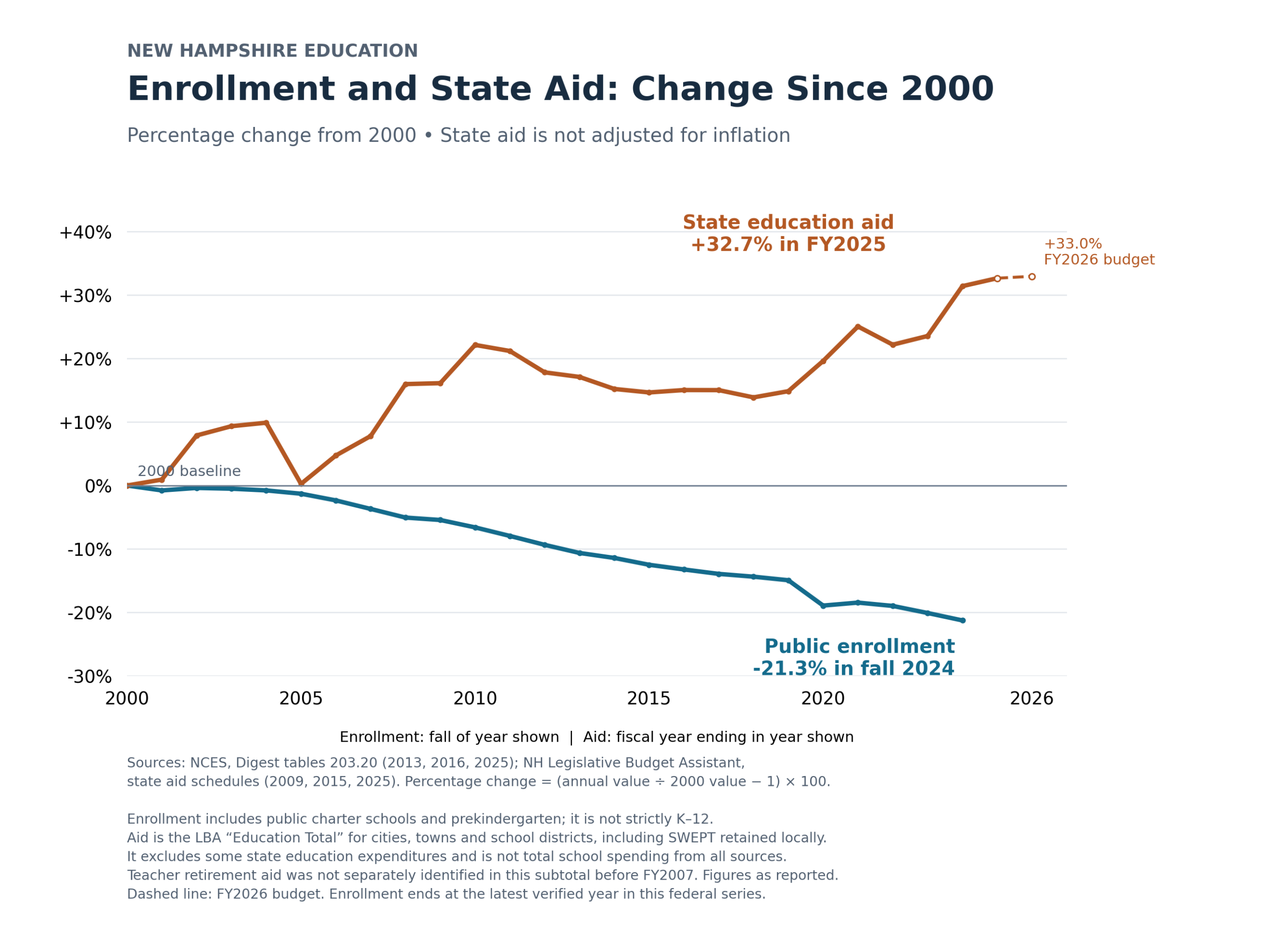
“The actual state dollars per student in the last few years, especially, have gone up, not down. It’s just that the total number of students keeps going down,” Cline said. “The amount of money per student that we are spending in New Hampshire to educate a child is way higher than it’s ever been in history, and it keeps going up every year.”
As a result, taxpayers have good reason to be frustrated when enrollment falls while budgets and property tax bills continue rising.
“That’s how taxpayers feel when they keep seeing their taxes go up, spending go up, enrollment go down,” Cline said.
EFA Money Is State, Not Local, Money
On EFAs, Cline points out that the funding comes from the state’s Education Trust Fund, not locally raised property tax revenue.
“There’s no local property-tax money going to an EFA student. None,” Cline said.
Participating families receive roughly $4,000 to $5,000 per student, depending on the child’s eligibility for additional aid. By comparison, New Hampshire’s combined state, local and federal spending averages approximately $26,000 per public school student, Cline said.
When a student leaves a district school for an EFA, the district no longer receives that student’s state adequacy grant. But it retains the locally raised property tax money it otherwise would have spent educating that child.
“If they get an EFA, they’re getting educated at a taxpayer cost of about $4,000 a year,” Cline said. “You’re saving money with an EFA. It’s not costing you money.”
To put it another way, EFAs actually increase the money available for local schools to spend on their remaining students.
“The idea that these children taking this path that saves about $19,000 per student, roughly, to the taxpayer is somehow costing the taxpayer is preposterous,” Cline said.
The EFA Program Doesn’t Benefit 'Millionaires'
Since Gov. Kelly Ayotte signed legislation last year eliminating the income limit for the EFA program, Democrats have been attacking it as a “giveaway to the wealthy.”
“Kelly Ayotte’s private school vouchers scheme takes your tax dollars and gives them to the richest people in our state,” Warmington said.
However, Ryan Bilodeau of the Children’s Scholarship Fund New Hampshire reports that more than 75% of current EFA students qualified under the program’s original income cap of 350% of the federal poverty level.
While the EFA program currently has a cap of 12,500 participants, it includes exceptions for “priority groups,” including students who qualify based on income and students with special needs.
“If you are below a certain income, if your sibling was in the program, if you’re among the neediest students among us, the legislature was smart enough to protect those cases,” Bilodeau said.
Due in part to the 12,500 cap, this year the program will cost $63 million, not the $120 million that Democratic legislators have claimed. And while that is a significant investment, Cline puts it into context with the approximately $4 billion in state, local, and federal money spent annually on K-12 education in New Hampshire.
“Sixty-three million out of $4 billion is a tiny little figure,” Cline said.
Cline said the common thread connecting the campaign claims is using convenient political targets to avoid confronting harder structural questions—particularly why New Hampshire continues spending more money to educate fewer public school students.
“One of the biggest frustrations is when politicians come up with a scapegoat to blame for a problem that is systemic and ongoing,” Cline said.
This story was originally published by the NH Journal, an online news publication dedicated to providing fair, unbiased reporting on, and analysis of, political news of interest to New Hampshire. For more stories from the NH Journal, visit NHJournal.com.