Crime & Safety
NYC Crime Numbers Are In: Here's What You Need To Know
Officials say the latest public safety report reveals a shift that could reshape the City's future


NEW YORK, NY— The City recorded the fewest murders, shooting incidents and shooting victims for the first six months of a year, Mayor Zohran Mamdani and Police Commissioner Jessica Tisch announced Thursday.
Speaking at One Police Plaza during the NYPD's quarterly crime statistics briefing, Mamdani said major crime has fallen nearly 6 percent citywide since January.
The City recorded 122 murders through the first half of 2026, a 24.7 percent decline from the same period last year and the lowest total on record.
Find out what's happening in New York Cityfor free with the latest updates from Patch.
Police also reported 322 shooting incidents, down from last year's previous record low of 337, and 381 shooting victims, a 4 percent decline from 2025.
"Each of these numbers represents a life untouched by violence," Mamdani said. "A New Yorker who never had to endure what would have otherwise been the worst day in their life."
Find out what's happening in New York Cityfor free with the latest updates from Patch.
What Is Driving The Decline In Crime?
Tisch pointed to what she described as the department's precision policing strategy, which concentrates officers, detectives and specialized units where crime patterns emerge.
"New York City just had the lowest number of shooting incidents, the lowest number of shooting victims, and the lowest number of murders for the first six months of any year in recorded history," Tisch said.
She said those results came after the City already reached historic lows last year.
"Those were not easy numbers to improve on, but through the first six months this year, the NYPD has pushed them even lower."
Major crime dropped nearly 6 percent citywide during the first half of the year, while second-quarter crime fell 8 percent, according to the department.
Police said there were more than 3,400 fewer major crime complaints compared with the same period last year.
"That is 3,400 fewer victims," Tisch said.
Crime By The Numbers
- 122 murders, lowest first-half total on record
- 322 shooting incidents, lowest first-half total on record
- 381 shooting victims, lowest first-half total on record
- Major crime down nearly 6 percent
- More than 2,500 illegal guns removed from city streets
Which Borough Saw The Biggest Improvement?
The Bronx posted the city's largest crime decline.
Index crime fell nearly 12 percent during the first six months of the year.
Tisch said the NYPD recently divided the borough into Bronx North and Bronx South commands to sharpen deployment decisions.
"The Bronx is leading the city with a 12 percent reduction in index crime year to date," she said.
Brooklyn and Manhattan also posted declines, while Queens and Staten Island remained largely unchanged after lower crime levels last year.
How Far Has Violence Fallen Since The Pandemic?
Tisch compared current crime levels with 2021, when the city was emerging from the COVID-19 pandemic.
During the first six months of 2021:
- 737 shooting incidents
- 852 shooting victims
- 229 murders
During the first six months of 2026:
- 322 shooting incidents
- 381 shooting victims
- 122 murders
"It means 471 fewer people were shot in the first half of the year, and it means 107 fewer people were murdered," Tisch said.
Where Else Is Crime Declining?
Police reported declines across several major crime categories.
Robberies fell 12 percent.
Burglaries dropped 16 percent, reaching their lowest level since 2019.
Grand larcenies declined more than 4 percent.
Auto theft fell nearly 10 percent citywide and 26 percent in the Bronx after investigators dismantled a theft ring responsible for stealing more than 700 vehicle parts worth approximately $1.2 million.
"Cases like that do not come together overnight," Tisch said.
"They are built by detectives identifying patterns, connecting incidents, tracking stolen property, and following the evidence until they can dismantle the people driving the crime."
Crime Categories Moving Lower
- Robbery: Down 12 percent
- Burglary: Down 16 percent
- Grand larceny: Down more than 4 percent
- Auto theft: Down nearly 10 percent
- Retail theft: Down 16 percent
Where Does The City Still Face Challenges?
Officials said several categories continue to demand attention.
Felony assaults remained essentially flat.
Reported rapes increased nearly 6 percent, though Tisch said much of the increase reflects survivors reporting assaults from previous years and cases covered under New York's expanded "Rape Is Rape" law.
The city also recorded increases in confirmed hate crimes.
Mamdani highlighted sharp increases in crimes targeting LGBTQ residents and Muslims while noting anti-Semitic incidents continue to account for most confirmed hate crimes.
"There is no room for hatred of any kind in our city," Mamdani said.
He said the city's newly adopted budget increases hate crime prevention funding by more than 800 percent.
Tisch said anti-Semitic incidents represent 55 percent of confirmed hate crimes even though Jewish residents make up about 10 percent of New York City's population.
What About Crime On The Subway?
Overall major crime in transit declined 1 percent, even as subway ridership increased nearly 5 percent.
Police reported:
- Grand larceny down 8 percent
- Transit robbery arrests up 10 percent
- Transit felony assault arrests up 9 percent
- A record 39 guns recovered in the transit system
Tisch said robberies involving juveniles remain a concern.
"Forty-eight percent of robbery arrestees in transit are 18 or younger."
How Is Public Housing Performing?
The NYPD reported some of its largest improvements inside New York City Housing Authority developments.
Compared with last year:
- Major crime fell 9 percent
- Murders dropped 44 percent
- Shooting incidents declined 27 percent
- Shooting victims fell 31 percent
Police said those figures represent record lows.
NYCHA Crime Snapshot
- Major crime: Down 9 percent
- Murders: Down 44 percent
- Shootings: Down 27 percent
- Shooting victims: Down 31 percent
- Auto theft: Down 25 percent
What Is Precision Policing?
Throughout the briefing, Tisch repeatedly returned to the department's policing model.
She said the strategy shifts officers and specialized units based on changing crime patterns rather than fixed deployments.
"The reductions that I just walked through did not happen by chance," Tisch said.
"They are the result of our precision policing strategy, putting officers where and when the data tells us they are needed most."
Police said that approach also contributed to a 54 percent decline in major crime around school safety zones during deployment hours.
Gang investigators have completed 24 gang takedowns, arrested 224 gang members and associates, recovered 106 illegal guns and removed more than 2,500 firearms citywide since Jan. 1.
Why Did Mamdani Reverse Course On Hiring More Officers?
The City's final budget keeps the NYPD's authorized headcount at 35,000 officers instead of expanding the force.
The reversal came after Mamdani and Tisch reviewed spending during budget negotiations.
"Commissioner Tisch and I were able to identify ways to keep the NYPD head count at the originally authorized 35,000 while also meeting all of our crime fighting needs and implementing the new programs that were announced earlier this year," Mamdani said.
The proposed increase would have cost an estimated $70 million.
A City Hall official said Mamdani asked Tisch whether the department could meet its needs without additional officers.
After reviewing staffing, she concluded it could.
"It is no secret that the City is facing serious financial challenges," NYPD spokesperson Delaney Kempner said. "For now, the department is able to police effectively with the budgeted head count we have."
The department currently employs about 34,000 uniformed officers.
NYPD Staffing
- Current uniformed officers: About 34,000
- Authorized headcount: 35,000
- Proposed increase: 580 officers
- Estimated cost: $70 million
- Final budget: No increase approved
What Does The Decision Mean For Police Operations?
Despite holding staffing flat, Mamdani has largely supported Tisch's operational priorities.
He approved:
- Summer deployments into high-crime neighborhoods, particularly in the Bronx.
- Twelve-hour officer shifts during major international events.
- Increased security for large public gatherings.
- Continued hiring to replace retirements and attrition.
Tisch has repeatedly pointed to historically low levels in several violent crime categories while arguing the department can continue policing effectively under its current staffing model.
How Will The NYPD Handle July Fourth And America's 250th Birthday Events?
The administration plans one of the city's largest security operations of the year.
Hundreds of thousands of people are expected to line the waterfront for the parade of Tall Ships and naval vessels before gathering for fireworks celebrations.
The NYPD will deploy additional uniformed officers across waterfront locations while screening visitors at designated entrances.
Officials have banned:
- Backpacks
- Coolers
- Umbrellas
- Drones
Since June 13, the NYPD and FBI have intercepted 97 hobbyist drones operating around FIFA Club World Cup events.
"Conflicts overseas have resulted in a spate of terrorism and targeted violence around the world as well as attacks and attempted attacks here in the United States," Tisch said.
"But I want to emphasize that there are no specific or credible threats to this year's celebrations."
Mamdani offered one additional reminder.
"Bring earplugs."
What Visitors Should Know Before July Fourth
Expect security screening
Everyone entering viewing areas will pass through checkpoints.
Leave these items at home
- Backpacks
- Coolers
- Umbrellas
- Drones
Expect heavy police presence
Additional officers will patrol waterfronts and major gathering areas.
Has Fare Evasion Enforcement Changed?
Not significantly.
New NYPD data show the City continues making arrests for subway fare evasion at levels similar to the previous administration.
The data also show New Yorkers of color accounted for 94 percent of fare evasion arrests and nearly 81 percent of summonses where race was identified.
The Legal Aid Society argues the policy continues to pull people into the criminal justice system over minor offenses.
"Arresting and jailing New Yorkers for low-level fare evasion does nothing to improve public safety," Philip Desgranges, attorney-in-charge of criminal law reform at Legal Aid, said.
"It funnels people into the criminal legal system and, for many immigrants, into the ICE detention and deportation pipeline."
Where Is The Administration Investing Beyond Traditional Policing?
Mamdani has continued backing Cure Violence programs that treat shootings as a public health issue rather than relying solely on arrests.
Violence interrupters work inside neighborhoods to mediate conflicts before they escalate while connecting residents with employment, education and counseling.
Assemblywoman Michaelle Solages said expanding those efforts remains a priority.
"We do have an epidemic of gun violence in our communities," Solages said. "We talked about how we can use holistic and community-based programs to end the violence that exists in our community."
Research from the City Council Data Team found shootings declined after Cure Violence programs launched in participating precincts.
A Patch analysis also found shootings dropped substantially after neighborhoods adopted the programs.
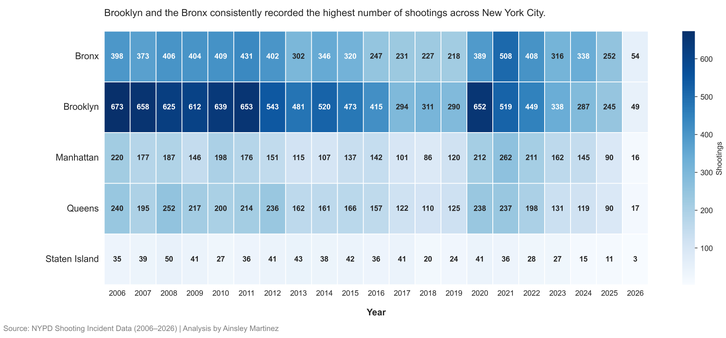
Researchers estimate the city's Cure Violence and Crisis Management System initiatives prevented roughly 1,300 shootings between 2012 and 2023.
What Is Cure Violence?
Instead of relying primarily on arrests, the program:
- Uses trained violence interrupters to mediate conflicts.
- Connects residents with jobs and education.
- Offers counseling and social services.
- Focuses on neighborhoods with the highest rates of gun violence.
How Are Political Allies Responding?
The staffing reversal drew sharply different reactions.
Progressive groups praised the decision to keep police staffing flat.
"We pushed incredibly hard, and so I'm glad that we ended where we did," council member Tiffany Cabán said
Police union leaders disagreed.
"Police officers are already burning out and leaving by the hundreds," Police Benevolent Association President Patrick Hendry said.
"Mayor Mamdani needs to recognize that there is an even bigger staffing crisis looming."
What Comes Next For The NYPD?
The crime briefing comes as New York enters one of its busiest periods, with major sporting events, international visitors, Fourth of July celebrations and Sail250 activities drawing large crowds across the city.
Tisch said those events have not slowed crime reduction efforts.
"The records that we discussed today belong to" the officers of the NYPD, Tisch said. "Every New Yorker is safer because of their work."
Mamdani said the administration intends to continue pairing policing with broader public safety investments.
"There is always more to be done to make our city safer," he said. "We will always continue by building on the approach that we know works."
Get more local news delivered straight to your inbox. Sign up for free Patch newsletters and alerts.