Politics & Government
Trump's Immigration Policies Keep Pa. Asylum Seeker In Detention, Facing Deportation
A family, no criminal history, medical need — only Trump's administration would keep Omar Viadurre-Luis behind bars, expert says.

April 13, 2026
The continued detention of an asylum-seeker arrested in central Pennsylvania highlights many of the changes President Donald Trump’s administration has made to immigration policy.
Find out what's happening in Across Pennsylvaniafor free with the latest updates from Patch.
Almost every aspect of Omar Vidaurre-Luis’ immigration detention and legal cases is different now than it would have been under previous administrations, according to his lawyers and an immigration law expert.
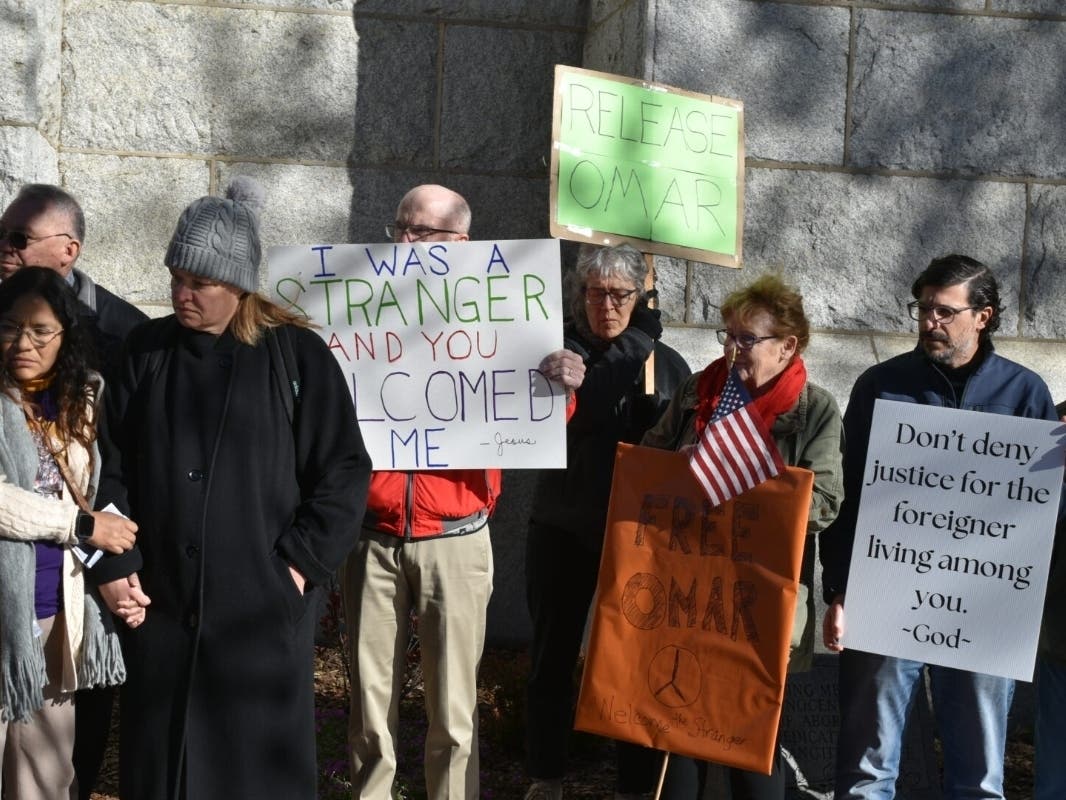
Immigration and Customs Enforcement agents detained Vidaurre-Luis on Oct. 27 at a Dauphin County court hearing for a misdemeanor charge, to which he pleaded not guilty and was later dropped. Vidaurre-Luis is being held in Lewisburg federal penitentiary.
Find out what's happening in Across Pennsylvaniafor free with the latest updates from Patch.
He has no criminal record, a pre-existing asylum case, a wife and an elementary-aged child, a job, and medical complications. Normally, that would all contribute to his release, said Kerry Doyle, an immigration attorney and the former top ICE lawyer in President Joe Biden’s administration.
“They’re doing a forced separation of a family,” Doyle said.
Vidaurre-Luis and his family came to the U.S. and were on the normal path to having their case heard in court. Under Trump, the hope of safety and a new start has changed into a fight for survival.
Laura Ramirez said she and Vidaurre-Luis entered the United States on Sept. 19, 2022, with their five-year-old son.
“We have done everything the American government has told us to do,” she said. “We registered at the border. We have applied for asylum and we were allowed to legally enter the United States.”
Ramirez said organized criminals were trying to extort Vidaurre-Luis in their home country, Peru, and that their son faced kidnapping attempts. They had a joint asylum case scheduled for July 2027 before ICE arrested Vidaurre-Luis and separated their proceedings.
Now, the government is trying to deport him to Honduras using a process that prevents Vidaurre-Luis from even presenting an asylum case, according to his lawyers.
Under previous administrations, and even in Trump’s first term, Doyle said this third-country workaround to deport people was rarely used. She said never before has the U.S. government systematically attempted to speed up deportation proceedings by entering into “asylum cooperative agreements” like the one with Honduras. The government’s logic is that because Vidaurre-Luis is seeking protection from harm in Peru, it doesn’t violate human rights laws to deport him to a different country. Under that premise, there’s also no reason to hear his asylum arguments.
On Jan. 2, an immigration judge agreed and ordered Vidaurre-Luis to be deported to Honduras.
The process is a violation of his Constitutional rights, according to his immigration attorney, Philadelphia-based Kadijah Turay-Sengova. That creates a concern beyond immigration law, she said.
“If you can take his due process away, it means U.S. citizens’ due process can be taken away just as easily,” Turay-Sengova said.
She appealed his case to the Board of Immigration Appeals on Jan. 16. The decision could take weeks or months, Turay-Sengova said, and Vidaurre-Luis can’t be deported until the decision is final.
But at this point, appealing to the Board is all but futile, Doyle said.
Over the past year, the Trump administration has remade both the country’s immigration court system and the Board of Immigration Appeals. Doyle was an immigration judge for two months before she was fired by the new Trump administration in February 2025. She was not alone. The Trump administration “has dismissed more than 100 immigration judges out of about 750 in place” when he took office last year, according to a recent New York Times analysisfinding the remaining judges are deporting more people than ever before.
At the same time, Trump has shrunk the Board by nearly half and replaced judges with his own appointments. The Board sides with Trump officials in almost every case, according to an NPR analysis, and has made several policy changes making it harder for detainees to be released on bond or to appeal their cases, while making it easier for the government to deport people to third-party countries.
Every one of those policies is being challenged in federal court. But in the meantime, people like Vidaurre-Luis are kept in detention without bond.
While Vidaurre-Luis was fighting his deportation, his lawyers started a second set of proceedings to get him freed. Before the Board of Immigration Appeals changed its rules last year, cases like Vidaurre-Luis’s would be reviewed for bond.
Generally, in these cases, judges will consider whether the defendant has connections to family members, the community, and a lack of a criminal record. They’ll weigh whether he or she is a flight risk or a threat to public safety. But now, the blanket policy is not to release people in immigration detention.
Since the changes, the number of filings from immigrants challenging their detention has skyrocketed in federal courts around the country. Reuters tracked 20,000 of these “habeas corpus” cases nationally in just three months from October into early February.
And Vidaurre-Luis was successful: he won his habeas case on Jan. 23, with federal district court judge Stephanie Haines ordering a bond hearing in immigration court.
But at the time of the bond hearing, Vidaurre-Luis was still facing a misdemeanor charge for “fleeing or attempting to elude an officer.” The charges were later dropped, but the immigration judge who had ordered Vidaurre-Luis deported ordered that he posed a flight risk and denied bond. WITF cannot provide the judge’s name because immigration records are not public, and the federal office that manages case information has not updated Vidaurre-Luis’ case page. His lawyer, Turay-Sengova, declined to name the judge.
Turay-Sengova asked the immigration judge to reconsider offering bond to Vidaurre-Luis. Again, the judge declined. Doyle called the decision “very unusual,” given all of Vidaurre-Luis’s connections to his family, community, and lack of criminal record.
On March 26, Vidaurre-Luis’s attorneys filed another motion with Judge Haines in federal court, seeking to force the immigration judge to reconsider. That order is expected in the next couple of weeks.
The Pennsylvania Capital-Star, a nonpartisan, nonprofit news site, delivers honest and aggressive coverage of state government, politics and policy. Since launching in February 2019, the Capital-Star has emerged as a go-to source for in-depth original reporting, explainers on complex topics, features that ground policy debates, and progressive commentary on a range of issues. The Capital-Star is part of States Newsroom, a national 501(c)(3) nonprofit supported by grants and a coalition of donors and readers.