Schools
Fairfax Parents Press School Board For Faster Limits On Classroom Technology
Fairfax school board unanimously approved a technology resolution as parents, students and educators urged faster limits on screens and AI.


FAIRFAX COUNTY, VA — The Fairfax County School Board unanimously approved a resolution Thursday night establishing guiding principles for the future use of instructional technology and artificial intelligence in Fairfax County Public Schools, while dozens of parents, educators and students urged the board to move quickly from broad principles to concrete policy changes.
The resolution declares that education "is, and should remain, a human-centered endeavor," describes technology as a tool to support—not replace—teachers, acknowledges that artificial intelligence carries both benefits and risks, and directs the development of policies that could include grade-level limits on screen time and device access, family opt-out options, and a digital citizenship and literacy plan.
The vote followed months of debate over classroom technology, AI and student device use, an issue that has drawn increasing attention from parents concerned about screen time while others have emphasized technology's role in supporting individualized learning and students with disabilities.
Find out what's happening in McLeanfor free with the latest updates from Patch.
Board Members Call Resolution Starting Point
Braddock District School Board Member Tom Dannan formally introduced the resolution, saying the measure was intended to establish common ground after a year of sometimes-divisive discussions.
"When I had the idea of proposing a resolution, a colleague suggested I work out a statement with the member I probably disagreed with the most on this topic," Dannan said. "That process was illuminating. I realized there is a lot of shared agreement; we've just been talking about it in different ways."
Find out what's happening in McLeanfor free with the latest updates from Patch.
Dannan described the resolution as "one step of many," saying it would guide future policy while affirming that educators remain "the foundation of education" and technology should be viewed as a tool.
School Board Member Sandy Anderson (Springfield), who seconded the motion, acknowledged the resolution was arriving after much of the division's work on educational technology had already begun, but said it still served an important purpose.
Also See ...
- Fairfax School Board Orders Review Of Device Opt-Outs, Tech Limits And AI Literacy
- Mother Shares Son's Experience Facing Anti-Black Bias With FCPS Leaders
- 6 Fairfax County Students Receive NAACP Michelle Leete Scholarships
"I support this resolution because it sends a clear, powerful message to our community," she said. "By passing it, we show a unified, consensus voice that this board is taking the future of technology in our schools with utmost seriousness."
Anderson said future technology decisions must balance innovation with protecting student privacy, limiting distractions and safeguarding students' health while preparing them for an increasingly technology-driven workforce.
"If this resolution passes, I want it to inform the policy now being developed by the superintendent's team," Anderson said, noting it reflects months of board discussions about human-centered education, appropriate technology use, ongoing evaluation and family opt-out options. "We can treat this resolution as a template for the philosophy and purpose sections of our policy."
School Board Member Melanie Meren (Hunter Mill) praised the resolution's language while expressing frustration with the pace of change.
"What I like about this resolution is that it does not presume use of technology; it says 'technology may be used,'" Meren said. However, she also told fellow members the statement "does not have teeth" and warned that "nothing is going to change for students this fall unless we act faster."
School Board Member Mateo Dunne (Mount Vernon) said years of research have already documented the harms associated with excessive screen time and social media, arguing that the division should move more quickly toward concrete action.
"The answers are already out there," he said. "Every year we delay—studying, passing resolutions, creating commissions—is another year children are harmed."
Other members defended the value of adopting a resolution before detailed policy work, saying it establishes a common foundation by recognizing both the benefits and risks of instructional technology and AI.
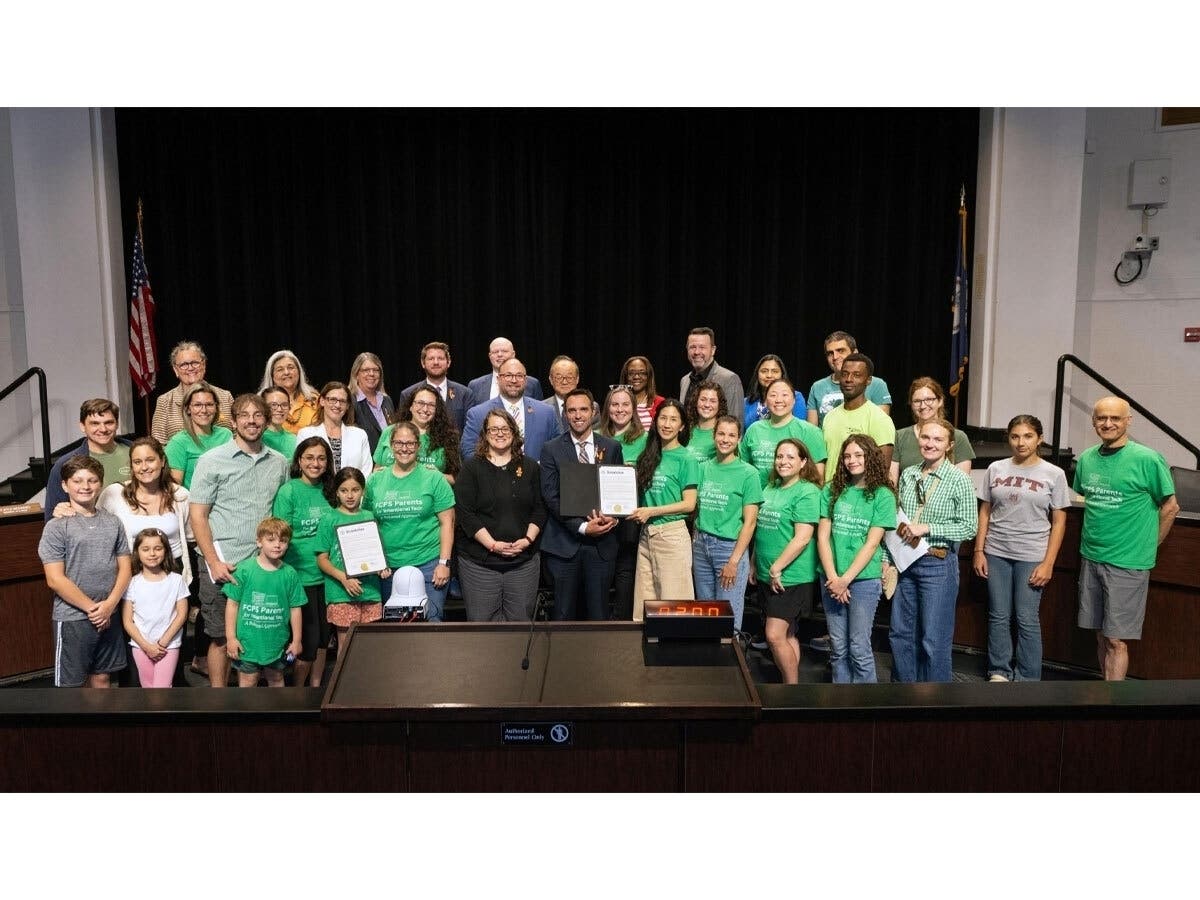
The resolution passed unanimously before supporters gathered with board members for a photo.
Public Speakers Push For Faster Action
Following the vote, numerous speakers addressed technology use in FCPS classrooms, with many calling for stricter limits on student device use.
Sophia Chatzigianni, a rising sophomore at Woodson High School, said technology became essential during the COVID-19 pandemic but argued the division should reconsider how much schoolwork remains online.
"I am not saying all technology or AI is bad," Chatzigianni said. "Technology should support learning, not replace it." She urged FCPS to return more assignments and tests to paper to reduce cheating and encourage students to think independently.
Parent Juliana Chan Erickson told the board she was withdrawing her oldest child from FCPS because of technology use, saying her teenage son spent about 13 hours a day on his school-issued laptop and frequently visited gaming and entertainment websites during school hours.
She asked the board to ban YouTube for students, stop issuing laptops to elementary school students and delay widespread use of generative AI for at least two years.
Katie O'Connor, whose son attends Bucknell Elementary School, urged the board to eliminate devices for students in pre-K through second grade.
"My son is a rising kindergartner," O'Connor said. "He and his classmates deserve to have their reading skills nurtured, not distracted away by devices."
She also asked the board to establish a two-year moratorium on generative AI for students in kindergarten through eighth grade and guarantee parents the ability to opt out.
Dr. Brian Long, a Fairfax parent and primary care pediatrician, said he sees more than 2,000 school-age children each year and increasingly hears from families that screens interfere with learning.
"Current access to technology is not safe,"Long said. "This is a crisis, and you need to move faster than you think."
Hana Lee, whose son will enter kindergarten at Powell Elementary School's Korean immersion program, said the newly adopted resolution did not go far enough.
"Tonight's resolution is not enough in the face of overwhelming evidence that electronic devices harm children," Lee said as she urged the board to eliminate electronic devices for students through second grade beginning this fall.
Alex Fetch, a parent with a doctorate in linguistics and cognitive science, questioned why the division required extensive evidence before reducing screen time but not before expanding technology use.
"The students who will thrive tomorrow are not those who spent the most time using technology, but those who have the skills to learn, adapt and lead in a rapidly changing world," Fetch said.
Others Advocate For Transformative Technology
Not every speaker advocated reducing technology.
Eli Bolotin, the parent of a student receiving special education services, said instructional technology had been transformative for his daughter, particularly the Lexia literacy program.
"I support limits and intentional use," Bolotin said, "but I ask that you also recognize there are students, especially in special education, who benefit significantly from well-designed instructional technology."
In video testimony, FCPS middle school teacher and parent Julie Kouril, speaking for FCPS Parents for Intentional Technology, called for family opt-out options for classroom technology, removal of devices from preschool through second grade and a return to shared computer labs or carts for students in grades three through eight.
Kouril argued that requiring teachers to reserve computers would make technology use more intentional rather than automatic.
The newly adopted resolution does not itself change classroom technology practices but establishes principles intended to guide the development of future School Board policies governing instructional technology and artificial intelligence in Fairfax County Public Schools.
Get more local news delivered straight to your inbox. Sign up for free Patch newsletters and alerts.