Politics & Government
Court Battles Leave Virginia's New Assault Weapons Ban In Legal Limbo
Attorney General Jay Jones vows to defend the new law as state and federal court challenges cloud enforcement across the commonwealth.
July 8, 2026
Virginia Attorney General Jay Jones joined more than two dozen local officials, clergy members and lawmakers in Petersburg Tuesday to discuss gun violence prevention as Virginia’s new assault weapons ban — barely a week old — remains tied up in a series of legal challenges that have essentially stalled enforcement across the commonwealth.
Find out what's happening in Across Virginiafor free with the latest updates from Patch.
The one-hour roundtable at Good Shepherd Baptist Church came as several firearms restrictions signed into law earlier this year by Gov. Abigail Spanberger and in effect since July 1 remain tangled in overlapping state and federal court fights, setting up what could become a lengthy legal battle over one of the most sweeping gun-control measures ever approved in Virginia.
The uncertainty surrounding the law’s future deepened Monday when a three-judge panel of the Supreme Court of Virginia declined Jones’s request to consolidate four lawsuits filed in Washington, Lancaster, Fauquier and Spotsylvania counties following roughly 90 minutes of arguments in Charlottesville.
Find out what's happening in Across Virginiafor free with the latest updates from Patch.
Asked Tuesday what the ruling means for enforcement of the new law, Jones said his office still plans to defend the legislation aggressively.
“Certainly yesterday, we had hoped to get a decision to streamline these cases,” he told The Mercury. “They popped up in certain parts of Virginia, but we are going to continue to fight to enforce the bills that were passed by the General Assembly and signed into law by Governor Spanberger.”
Jones emphasized public safety remains the administration’s focus.
“We want to keep our communities safe,” he said. “I’m a parent, I have two young boys. I want to make sure that they grow up in safe communities, just like every other citizen here in Virginia.”
The Petersburg gathering also came after several recent shootings in the city prompted local police to increase patrols.
“I want to acknowledge what so many residents, families, and businesses are feeling right now, because I’ve heard from them directly,” said state Sen. Lashrecse Aird, D-Henrico, a former city resident. “There is fear, there is frustration, and there is grief.”
“Our community deserves more than a concern,” Aird added. “It deserves a coordinated response.”

Enforcement questions emerge across Virginia
The lawsuits have already created a patchwork enforcement picture only days after the law officially took effect.
Circuit court judges in Washington County and Lancaster County issued temporary injunctions limiting enforcement while courts consider constitutional challenges to the legislation.
Because Virginia State Police Superintendent Col. Matthew Hanley was named as a defendant in the Lancaster case, state police currently cannot enforce the law anywhere. Commonwealth’s attorneys in Washington, York, Frederick, Giles and Chesterfield counties, along with Chesapeake, are also barred from enforcement under separate court orders.
Jones’s office argued the multiple lawsuits risk creating confusion among prosecutors, law enforcement agencies and gun dealers across Virginia.
During Monday’s court hearing, state attorneys said consolidating the cases would reduce conflicting rulings and conserve judicial resources.
Lawyers challenging the new statute countered that the lawsuits involve different plaintiffs, legal claims and jurisdictions.
Sen. Bill Stanley, R-Franklin, an attorney representing plaintiffs in the Washington County case, said the Supreme Court panel made the correct decision by allowing the lawsuits to continue separately.
“Attorney General Jay Jones was trying to move everything, stop the processes in the four circuit courts and move it all into one court, hopefully in a more favorable area close by to his office,” Stanley said in a phone interview after the hearing.
Stanley said attorneys opposing consolidation argued that transferring the cases after injunctions had already been issued “would tend to lead to chaos rather than order” in the system.
“What that means is that all four cases proceed in their originally filed places,” Stanley said.
Former Attorney General Ken Cuccinelli, who represents plaintiffs in the Spotsylvania case, said Monday the consolidation request came too late.
“The horse was sort of out of the barn and in this case, the horses were out of the barn, and there was no reasonable way to put them back,” Cuccinelli said.
The Republican also argued that the state lacked sufficient legal grounds to merge the lawsuits.
“They really didn’t have a good case for consolidation here and we’re all prepared to press ahead to protect (the) constitutional rights of our plaintiffs,” he said.
What the law changes
The legislation signed by Spanberger in May prohibits the future sale, manufacture, transfer and purchase of many semiautomatic rifles, pistols and shotguns classified under Virginia law as assault firearms.
The law also bans high-capacity magazines capable of holding more than 10 rounds.
Another provision restricting the public carrying of certain assault-style firearms was delayed until 2027.
Jones repeatedly referred to the legislation Tuesday as “common sense gun laws” intended to reduce violence and improve public safety.
“These common sense gun laws that were passed by the General Assembly and signed into law by Governor Spanberger to prevent gun violence here in this commonwealth, they protect families, and they help every Virginian feel safe in their communities,” he said.
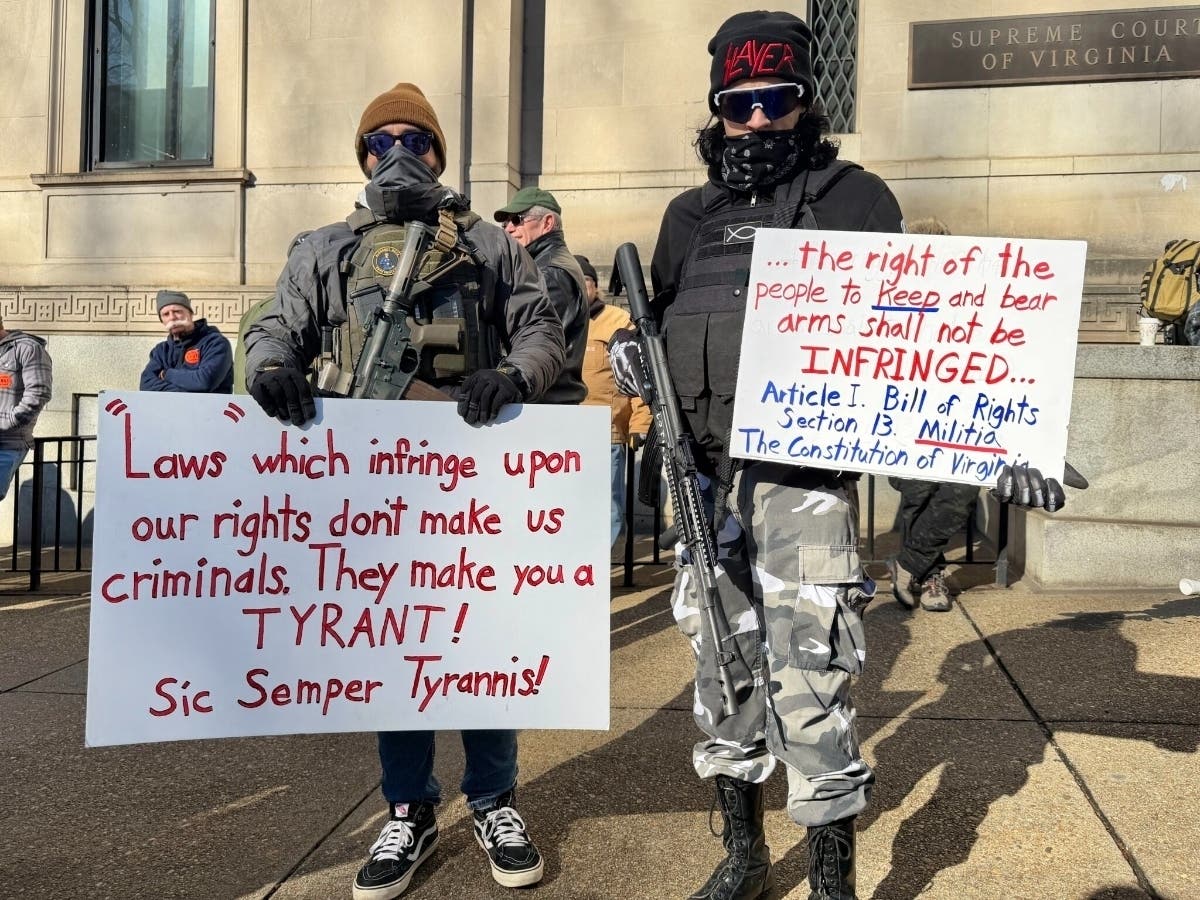
The assault weapons ban cleared the Democratic-controlled legislature earlier this year after weeks of heated debate that drew large crowds of both gun-rights activists and gun-control advocates to the Capitol in Richmond.
Republicans and gun-rights groups warned at the time that the restrictions would quickly face constitutional challenges under recent U.S. Supreme Court rulings expanding Second Amendment protections.
Opponents say restrictions violate the Second Amendment
Gun-rights advocates argue the law targets firearms commonly owned by Americans for lawful purposes.
“The assault weapons ban that became law on July 1 is headed for defeat, and rightfully so,” Philip Van Cleave, president of the Virginia Citizens Defense League, said in an email Monday.
“It is clearly unconstitutional, as it bans some of the most popular firearms in America. The U.S. Supreme Court, in District of Columbia v. Heller, has already said that firearms that are in common use cannot be banned,” Van Cleave said, referring to a landmark 2008 ruling establishing that the Second Amendment protects an individual’s right to possess a firearm.
Stanley similarly argued that semiautomatic rifles such as AR-15s are constitutionally protected.
“The AR-15 is a center-fire, semi-automatic rifle,” Stanley said. “That rifle is the most popular rifle in the United States, commonly possessed and used by citizens for lawful purposes.”
He also criticized provisions targeting certain semiautomatic handguns and magazines.
“Those are commonly used in self-defense, they’re used for lawful purposes, and therefore, they’re protected,” Stanley said.
Stanley said injunctions issued in Washington and Lancaster counties — which currently prevent state police and several local prosecutors from enforcing the law while the cases proceed — leave Virginia in roughly the same position it was in before the ban took effect last week.
“The gun ban bill was signed by the governor and is on the books, but it cannot be enforced during the time in which the courts determine its constitutionality,” he said. “The status quo is the same as what you could and could not do on June 30 in Virginia.”
Stanley predicted the litigation could continue for months as the cases move through circuit courts and eventually back before the Supreme Court of Virginia.
“We’re looking at six to eight months,” he said.

Federal lawsuit adds another front
The state court fights are unfolding alongside a separate federal lawsuit filed last week by the U.S. Department of Justice.
President Donald Trump’s administration sued Virginia in federal court July 1, arguing the law violates the Second Amendment by banning firearms and magazines commonly owned for lawful purposes.
The Justice Department’s complaint also cites recent U.S. Supreme Court decisions, including District of Columbia v. Heller and New York State Rifle & Pistol Association v. Bruen, both of which expanded constitutional protections for gun ownership.
Stanley said the state and federal cases will likely proceed independently.
“There are other federal court actions going on right now that pertain to this,” he said. “Those are a different process altogether.”
Despite Monday’s setback, Jones said he remains confident the law ultimately will survive legal challenges.
“While the consolidation that we were seeking yesterday was providing a single uniform path for resolving these important legal questions, the commonwealth remains steadfast in belief that the constitutionality of these laws are valid, and we are optimistic that they will be upheld upon a final adjudication of these several cases,” he said Tuesday.
Jones also argued that reducing gun violence remains tied to broader concerns about community stability and economic development.
“Gun violence prevention is not just about responding to incidents,” he said. “It is about building environments where people feel secure, supported, and connected.”
This story was originally published by the Virginia Mercury. For more stories from the Virginia Mercury, visit Virginia Mercury.com.